



Caredoc Selects INFRA as Senior Industry Keyword for 2026… Public and Private Sectors Begin Full-Scale Implementation of Senior Industry Infrastructure
Accelerate institutional and market changes in five areas: integrated care, geriatrics, senior finance, silver towns, and AI care.
CEO Park Jae-byeong: "This year marks the tangible milestone of progress in addressing the aging society… We will create real change through advanced services."
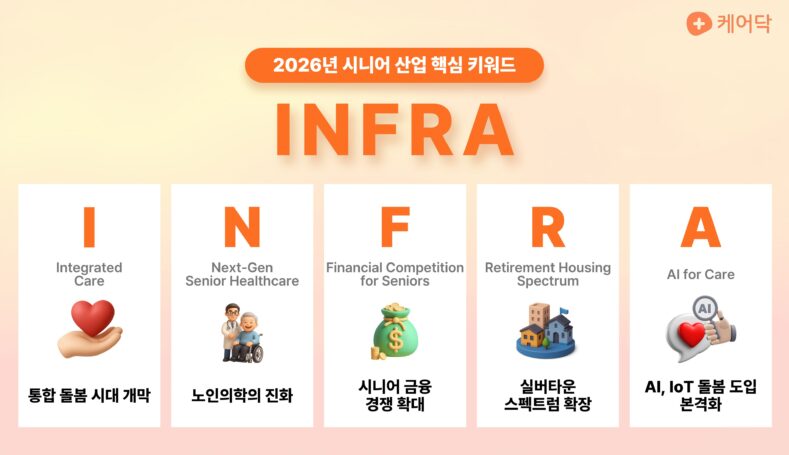
Caredoc (CEO Jae-Byeong Park), a senior total care company, announced on the 6th that it selected 'INFRA' as a key trend keyword predicting the flow of the domestic senior industry in 2026.
Caredoc sees 2026 as the year when public and private infrastructure for the 10 million elderly population will be fully implemented, and has summarized key trends in the senior industry under the keyword "INFRA." Focusing specifically on changes occurring in five sectors—care, healthcare, finance, housing, and AI—Caredoc has compiled a list of institutional and market trends that will impact the daily lives of seniors.
The 2026 Senior Industry Trend Keywords INFRA are a combination of the first letters of each trend keyword: ▲The opening of the era of integrated care (Integrated Care), ▲The evolution of geriatric medicine (Next-Gen Senior Healthcare), ▲Expansion of senior financial competition (Financial Competition for Seniors), ▲Expansion of the silver town spectrum (Retirement Housing Spectrum), and ▲Full-scale introduction of AI and IoT into care settings (AI for Care).
The first change that will be felt is the dawn of an era of integrated care. First, the "Integrated Care Support Act" will take effect on March 27th. This system organically links and provides medical, nursing, and care services for the elderly and people with disabilities. This is expected to significantly alleviate the nationwide care gap. Discussions on policies that can improve access to medical care and caregiving for vulnerable groups, such as the abolition of the medical aid dependency system and reductions in out-of-pocket nursing care costs, are also expected to continue. Amid these changes, discussions on a collaborative model for integrated care involving various public and private entities are also expected to become more concrete.
The trend of next-generation senior healthcare is also expected to become more sophisticated. With Korea's average life expectancy rising to a high level among OECD countries, awareness of healthy longevity is growing, and demand for preventive care and specialized treatment among the elderly is rapidly increasing. The number of medical institutions introducing dedicated senior care systems is also increasing. Consequently, the trend of senior-friendly care based on specialized geriatrics is likely to expand further by 2026. Institutionalization discussions are also gaining momentum, with a bill to train geriatric specialists introduced in the National Assembly last December.
The financial sector is expected to see accelerated financial competition for seniors. Major financial institutions already actively strengthened their branded channels for seniors, including pension and asset management, last year. Representative examples include Shinhan SOL Mate, KB Golden Life Center, Woori Wonder Life, and Hana The Next. Furthermore, this year, senior financial products are likely to expand into areas closely related to daily life, such as dementia risk management and housing and nursing care. In particular, the Financial Services Commission announced in its business report that it will promote the introduction of lifestyle-focused insurance to systematically manage dementia funds and retirement funds. This is expected to further intensify competition in senior asset management and risk management.
Caredoc also predicted that this year will usher in a period of expansion in the retirement housing spectrum. The company believes that the market, which underwent quantitative expansion last year, is now moving beyond polarization and entering a phase of diversification. In addition to the Dongtan Healthcare REIT, which is slated to break ground in September, the range of affordable and ultra-luxury products is diversifying, and the trend of expanding public retirement communities continues. Caredoc also plans to actively respond to market changes by expanding its senior housing lineup with the premium brand "Care Home Premio," which will debut in June. Furthermore, with specialized senior housing operators like Care Operation, Parnas Hotel, and KB Golden Life Care gaining prominence, service operation capabilities are likely to emerge as a key competitive edge in senior housing.
The adoption of AI and the Internet of Things (IoT) in care settings (AI for Care) is also expected to accelerate. As the Ministry of Health and Welfare announced plans to launch pilot projects for AI smart homes and smart welfare facilities in 2026 and support the commercialization of advanced welfare technologies, related technologies for public care are expected to evolve into more practical ones. In addition to ongoing AI and IoT-based senior healthcare projects, such as AI-based phone calls and wearable public healthcare services, the scope of digital infrastructure utilization across the entire care process is expected to expand in the future. In fact, the National Health Insurance Service is promoting the practical use and verification of new technology-based welfare devices through the third pilot project for preliminary benefits for welfare devices. Starting this January, benefits for new technology-based welfare devices, such as AI and IoT, will be subject to a 30% co-payment rate.
As Korea's leading comprehensive senior care platform, Caredoc is committed to proactively identifying and responding to real-world changes in the care landscape. Last December, the company released the "2025 Elderly Care Gap Index Report," based on public data, to visualize the reality of the care gap and identify challenges that policy and industry must address together. Caredoc plans to continue to proactively assess care needs and institutional environments, contributing to addressing the real-world care gap through public-private collaboration.
Caredoc CEO Jae-Byeong Park said, “We believe that 2026 will be a year in which policy and industrial responses to the super-aged society will advance to the next level and become more visible, so we selected five core keywords that capture those changes.” He added, “Caredoc will continue to further enhance the quality of care services based on field-based know-how and industry trends, and through this, we will take the lead in creating reliable services that substantially improve the quality of life for the elderly.”
You must be logged in to post a comment.