



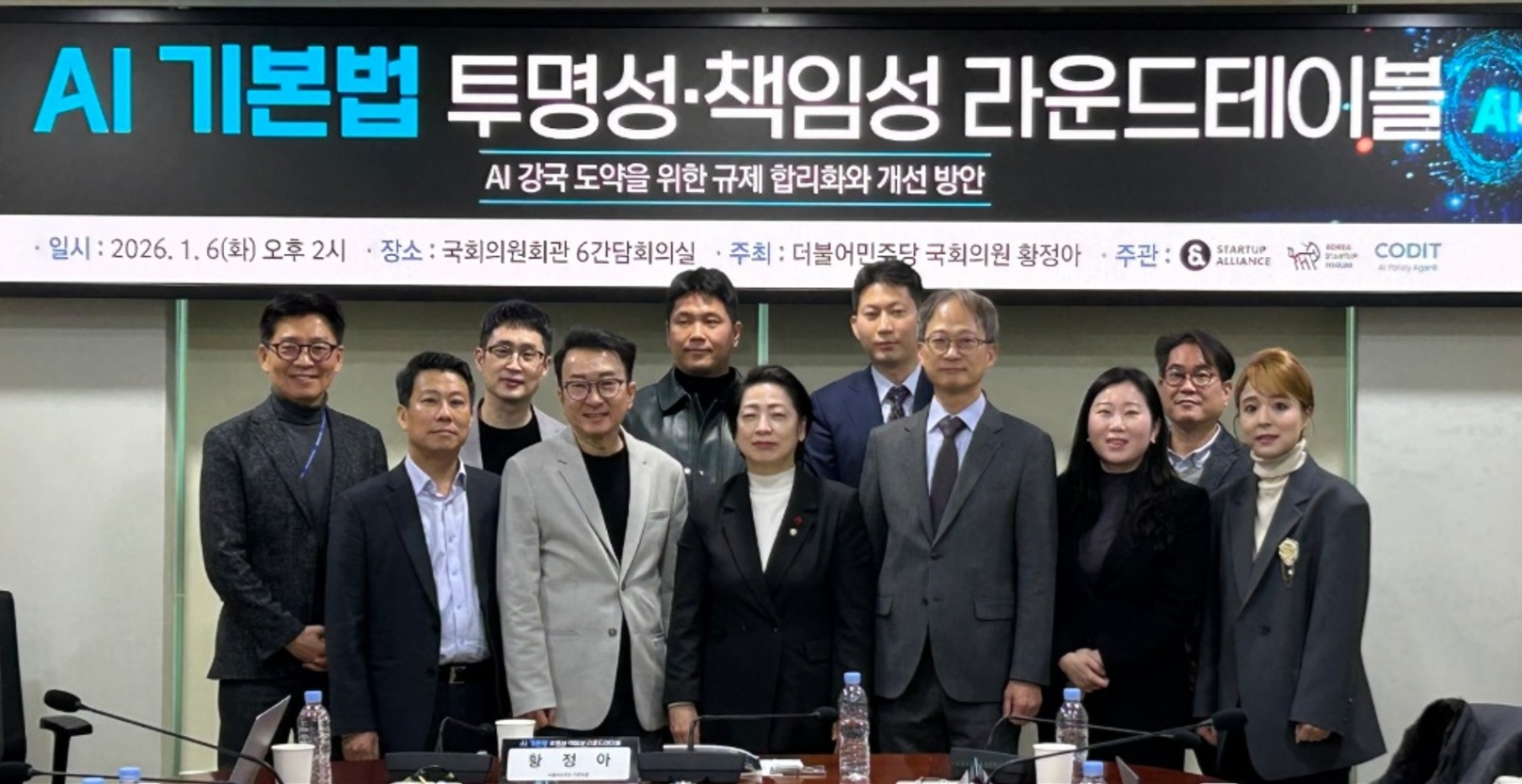
On the 6th , Startup Alliance (CEOs Lee Ki-dae and Lim Jeong-wook) hosted a "Roundtable on Transparency and Accountability of the AI Basic Law" in Conference Room 6 of the National Assembly Members' Hall, alongside Democratic Party of Korea Representative Hwang Jeong-ah. This roundtable, co-hosted with the Korea Startup Forum and the Codeit Global Policy Research Institute, was organized in response to a recent survey of 101 AI companies, which found that 98% responded that they were unprepared for the AI Basic Law. The roundtable aimed to clearly understand the practical burdens imposed by the upcoming AI Basic Law on businesses and to discuss ways to design a predictable and effective system.
Rep. Hwang Jeong-ah stated, "The government is making efforts to incorporate minimal regulations, but concerns exist on the ground." She added, "Discussions on transparency and accountability should be a crucial starting point, and field experiences should be reflected in system design." She also emphasized, "We will continue to provide policy support so that startups can take on challenges without the burden of regulation."
Lim Jeong-wook, CEO of Startup Alliance, said, “The AI industry is experiencing rapid global competition and technological change, so we must consider speed, effectiveness, and predictability when designing regulations.” He added, “I hope that opinions from the field will be reflected in the process of revising enforcement decrees and guidelines, so that the AI Basic Act can become the foundation for trust and innovation.”
“Startups are at the forefront of technology experimentation and market expansion, but they lack the resources to respond to regulations,” said Choi Ji-young, executive director of the Korea Startup Forum. “They need a reasonable system, clear standards, and support infrastructure that lowers compliance costs.”
The discussion focused on the practical applicability of key enforcement provisions, including the designation of high-impact AI, the mandatory labeling of generative AI, and the establishment of a risk management system. Choi Seong-jin, CEO of the Startup Growth Research Institute, stated, "The unclear standards and procedures for individual provisions could spread unintended regulatory risks across the industry." He emphasized, "Even after the law takes effect, a flexible system design is necessary."
Participants pointed out that requiring the display of generative AI results poses technical and user experience challenges, particularly for non-standard content. Furthermore, they emphasized the need for businesses to establish predictable standards, as the criteria for designating high-impact AI can vary depending on the context of use. Furthermore, practical burdens such as safety assessments based on AI system computational load and the requirement to submit training data were discussed.
Choi Woo-seok, director of the Ministry of Science and ICT, said, “The Basic AI Act is a system for national safety and responsible use of AI. We will operate it with a focus on grace and guidance while minimizing the burden on companies,” and added, “We will present specific interpretation standards through enforcement decrees and guidelines.”
Professor Lee Sang-yong, who chaired the discussion, emphasized the need to improve the current law, pointing out systemic inconsistencies in some provisions and the need for high-performance AI regulation. The materials and video from this discussion can be found on the Startup Alliance's official website and YouTube channel.
- See more related articles
You must be logged in to post a comment.