



I've seen many quotes plastered on the walls of startup offices. Some are posted as posters, others are shared through digital signage. As a writer, one day these quotes caught my eye.
"What does this phrase mean? And why do we create and share it?"
I was curious, and I thought it would be fun to investigate this phrase.
Before we get into the real story, I think I should give this phrase on my office wall a name. I asked a few people I know, but no one had any idea. It reminded me of a scene from a comedy show where someone holds up an object and asks people to name it. There are many objects we use and see often, but they don't have names, or even if they do, we don't know them. This was one of those things.
We've seen wall-mounted phrases that everyone takes to heart, even outside of the office. Class mottos like "Always be grateful" (my second-year middle school class motto) and family mottos like "Family harmony is everything" (가화만사성) framed and hung in every home. If classes have class mottos and families have family mottos, then the motto posted in the company office must undoubtedly be a company motto, a name derived from the same character, "訓" (hun).
But calling it a company motto seems a bit old-fashioned. If we named the series "Company Motto Outing," I feel like it would be doomed. The meanings are different. Company mottos, lessons, and precepts all strongly imply that the leader teaches something to the members, and the members follow it without question. If we continued to do this to a startup that members created and tried to maintain together, all the employees would leave. The content is also different. While traditional company mottos are centered around stiff nouns like "diligence" and "cooperation," startup mottos are often verb-like, like "one team" and "fail."
After much deliberation over slogans and mottos, I settled on a slogan. While a motto conveys the feeling of something precious to be enshrined in a new housing complex, a slogan conveys a sense of dynamism, a sense of urgency, a sense of urgency to embrace and act on immediately. I thought it suited the startup world perfectly. That's why I named this series "Editor Jo Gwang-hyun's Startup Culture Slogan, Organizational Culture Exploration" (shortened to "Culture Slogan Exploration" or "Organizational Culture Exploration"). If you have a better title, please let me know.
A company with good numbers lasts for one or two years, but a company with language lasts for more than ten years.
“What are your sales?”, “Are you profitable this time?”, “How much investment did you raise?”, “How many customers do you have?”
Everyone's interested in this. Almost all articles are filled with numbers. Even startup databases are all about numerical data.
“How did you achieve your KPIs this time?”, “How are your DAUs/MAUs performing?”, “Has your conversion rate gone up or down?”, “How is your CAC (customer acquisition cost) compared to your target?”, “What is your churn rate?”
Even internal meetings are filled with conversations like this.
There was a story I wanted to tell in a novel I read a while ago. It's a novel even elementary school students would know, and I've read it countless times.
"Adults love numbers. If you tell them you've made a friend, they won't ask you anything important. They want to know things like, "How old are you? How many siblings do you have? How much does your father earn?" If you tell them, "I saw a beautiful, rose-colored brick house. It had geraniums in the window frames and pigeons on the roof," they won't know what kind of house it is. If you tell them, "I saw a house worth $20,000," they'll exclaim, "Oh my, that's a really nice house!"
The above passage is from "The Little Prince." Saint-Exupéry lamented the world of adults, where no one would understand if someone said, "That person (or company) is a good person (or company)," but everyone would understand if someone said, "That person (or company) is worth 100 million won."
'A company with good numbers lasts for one or two years, but a company with good language lasts for ten years.'
This may be a bit of an exaggeration, but I've made a somewhat provocative definition : a company with a clear purpose, goals, direction, and core values is more sustainable than one with just good immediate numbers . There are quite a few companies that have disappeared, many of which lacked a true corporate language or failed to establish one, instead focusing solely on increasing their numbers.
Core values, the core of corporate language
Let me introduce some interesting statistics. 'Top 7 Reasons for Resignation That Couldn't Be Revealed' (2,288 Office Workers, Job Korea*Albamon) 1st place is conflict with superiors and coworkers, 2nd place is organizational culture not fitting for me, 3rd place is dissatisfaction with position and title, 4th place is work-life balance not being maintained, 5th place is welfare benefits not meeting expectations, 6th place is job not fitting aptitude, 7th place is company vision is unclear. Therefore, according to Job Korea survey, 37.5% of first job changers have been with the company for less than 1 year, 27.0% for less than 2 years, and the resignation rate of less than 2 years is over 50%.
Considering that the primary reason for choosing a job is salary and benefits, we can conclude that we choose a company for economic reasons, but leave because of the organizational culture .
Because organizational culture is created collaboratively by its members, it's difficult for outsiders to grasp without firsthand experience. Things like working styles and atmosphere can't be grasped solely through job postings or company materials. This is a crucial issue for companies as well. Even if you carefully select talented individuals with a well-balanced salary and benefits, if the culture doesn't fit, they'll struggle to work together. Recruitment costs directly translate into losses for the company.
There are things that outsiders can use to gauge a company's culture and work environment: its mission, vision, and core values.
A mission statement can be thought of as the answer to the question, "Why do we exist?" or "What is our reason for being?" In corporate interviews, we always ask about the motivation behind starting a business or creating a company, as this helps us understand the organization's role in society and its essential identity.
A vision represents the desired future state and ultimate goal a company hopes to achieve. When interviewing companies, we always ask about their ultimate goal. Some say becoming number one, others a global company, and still others a beautiful world. Depending on how the company sets its vision, we can anticipate its ultimate future.
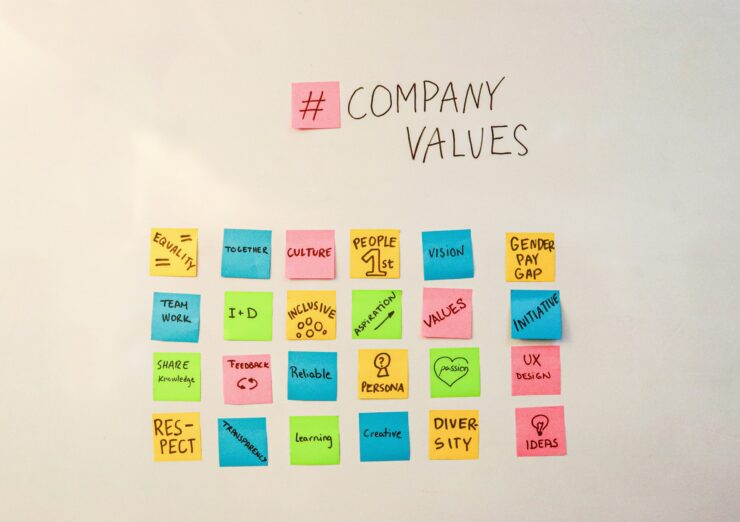
What are core values? I believe they are the behavioral guidelines for achieving the mission and vision. They serve as the basis for decision-making and the criteria for judgment in dilemmas. The sum of the choices made by members who share these core values is the company's current and future state . Core values are one of the most important elements of organizational culture.
An organization isn't a place where individuals work alone. No matter how capable an individual is, they can't compete with many others working together toward a common goal. This is clearly demonstrated by a sports team. A batting lineup comprised of nine home run hitters is far more powerful than a lineup comprised of all nine batters, each with a clear understanding of their role and each fulfilling their role. So how do all nine players clearly understand their roles and engage in the game? This can only be achieved through a clear understanding of the organization's identity, goals, and direction.
The same goes for startups. I advise startups that have completed product development and are wondering about their sales strategy to first define themselves. Without a clear understanding of who they are and what their company is, they can't explain their product. However, many startups that have just launched their products often struggle to define themselves. I advise them to first define why they're doing this and what they ultimately want to achieve through it. That's what MVC is all about.
Many startups have an MVC. However, many don't have a clear concept or can't clearly define it, leading to individual interpretations. A clear MVC allows for the recruitment of talent with a strong cultural fit, assignment of clear roles, and consistent evaluation criteria. Furthermore, as the organization grows, it can focus the diverse ideas and capabilities (centrifugal force) of its members in a single direction (centripetal force). The current trend of high talent density requires a clear MVC.
I'm not an expert on MVC, organizational culture, or HR. I'm neither interested in nor competent in theoretical approaches to MVC. I'm going to examine each company's MVC, especially its core values. Some might point out the point of looking at other companies' language. There's nothing more fun than exploring someone else's home. In middle and high school, I used to go around each class to read their class mottos. Whenever I went to a friend's house, I'd start by looking at the family motto hanging on the wall. What's the benefit of peeking like this? It's like asking what's good about reading a book. Understanding other people's experiences and thoughts allows me to examine and reexamine my own thoughts.
We haven't yet decided whether to focus more on culture as a language (MVC expression) or culture as an institution (recruitment, evaluation). First, we're looking to meet with companies, regardless of industry or size, that have a strong language that reflects their core values.
From the next episode onwards, we will cover the core values and organizational culture of a company, focusing on specific examples.
You must be logged in to post a comment.