



This article is a contribution by Attorney Hee-chul Ahn of DLG Law Firm. If you would like to share quality content for startups in the form of a contribution, please contact the Venture Square editorial team at editor@venturesquare.net .
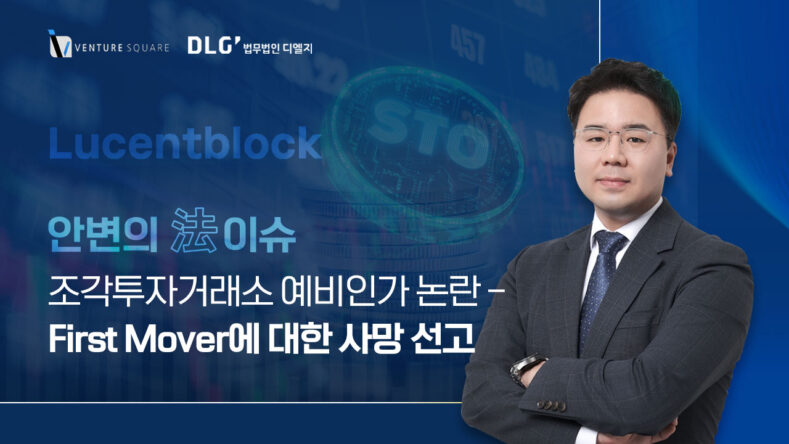
The controversy surrounding the preliminary approval of the STO exchange, which is killing off innovative startups in South Korea, is escalating.
The Financial Services Commission (FSC) held a meeting of the Securities and Futures Commission on January 7, 2026, and reviewed the application for preliminary approval for the financial investment business of the over-the-counter (OTC) exchange for fragmented investment. The consortiums, the Korea Exchange-KOSCOM and the Nextrade (NXT)-Music Cow, were highly likely to be selected. Conversely, Lucent Block, which has been providing fragmented investment services as an innovative financial service provider through the financial regulatory sandbox, is unlikely to be selected. However, following the controversy, the FSC immediately issued a press release stating that no decision had been made regarding the approval of the fragmented investment OTC exchange. Nevertheless, the reason many in the startup ecosystem are deeply angered is that the government has completely abandoned the long-held promise of the regulatory sandbox: that those who pursue innovation first will be given priority in the institutionalization process. If Lucent Block, which has been at the forefront of innovation in fragmented investment trading, fails to receive preliminary approval for the OTC exchange, its status as an innovative financial service provider will be lost, potentially jeopardizing its future existence. The Financial Services Commission's final approval decision is expected to be made on January 14, 2026, and attention is focused on whether this result will remain the same or change.
Regulatory sandboxes—not "special exceptions," but "a national commitment to commercialization for innovative companies."
The regulatory sandbox system should not be misunderstood as merely a temporary deregulation mechanism. The "Special Act on Supporting Financial Innovation" (hereinafter referred to as the "Financial Innovation Act") serves as the foundation for the financial regulatory sandbox, temporarily easing existing regulations to promote the development of financial services and designating innovative financial services to facilitate their market launch. Designated innovative financial service providers under the Financial Innovation Act receive regulatory exemptions for a certain period of time, but are required to provide services after verification of additional conditions (consumer protection measures), supervision and reporting, incident response, and business sustainability. In essence, the system allows the government to experiment with innovative services in the market, but only formally recognizes them once they are proven risk-free.
The core of the regulatory sandbox system is not "temporary deregulation or demonstration testing," but "transition to official service." The regulatory sandbox was not initially intended to be a mere experimental exception, but rather a bridge that allows business models proven stable through demonstration to be introduced into the institutional system. The Financial Innovation Act grants exclusive operating rights for up to two years to innovative financial institutions that meet certain requirements and have received approval or license. In June 2025, the Financial Services Commission (FSC) issued separate guidelines specifying the requirements and procedures for exclusive operating rights (such as obtaining approval or license before the expiration of the designated period, actual launch, and scope of operation). These exclusive operating rights are not a special privilege for specific startups, but rather a minimum reward for companies that pioneer innovative services despite regulatory constraints.
Without even the aforementioned compensation for companies that pursue innovation while enduring various regulations and civil and criminal legal risks, South Korea's innovators would have no incentive to pursue innovation as first movers. Businesses have been actively responding to outdated regulations for years, complying with burdensome conditions imposed by regulators, proving technological stability, and establishing investor protection systems to shape the market. Therefore, the government must clearly signal that it will not ignore the efforts and risks of innovative startups when formal institutionalization takes place.
The Problem with the Preliminary Approval Process – A Death Sentence for First-Mover Startups Pursuing Innovation
The recent preliminary approval of the financial investment business for the over-the-counter (OTC) exchange is becoming increasingly problematic because it comprehensively exposes several legal and policy issues. First, there is criticism that the preliminary approval criteria are overly focused on infrastructure and asset ownership for the business in question, rather than on verifying innovation and establishing a stable industry. There is also criticism that the approval process favors established powers, such as the Korea Exchange, and is based on a system of distribution. If these findings are confirmed, startups will inevitably feel that pursuing innovation will inevitably lead to the perception that large corporations with extensive infrastructure, established businesses with vested interests, and established traditional markets will take over. Furthermore, this could foster an anti-innovation mindset among large corporations, who believe that emulating the business models of innovative companies within their own extensive infrastructure is sufficient, rather than taking risks themselves.
Of course, a business's infrastructure capacity and asset size can be important from a business stability perspective, investor protection perspective, and market protection perspective. However, we must rethink the very purpose of the regulatory sandbox system. The regulatory sandbox system allows even innovative businesses with somewhat limited infrastructure freedom to conduct limited and conditional experiments, allowing them to test the potential of innovative markets that are unprecedented in the world. Successful verification guarantees exclusive operating rights for a certain period of time, providing opportunities and rewards for leading not only Korea but the world. This is specifically stipulated in Articles 21 (Applications for Licenses, Permits, etc. by Innovative Financial Businesses) and 23 (Exclusive Operating Rights) of the Financial Innovation Act. However, if, as seen in the recent preliminary approval results, the belief that those with assets and infrastructure, existing vested interests, or quasi-governmental organizations will ultimately prevail at the threshold of formal institutionalization takes hold, the regulatory sandbox system will be reduced to a mere sham. Innovative startups struggle to conduct research and development while bearing regulatory risks, while well-funded infrastructure providers provide similar services and ultimately receive preliminary approval. This is the current state of affairs with the preliminary approval of the STO exchange.
Second, the policy design that limits STO exchange licenses to a maximum of two also presents significant structural problems. In its September 2025 operating plan, the Financial Services Commission announced that it would limit licenses to a maximum of two, citing the nascent and small scale of the fragmented investment market and the potential for a proliferation of platforms to fragment liquidity, reducing liquidity and potentially harming investors. However, limiting licenses to two would result in the unfair outcome of first movers, who spearheaded innovation, being deprived of rewards, while fast followers would reap the rewards. Fragmented investment distribution platforms are an infrastructure industry where initial liquidity, price formation, and consumer protection are intertwined. Whoever passes the first barrier is not simply a short-term business opportunity; it will determine the future market structure (competition, innovation, and barriers to entry). However, the announcement of this preliminary approval, which limits the first two gateways and excludes the pioneers who have personally shouldered all the legal and policy risks, raises questions about whether the Korean government truly intends to pursue innovation.
Third, the fact that this preliminary approval decision was made amidst significant controversy over the theft of technological secrets between the leader and the follower is also problematic. Nextrade, part of the "Nextrade (NXT)-Music Cow" consortium, one of the two candidates for preliminary approval, entered the race for STO exchange approval after previously signing a non-disclosure agreement (NDA) with Lucent Block. Nextrade, Korea's first ATS (Automated Trading System) that received primary approval from the Financial Services Commission in February 2025, was selected as a candidate for preliminary approval without any issues amidst these growing allegations. This raises questions about fairness and transparency. Furthermore, the criticism that the result is that even the innovative market has been amicably divided up between established players with significant capital and infrastructure is unavoidable. Why on earth did such a negative precedent have been set?
Fourth, this controversy is particularly significant because it coincides with the current transitional period for the institutionalization of STOs. Trust in government policy is crucial for industries undergoing transition, such as STO exchanges and fragmented investments. Bringing industries and markets within the institutional framework while the laws are still in place inevitably requires the private sector to shoulder regulatory risks and conduct validation. The STO exchange, for example, was also a private startup that assumed all the risks and conducted validation. Ultimately, the Korea Exchange and a consortium led by Nextrade (NXT), which are hardly entirely private entities, were selected as the two candidates for preliminary approval. If this pattern of the private sector, which assumed all the risks, being excluded from the institutionalization stage, continues, who will lead innovation and validation in the next transitional innovation industries (e.g., Real World Asset Tokenization (RWA), atypical securities, and digital bond distribution)? This too raises questions.
Without a regulatory sandbox operating without principles, we have no right to talk about innovation.
What status do those who endure and overcome innovation have in the institutionalization of the industry? Have they been adequately compensated? If we fail to properly answer these questions, the regulatory sandbox system can no longer offer hope to the startup ecosystem. Startups selected for the regulatory sandbox must clearly establish that, provided their services are free of significant issues, they will receive final approval. This case goes beyond the success or failure of a specific company and speaks volumes about the methods and structure through which South Korea pursues innovation. The regulatory sandbox should not be a system that temporarily grants innovation, but rather a system that provides and promises policy trust that "risks are acceptable" to innovators. If that trust erodes and a structure is established where vested interests in the existing market steal innovation from others, not only the STO exchange industry but all innovative industries in South Korea will inevitably collapse.
When principles are established to foster and protect innovative startups, South Korea will have the minimum qualification to speak of innovation. The regulatory sandbox is a promise to our startups, who are working tirelessly to pursue innovation and develop world-leading technologies and services. Why aren't they keeping their promise?
Inquiry for information
Attorney Heechul Ahn 010-9135-4773 / heechul.an@dlglaw.co.kr
Simharu, Senior Manager, PR Marketing Team 010-9458-6068 / ru.sim@dlglaw.co.kr
You must be logged in to post a comment.