



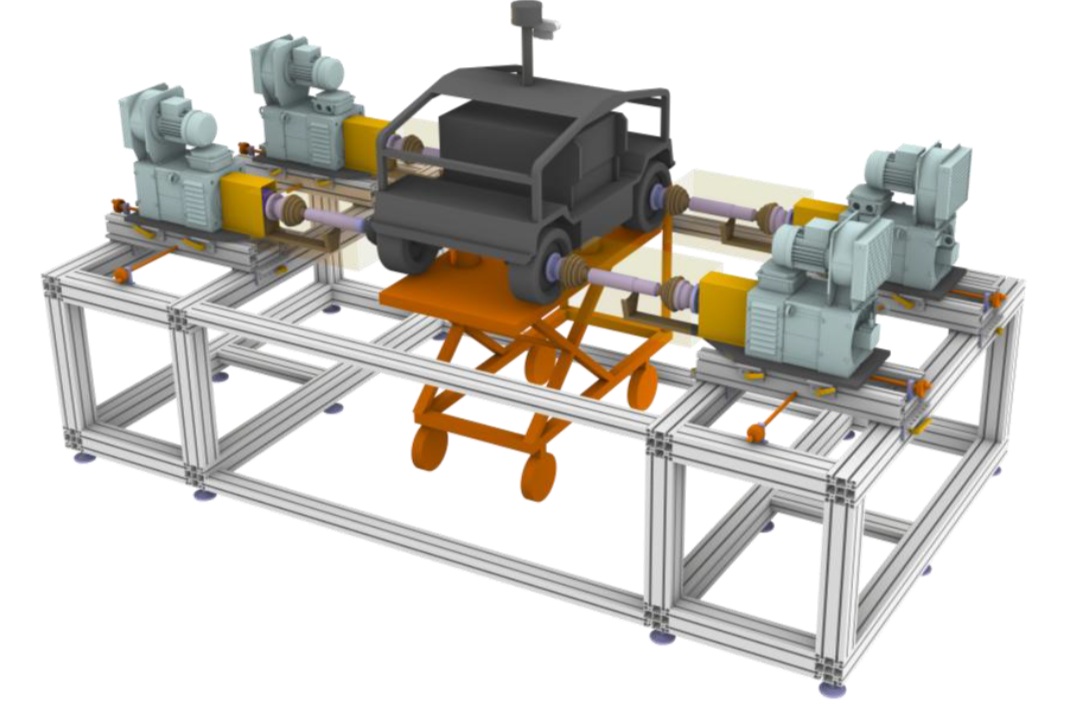
Innosimulation has won a contract worth approximately 700 million won for the "E-Mobility Performance Testing Equipment Construction Project" hosted by the Korea Testing Laboratory (KTL). This contract will allow the company to expand its business beyond software-based simulations into hardware performance verification, where AI interacts with real-world physical environments.
The e-mobility sector is actively applying physical AI to autonomous delivery robots, electric kickboards, and unmanned vehicles. The physical errors that arise when implementing AI learning on actual roads are pointed out as a safety-critical issue. The equipment built by InnoSimulation is considered a key solution for verifying this "Sim2Real" process.
The core of the project is to ensure that autonomous robots and electric vehicles experience realistic physical loads in a laboratory environment. This allows for quantitative verification of hardware component performance, including drive motor response, steering precision, and power and torque control. Compared to existing road-based testing, this reduces costs and time while minimizing the risk of accidents.
This equipment enables extreme testing of mobility hardware performance in scenarios that simulate real-world driving environments, reducing development costs and shortening the time to commercialization. InnoSimulation is transferring its hardware-in-the-loop (HIL) simulation technology, developed in the defense and aerospace industries, to the civilian autonomous driving and mobility markets.
Our collaborative relationship with KTL has also been strengthened. Following our previous collaboration on outdoor delivery robot simulations, we have now secured technological credibility by building real-world performance testing equipment. InnoSimulation believes that this contract has solidified their position as a provider of autonomous driving and physical AI verification infrastructure.
- See more related articles
You must be logged in to post a comment.