



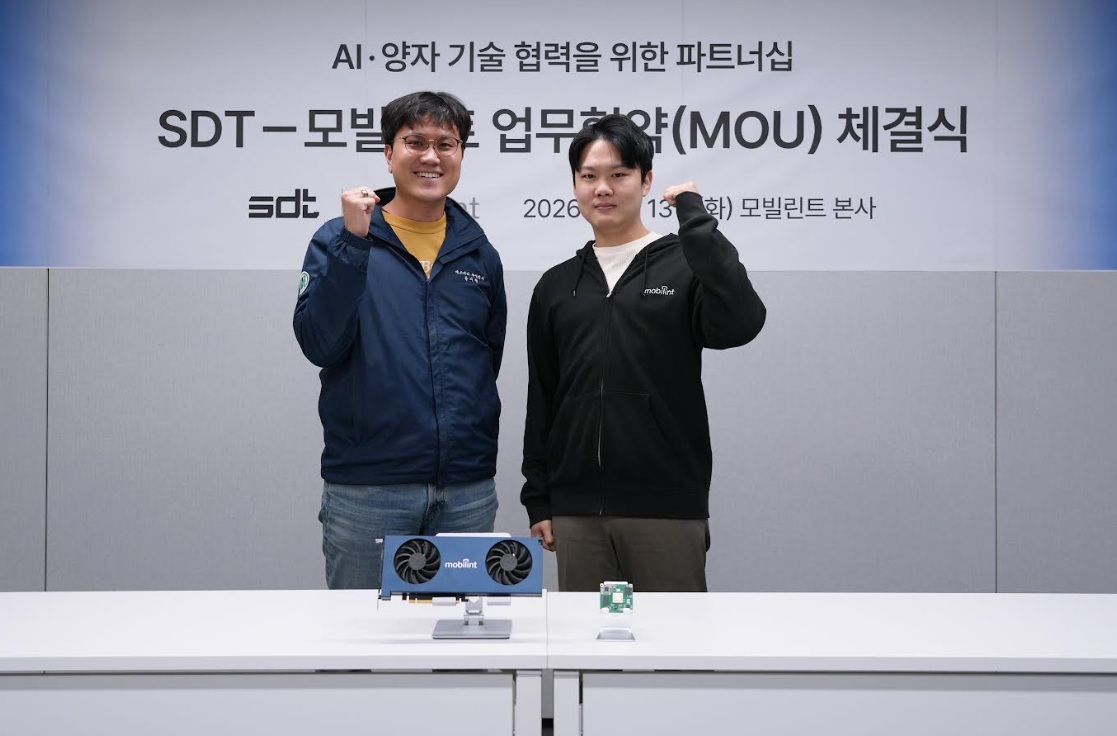
Quantum technology specialist SDT (CEO Jiwon Yoon) announced on the 14th that it has signed a memorandum of understanding (MOU) with AI semiconductor company Mobilint (CEO Dongjoo Shin) for the purpose of joint research and commercialization of QRNG·QKD-based quantum technology and AI control technology for application in the public and private sectors.
This agreement aims to establish a cooperative system that combines AI semiconductor technology with quantum security to strengthen communication security for manned and unmanned mobile platforms and enhance the reliability of autonomous driving and mobility systems. The two companies plan to counter potential hacking threats in mobility environments and promote the creation of a security-focused mobility platform ecosystem applicable to both the public and private sectors.
Under the agreement, the two companies will jointly develop technologies that combine AI-based manned and unmanned mobile platform control technology with quantum cryptography technologies based on QRNG (Quantum Random Number Generation) and QKD (Quantum Key Distribution). QRNG utilizes the irregularity of quantum mechanics to generate unpredictable random numbers, while QKD is a communications technology that transmits the corresponding encryption keys without the risk of eavesdropping.
Unmanned mobile platforms like autonomous vehicles and drones require critical communication security due to their need to transmit and receive massive amounts of data in real time. Consequently, the potential application of quantum security technology is gaining attention as a way to mitigate threats like intelligent hacking and remote control theft, which are difficult to address with existing cryptographic systems.
The two companies will conduct joint research and development utilizing their respective personnel, facilities, and equipment. They will also explore a commercialization model that integrates SDT's quantum security solution with Mobilint's AI semiconductor-based mobile platform. Furthermore, they will verify the stability of the technology through a proof-of-concept (PoC) in an actual operating environment and pursue cooperation to establish a certification system and expand the technology in the future.
In addition, we plan to continue cooperation in related promotional and research activities to share joint research results internally and externally and to disseminate them academically.
- See more related articles
You must be logged in to post a comment.