



"20,000 people cry each year: 'Ineligible winners' aren't due to individual error, but to a systemic failure."
In Korea, subscriptions are called "lotteries," but the process itself is more like "torment." The Ministry of Land, Infrastructure and Transport's FAQ alone has 241 pages. Every year, over 20,000 "ineligible" applicants lose their lottery applications due to a single marking error, and are deprived of the opportunity for a year.
Jang Yong, who oversaw tenant selection at a renowned construction company for ten years, attributed the tragedy not to "individual negligence," but to a "disconnected administrative structure." His company, "Cheomcheom Cheoyak," aims to go beyond simply providing information and provide a "pre-judgment infrastructure" that allows applicants to verify their own eligibility.

Over the years, CEO Jang Yong has witnessed numerous cases of lottery cancellations. He pointed out, "Institutionally, all responsibility lies with the applicant. However, demanding a thorough understanding of the complex generational structure and constantly changing point-based criteria is tantamount to national negligence."
The current structure separates the application process (subscription website) from the verification process (business entity). Applicants must navigate the vast information gap between the two processes alone. CEO Jang Yong was convinced that a "pre-judgment digital infrastructure" was essential to address this issue. This is the background behind the creation of the first subscription system.
■ The philosophy behind the 'Subscription Profile': "It's a realm of judgment, not inquiry."
The key is the "subscription profile." Rather than simply displaying information, it structures an individual's qualifications through simple authentication. It then determines in real time whether a person is qualified to actually apply.
"Qualifications constantly change based on changes in time and circumstances, such as the length of time without a home, household composition, and residential relocation. The first subscription automatically updates these eligibility criteria, helping users manage their status until they win."

What's interesting is CEO Jang Yong's candid confession of failure. The "Jjim" and "Mock Subscription" features he initially planned failed to accumulate meaningful data. Instead, he revised his strategy to incorporate "empirical data" by combining model house pre-orders with subscription profiles. This evolved into a B2B data business that analyzes not simply "how many people came," but "who has the highest chance of winning, and under what conditions."
■ Security and accuracy realized through technology: “Judge without storing”
Subscription data contains sensitive personal information. The initial subscription process eliminated security risks from the design stage. He explained, "Our principle is a 'document-free' structure," and "We extract only the information necessary for decision-making from documents retrieved through simple authentication, and then immediately destroy the originals."
"We're not a company that stores personal information; we only temporarily interpret it and generate 'decision results.' This structure allows us to fully meet security standards even when collaborating with external organizations."
The technological advantage stems from a "rule-based engine." It manages constantly changing real estate laws not on a document-by-document basis, but rather on a logic-by-decision basis. Any change in criteria immediately recalculates all users' profiles. AI then operates on this refined decision data, analyzing the likelihood of winning and the risks involved.
■ Map of the Future: “A World Where Everyone Judges by the Same Standards”
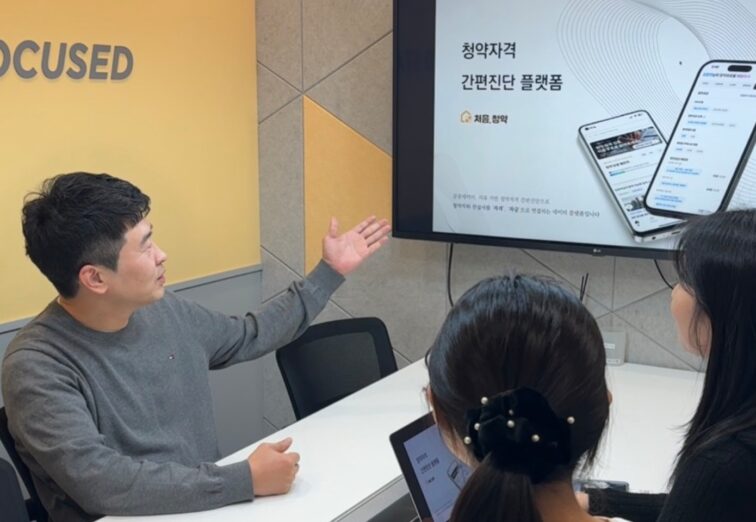
CEO Jang Yong defines the relationship between Cheongyak Home and major real estate platforms as "complementary." The roadmap calls for Cheongyak Home to handle listings, with the major platforms handling the application process, and Cheongyak Home handling the decision-making process.
"Our goal is to secure 5 million 'judgment users.' Rather than providing a one-size-fits-all tutoring service that simply tells you the right answers, we will provide a decision-making infrastructure that helps people make rational choices."
The economic value it will create is clear: reducing the trillions of dollars in annual personal losses and administrative costs associated with ineligible lottery winnings.
You must be logged in to post a comment.