



One day in 2017, I met a former Kakao CEO. He told me he'd just founded a startup that leveraged his experience at Kakao to create a home care service. It felt like a good time, as demand for home care services was growing and related companies were quickly emerging. I've used the service a few times and found it to be excellent.
This is Cheongyeon. Cheongyeon has been known by various names, including "Life Research Institute" and "Cleaning Research Institute," but has now unified its corporate name to "Cheongyeon." This is because, with the launch of "Cheongyeon Care," a senior care business, late last year, the need for a unified brand has grown as the business has expanded.
Currently, Cheongyeon provides services to a cumulative 2 million households. It also provides stable jobs to 200,000 housekeepers. In particular, it helps women who have taken a career break re-enter the workforce. By entering the senior care business late last year, Cheongyeon is also fulfilling its social responsibility to fill the gap in caregiving.
I met with CEO Yeon Hyeon-ju again after nine years. More than anything, I was curious about the core values that had driven Cheongyeon's growth over those nine years.
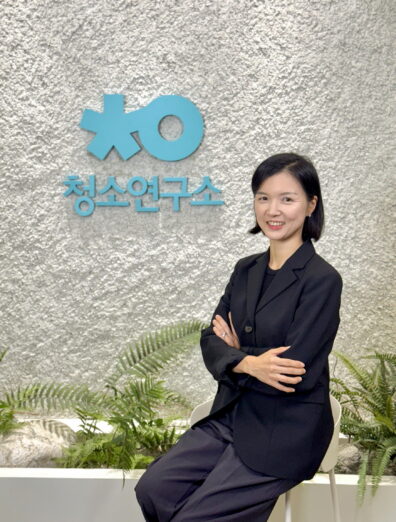
Reporter Cho: What are the core values that have helped Cheongyeon grow over the past nine years?
Representative Yeon: It's '406'
Reporter Cho: 406?
I thought it might be the room number, or the address of the place where it was founded (some startups use the address of their first place as their name to remind people not to forget their initial passion), or the secret formula for growth unique to Cheongyeon like Yoonha's 'Password 486', or the anniversary of the founding (Cheongyeon's anniversary is March 14th).
Representative Yeon: 406 is an abbreviation for love, sharing, and humor.
Cheongyeon's core value, "Sagongyuk," has remained unchanged since its founding. Compared to the core values of startups, which are often subject to change, I find this remarkable. It gives me a sense of stability. Cheongyeon will likely be the first and last company I've seen that has maintained its core values since its founding.
Q. How did you create the core value called 406?
"I never had any intention of creating something truly unique. During my career, I've always felt that imposing too much corporate direction doesn't resonate with me as a member. No matter how grandiose a company's core values are, if they don't resonate deeply with its members, they're meaningless. So, my first principle was that members had to feel them. Second, they had to be values that truly align with our business. Cheongyeon is all about creating good jobs, building trust with customers, and connecting people, so I thought it would be nice to have a sense of warmth."
Cheongyeon's core values were alive and well throughout the office. They were evident not only in the conference room names ("Love Room," "Sharing Room," and "Humor Room," and the interview was conducted in the "Humor Room") but also in the faces of its members.
Love between a colleague and a manager
Cheongyeon's Love tells the story of love between family, between colleagues, and between customers and managers. It particularly emphasizes the love between colleagues.
They emphasize that "the best welfare is loving colleagues." This is how Cheongyeon thinks about her colleagues.
- The person who makes it possible for me to do what I can't do alone is my colleague.
- During difficult times at work, colleagues who understand and help with difficulties
- The person you spend the most time with during the week
- A company may be finite, but colleagues are eternal.
If I had a colleague like this, I think I would want to go to work.
“Manager, thank you for your hard work today.”
Cheongyeon employs 200,000 housekeepers who meticulously clean customers' homes. They say their gratitude to these managers is reflected in their KPIs.
"When our employees treat managers, their attitude is reflected in the customers. If we don't treat them warmly, our managers won't be able to go to customers' homes and work with a warm heart."
It seems that warmth is transmitted to others, and those who receive warmth are in turn transmitted to others, just like the law of conservation of energy.
Share both work and daily life
Cheongyeon values "sharing my thoughts with others." Below are some specific examples of sharing.
- I explain in detail the background knowledge (information) and logic behind my thoughts.
"No, you don't even know this? Do I have to explain everything?
This isn't the right way to talk. The fastest and most effective way to reach a solution is to have a similar level of information and knowledge as your counterpart. To ensure a similar level of information, you should share information and knowledge in as much detail as possible.
- Always go first and talk.
'Why don't you understand what I'm thinking?
It's rare to find someone who can read others' minds. Go ahead and say what you think. "I don't know." "I'm confused about this." "This is a bit overwhelming and difficult for me." If you don't speak up first, no one will know. It's the person who didn't speak up. Misunderstandings are prohibited without speaking up first.
- It's okay to repeat important information.
“Do I have to explain again?”
There's so much information, so many meetings, so much that anyone can miss something. It's okay to repeat important points 10 or 20 times. Repetition isn't ineffective. It's difficult for an audience to absorb even 30-40% of the speaker's original message. Repeat important points multiple times!
- Speak honestly and politely.
"Thank you for the detailed information. However, I'm not sure if I understand it well enough or if this is the best approach. Perhaps you could explore other methods?
The purpose of meetings and conversations is to persuade others of my ideas. Honesty and polite expression are the most powerful weapons for swaying others.
Cheongyeon members share even the smallest details through Slack, a communication tool. All rooms are public, and there are no closed channels. Anyone can view data, so everyone knows what the other teams are working on.
"Instead of telling people to do a good job, I tell them to share well. Everyone knows what they're doing. They're also familiar with new things. People say they know too much, but the more they know, the better. When sharing is good, collaboration and efficiency within the organization improve."
The sharing Cheongyeon speaks of doesn't simply mean sharing work. It also encompasses sharing personal circumstances, emotions, and even difficulties.
"If a family member is sick and needs to go to the hospital, what happens if you don't say anything? Others might think, 'Why does that person keep leaving early?' or 'He's being dishonest.' Even the team leader might feel frustrated. But if you say, 'My mother is hospitalized, so I need to go to the hospital,' everyone understands and becomes more considerate."
There's no one in this world who understands someone's feelings without even saying a word. You have to speak to understand them. More importantly, those words must reach someone. Words are meaningless unless they reach someone's ears. However, such people and organizations are rare. If, despite repeated attempts to speak, no one understands or tries to understand, the speaker will eventually stop speaking or leave the person and organization. Sharing is necessary for mutual understanding, but it cannot be realized without the effort to understand each other.
Humor that can help you survive a crisis
When you meet startup CEOs, you feel their intensity. It feels like they live every day like a battlefield. Cheongyeon must have faced countless ups and downs, but the five original members are still with us. What is the driving force behind the team's longevity? CEO Yeon simply answers, "humor."
B2C businesses, in particular, are prone to customer complaints. Cheongyeondo reportedly received numerous complaints in the early days of its service. They even had to visit the police station. However, humor was what sustained the team through these critical moments.
"It was when online experts who had previously worked exclusively at Kakao suddenly launched offline businesses. The field was always chaotic. Problems we couldn't foresee kept cropping up. But the way to overcome it wasn't to endure it, but to embrace it with humor. The humor of the executives, in particular, seemed to be the lubricant for the organization."
There's a company that considers humor a core value of its organizational culture: Southwest Airlines. Southwest Airlines is renowned for its humorous in-flight announcements. They consider a candidate's sense of humor one of the most important hiring criteria. Thanks to this culture, Southwest Airlines maintains world-class standards for consistent takeoff and landing rates, low lost baggage rates, and customer satisfaction.
Cheongyeon defines humor as "the magic that makes the workplace a fun and comfortable place." To create a humorous workplace, they emphasize the importance and practice of humor as follows.
- A pleasant conversation is a great way to increase my attractiveness.
- In moments of conflict, humor lowers the tension.
- Humor promotes positive thinking and lifts the mood.
- When we laugh together, we become a team.
Humor can ease tension. There's no need to compete unnecessarily with colleagues. They're not the ones you need to beat, but the ones you need to work with. Humor acts as a lubricant in an organization. It improves the atmosphere. Even when things go wrong at work, it lightens the mood and allows you to start anew.
What was the joke that Cheongyeon told a lot in the early days?
They say "We're screwed now" ^^
The saying "the more urgent you are, the more you have to back off" comes to mind. Impatience often ruins things. I think leisure comes from confidence and self-assurance.
Who is the love interest of the year?
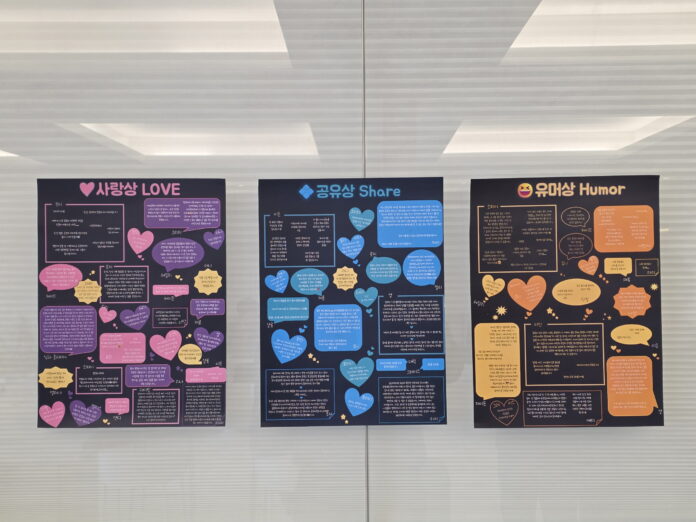
Who will be the best lover in Cheongyeon this year?
At its year-end party, Cheongyeon awards one person for each core value, based on a vote from all employees. The reasons for the nominations are often interesting. For example, they give specific reasons like, "This person is so lovable," or "He always makes me laugh, no matter how difficult the situation."
"The resignation rate among award recipients is virtually zero. Their performance is also truly outstanding. Because they're loved by their colleagues, they're motivated to work even harder."
Will 406 be a success?
Some people ask, "What does this have to do with making money?" However, it depends on the nature of the business. Cheongyeon is a trust-based service that connects people, so development, sales, and customer service must work organically. Sharing and attitude are crucial because, ultimately, they drive business success. By reducing unnecessary, wasteful competition and maintaining a positive attitude toward customers and managers, business will naturally flourish."
A place where there's love between coworkers, where people can comfortably share work and personal matters, and where laughter abounds, there seems to be no reason to leave. In fact, Cheongyeon's turnover rate is reportedly close to zero.

How is your company? Do we love the people next to us? Are there any secrets? Is there laughter in the organization? Check the following questions.
1. Love
- Do you express your gratitude to your colleagues specifically?
- Manager, do you maintain a sincere attitude when dealing with partners?
- Is that attitude reflected in front of customers?
2. Sharing
- Are you transparent about your information?
- Can you be honest about your personal struggles?
- Does the team leader listen to such stories and work together to resolve them?
3. Humor
- Do you not lose your smile even in difficult situations?
- Does the leader use humor to break up tense situations?
- Does it give you a feeling of togetherness?
In conclusion
"Even if there were other good deals, I couldn't leave because of this cleaning service. My spouse loves it so much, she tells me, 'Don't ever leave this company.'"
Cheongyeon offers its employees free cleaning services, worth 300,000 won per month. This system has been in place since the company's inception, even during periods of deficit.
"Our employees are our customers, too. Through this service, they gain a deeper understanding of our business, meet Cheongyeon's managers, and experience firsthand how excellent our service truly is. Beyond mere benefits, it gives employees a firsthand understanding of what kind of company we are, and it teaches them how to treat customers."
You must be logged in to post a comment.