



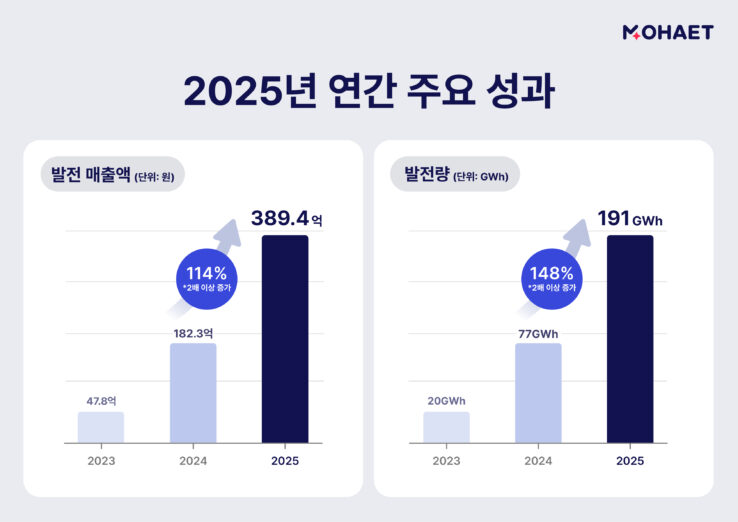
Annual power generation of 191 GWh and power generation sales of KRW 38.9 billion as of 2025, up 148% and 113% year-on-year, respectively.
-The union's participation amount increased by 34% year-on-year to KRW 177 billion, and the cumulative amount has exceeded KRW 420 billion since its launch in 2020.
Mohaet (Everyone's Sunshine), the largest renewable energy investment platform in Korea operated by renewable energy platform company H Energy (CEO Ham Il-han), released its '2025 Financial Statements' on the 20th and announced that power generation and power generation sales have more than doubled compared to the previous year.
MoHat is a renewable energy investment platform based on the "Renewable Energy Cooperative" model officially launched by H Energy in 2020. Members' funds are used to construct rooftop solar power plants nationwide. The renewable electricity generated by these plants is sold to Korea Electric Power Corporation (KEPCO) and its power generation subsidiaries under long-term, fixed-price power purchase agreements (PPAs), with profits paid to members as interest. Rather than relying on complex derivatives, MoHat distributes the cash flow generated by renewable energy production facilities to members.
According to the settlement, annual union participation in 2025 reached 177 billion won, a 34% increase from the previous year. Since its launch in 2020, cumulative union participation has exceeded 420 billion won, and the number of members has surpassed 210,000.
Operating performance also improved. Power generation in 2025 is projected to reach 191 GWh, a 148% increase from the previous year (77 GWh). Power generation revenue reached KRW 38.9 billion, a 113% increase year-on-year. The expansion of distributed energy assets is leading to robust power generation performance and sales growth.
To strengthen its foundation of trust, MoHat regularly conducts external audits by accounting firms and transparently provides financial and operational information. Since 2020, the company has consistently paid out approximately KRW 50 billion in interest income to members and over KRW 100 billion in capital contributions and maturing loans, all based on power generation revenue.
Another distinguishing feature of MoHat is its "platform cooperative" model. Members are not simply beneficiaries, but rather co-owners and stakeholders of renewable energy infrastructure, participating in systematic governance processes such as decision-making, information sharing, and general meeting operations. In recognition of this public service value, H Energy received the Bronze Tower Order of Industrial Service Merit in 2025. The company was highly praised for building small-scale, distributed power plants utilizing idle rooftop spaces across the country and then combining them to create a single, large-scale energy asset.
MoHat also has a risk management system in place. Rather than investing in individual power plants, it has adopted a structure that diversifies investments across its entire power plant portfolio. This design minimizes the impact on overall profits even if a specific power plant suffers losses due to unforeseen circumstances, such as natural disasters. The annual investment cap for the national cooperative (B2C) has been set at 30% of the total. The remaining portion is managed through Stick Investment and a special purpose vehicle (SPC) for asset transfer purposes. The SPC sequentially purchases the cooperative's shares in power plants, using the funds to repay members upon withdrawal or maturity.
Ham Il-han, CEO of H Energy, said, "MoHat is a renewable energy investor platform that transforms small-scale solar power plants across the country into a single, massive energy asset, allowing anyone to own it. This long-term infrastructure investment model, built on real solar assets, is contributing to the popularization of renewable energy and the local production-local consumption model." He added, "Through transparent information disclosure and systematic risk management, we will work with our members and institutional investors to expand the sustainable renewable energy ecosystem."
Meanwhile, the government has set a Nationally Determined Contribution (NDC) target of reducing greenhouse gases by up to 61% by 2035 compared to 2018 levels. To achieve this, the government plans to increase renewable energy capacity from approximately 35 GW by 2024 to 100 GW by 2030 and expand distributed solar power installations, including rooftops, parking lots, and agricultural facilities. In line with this energy transition, H Energy plans to expand its ecosystem, enabling anyone to participate in the distributed energy market through its platform.
You must be logged in to post a comment.