



No construction site ever goes according to plan, with drawings, plans, and schedules. Buildings rise with a constant struggle to conform. Even when problems are discovered, it's difficult to trace when, by whom, and why they occurred. Thousands of photos are taken, but pinpointing the location and finding the desired information later remains a legacy.
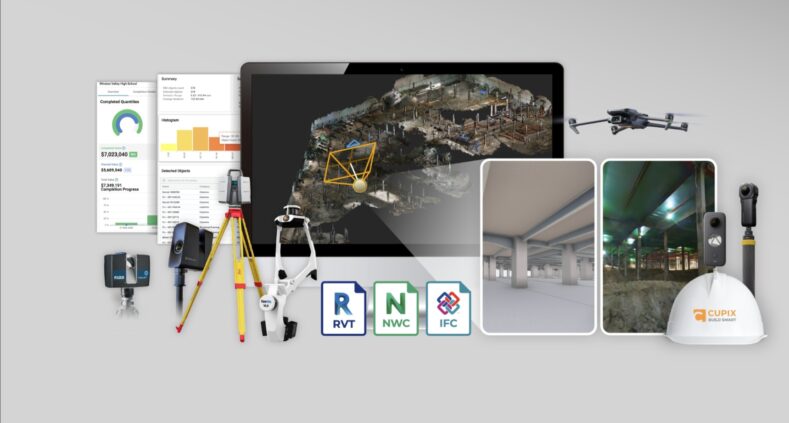
Cupix has completely digitized construction sites by combining 360-degree cameras, computer vision, and cloud computing. Its customers include over 800 construction companies in over 30 countries worldwide, and the cumulative number of sites where it has been implemented is approaching 150,000.
"Around 2010, when I bought a house in Silicon Valley and started renovating my backyard, I realized, 'This kind of stuff is still stuck in the 1980s.'"
Bae Seok-hoon, CEO of Cupix, is a researcher specializing in computational geometry and 3D reality capture. His first startup, a B2B 3D data processing software specialized for manufacturing, achieved the number one market share in the US. His second was a cloud collaboration solution for small and medium-sized engineering companies.
The question he always pondered was, "Why can't photos and videos alone convey spatial context in a way people can easily understand?" While working with landscaping companies on backyard renovations, this challenge presented itself as both a challenge and a tremendous business opportunity.
Construction companies spend huge sums on building projects, but digitizing spatial information sharing between the site, office, and client has been limited. Thousands of photos were taken, but pinpointing locations and finding desired information later remained a legacy process. The site didn't match drawings or initial schedules. Even when problems were discovered, it was impossible to trace when, by whom, and why they occurred.

In 2015, CEO Bae Seok-hoon concluded that 360-degree camera technology had reached maturity. He explained the background behind Cupix's creation, saying, "I was convinced that combining this technology with computer vision and cloud computing could completely digitize construction sites." The company's core philosophy is "accessibility." LiDAR equipment, while precise, costs tens of millions of won and requires specialized personnel.
“We focused on developing software that achieves the required precision with a standard 360-degree camera costing under $1,000, and, more importantly, maximizes ease of use.”
The core of the solution is a proprietary "multimodal 3D reconstruction algorithm." It utilizes not only 360-degree camera footage, but also the camera's tilt sensor and GPS information to reconstruct the space in three dimensions. Furthermore, deep learning technology removes noise and corrects distortion, producing stable results even in challenging shooting environments.
"Rather than increasing computational precision, the key is to address the various situations that arise when ordinary people film video: camera shocks, dark spaces, and uneven walking speeds. This is true 'technology accessibility.'"
This strategy is why it's been chosen by major global construction companies. It guarantees scalability and consistent quality, making it easy for all field personnel to use and applicable to hundreds of projects simultaneously.
Cupix accesses the latest LLMs, including Claude's, through AWS Amazon Bedrock. However, the real difference comes from the combination of two data sets it possesses: one is the drawings, BIM, and schedule data that reflect the project's "intention," and the other is the 3D spatial data of the field that reflects the "reality."
"Over the past decade, we've processed billions of 360-degree images from tens of thousands of construction sites around the world, accumulating an unparalleled amount of data. This isn't just images; it's data that maps to hundreds of millions of BIM models, connects construction progress, quality issues, and more. It's a combination that encompasses the gap between intention and reality."
Leveraging this, Cupix has built a system that creates AI models specialized for construction. While anyone can use the LLM itself, the practical knowledge and spatial data processing skills accumulated over a decade in construction sites are invaluable assets.
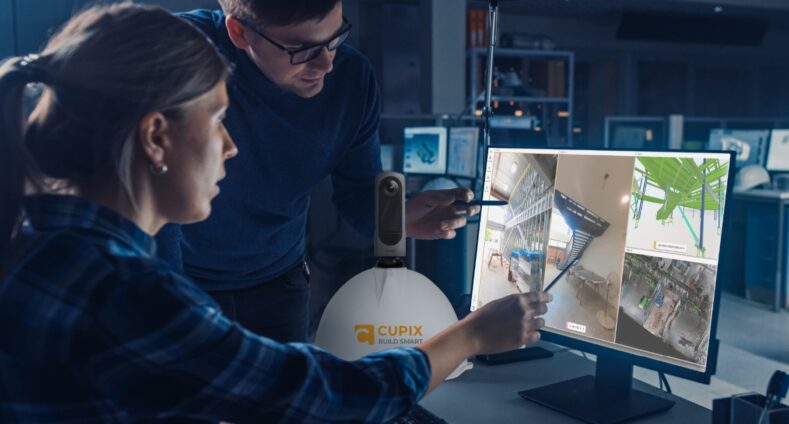
"Compass," scheduled for release this year, promises to change the paradigm of field management. Previously, site managers or supervisors had to walk through drawings and sites, looking for problems. "Compass's analysis is presented in a format understandable by ChatGPT, Google Gemini, and Claude," he explained. "Field managers can ask natural language questions using their preferred AI app and receive immediate answers."
For example, when asked, "Show me the areas where concrete was poured last week and check for quality issues," AI synthesizes all relevant data and provides a visual response. This reduces the project manager's documentation burden, automates comparisons of construction status against design intent, and enables real-time analysis of progress against schedule and causes of delays.
Cupix generates over 95% of its revenue overseas, with North America, Australia, and Europe being its key markets. Conservative global construction companies chose Cupix for three main reasons: proven technology, enterprise-level reliability, and continuous innovation.

"We work with more than 15 of the world's top 20 construction companies, and our solution has been deployed in nearly 150,000 sites across 30 countries. It's a commercially available solution with proven effectiveness, having been used for years on large-scale projects."
Built on AWS infrastructure, it boasts over 99.9% reliability and meets all the security and regulatory requirements demanded by global corporations, including ISO 27001, CSA STAR, US SOC 2 Type II certification, and GDPR compliance. The brand's global presence is no longer that of an "innovative Korean startup," but rather a "global standard for construction space information."
CEO Bae leads the Korea Proptech Forum, encouraging the industry to shift from "rapid expansion" to "sustainable value creation."
"Over the past decade, the proptech market has grown primarily through brokerage platforms and data aggregation. However, it has become overly reliant on the domestic market and government policies, ultimately revealing the limits of independent growth."
The future he envisions is a world where 'technology to understand space becomes a standard part of everyday life.'
"We take it for granted that we can use our smartphones to look at maps, order food, and call taxis. Soon, 'spatial intelligence' will become just as common."
When searching for a home, simply input your abstract criteria (1 billion won, two elementary school students, a one-hour commute to a Gangnam-based company). AI will find the optimal home, considering the interior condition, location, transportation, investment value, loan availability, and budget requirements of all available homes. It will digitally review hundreds of properties in an instant and generate a proposal.
During remodeling, analysis of past years' customer traffic, space utilization, environmental quality, and construction costs will automatically design for optimal customer experience and maximum sales. For plants, spatial intelligence will assist in detecting quality issues like water leaks and rust, predicting equipment failures for preemptive maintenance, proactively responding to sensor-based risk predictions, and optimizing worker movement.
Finally, he said he hopes Cupix's technology will be remembered as a company that achieved the 'democratization of space.'
"We're a company that enables anyone, anywhere, at a low cost to understand and utilize space digitally. We want to be remembered as a company that has contributed to increasing productivity in the construction industry, making buildings safer and more sustainable, and ultimately, enhancing people's quality of life."
You must be logged in to post a comment.