



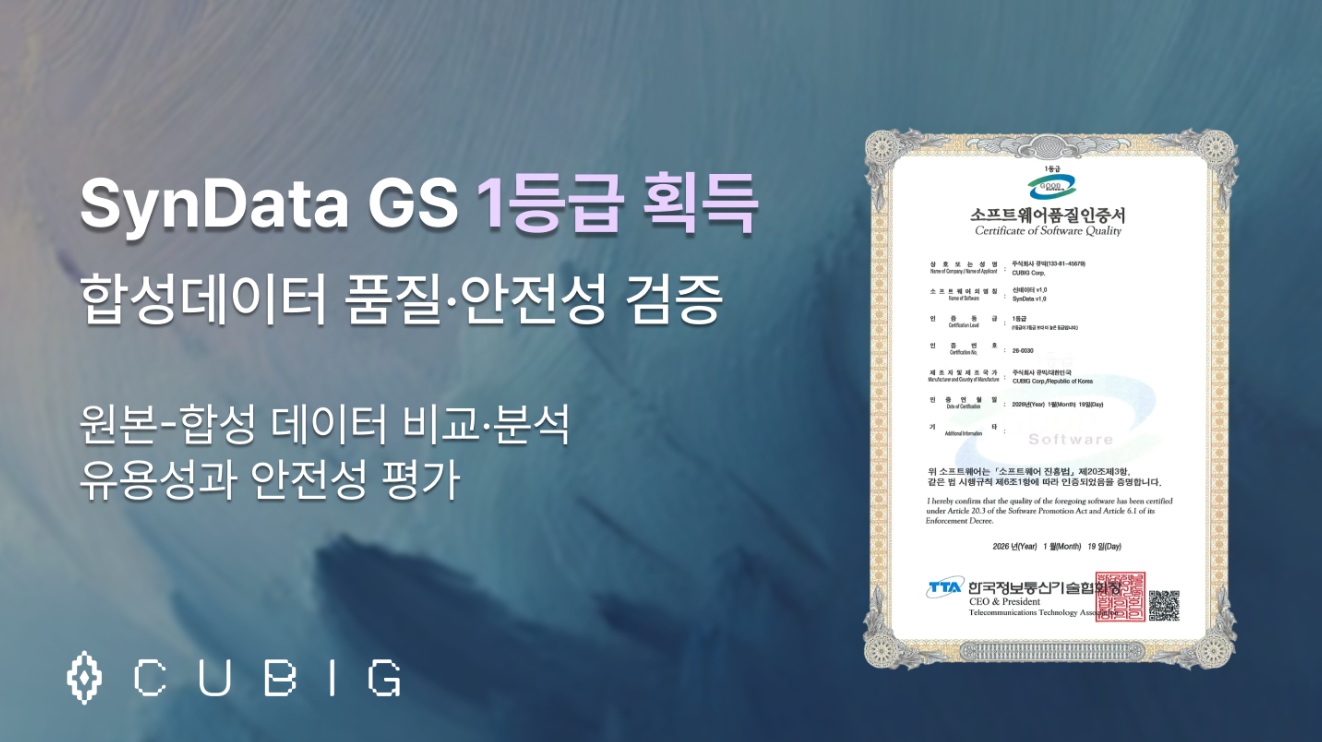
Cubic, a data utilization infrastructure company, announced that its synthetic data quality and safety verification program 'SynData v1.0' has received GS Grade 1 certification.
With the recent expansion of sensitive data in areas such as public, financial, and medical information, the use of synthetic data is on the rise as an alternative to protecting personal information. However, due to a lack of objective verification of the usability and risk of re-identification of synthetic data, its use has been limited during data disclosure and AI training. SynData is a solution focused on addressing this verification gap.
SynData automatically analyzes user-generated synthetic data and assesses its quality and security based on key indicators such as distributional similarity with the original data, statistical consistency, and privacy protection level. Beyond providing a single score, SynData is designed to identify potential quality degradation or privacy risks in specific sections through threshold-based interpretation and class-level analysis.
Furthermore, considering public and regulated industry environments, we adopted a standalone architecture that operates on a single client without external server connections. After uploading original and synthetic data, verification is possible simply by selecting label columns. Automatic column classification and search/filter functions support efficient verification even on large-scale data sets. Verification results are generated in file format for reporting and sharing.
Cubic explained that SynData simultaneously demonstrates the utility and safety of synthetic data, serving as a verification system that supports decision-making in data openness, AI learning, and external collaboration. GS certification is a national system that verifies software quality and serves as a key trust indicator when introduced into the public sector.
Cubic plans to use this GS Grade 1 certification as an opportunity to promote the expansion of standard processes spanning synthetic data creation, verification, and utilization across sensitive data industries, including the public, financial, medical, and manufacturing sectors.
- See more related articles
You must be logged in to post a comment.