



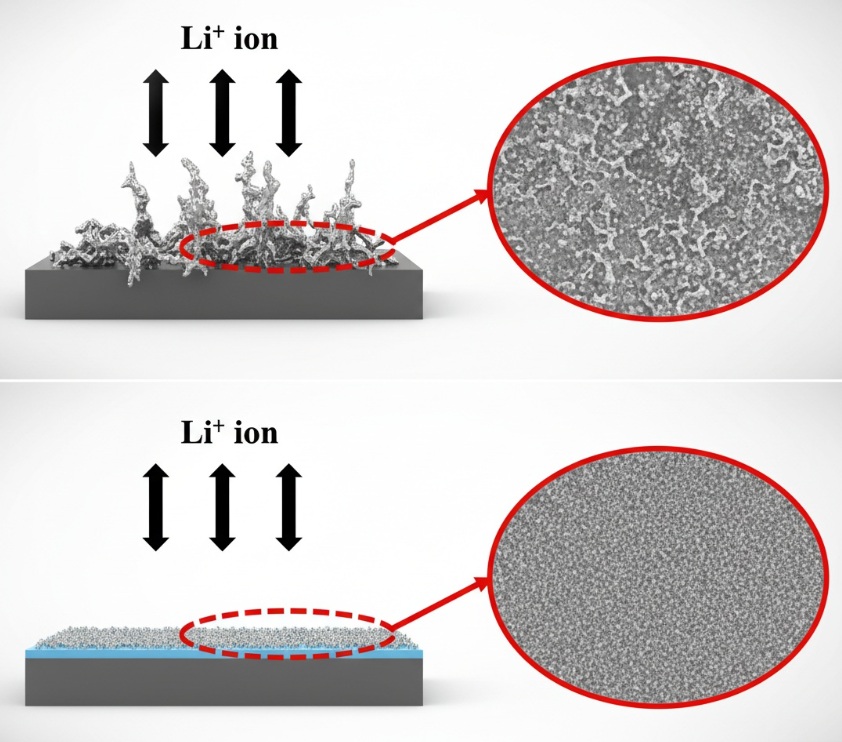
IL, a full-stack future mobility platform company, announced on the 30th that it has completed patent registration for a core technology for dendrite suppression that can dramatically improve the lifespan and stability of lithium metal batteries.
The newly registered patent, titled "Anode for a Lithium Secondary Battery Including a Protective Layer, Manufacturing Method Thereof, and a Lithium Secondary Battery Including the Same," describes a technology that effectively suppresses the uneven growth of dendrites in lithium metal anodes by utilizing lithium transition metal oxides. This technology is considered a fundamental technology that can simultaneously address the safety, lifespan, and reliability issues of next-generation lithium metal-based batteries.
Lithium metal is considered the ultimate anode material, offering high energy density. However, the risk of internal short circuits and fire due to dendrites generated during charge and discharge has been identified as a major obstacle to commercialization. Through this patented technology, IL has improved electrochemical stability by forming a functional protective layer on the surface of the copper current collector and inducing uniform lithium deposition.
In particular, the technology can be applied to the next-generation mobility market that requires high output and high stability, such as all-solid-state batteries, humanoid robots, and drones, and is expected to strengthen the technological competitiveness of the small-scale all-solid-state battery business that IL is pursuing.
"This patent presents a technical solution to the dendrite problem, which has been considered the most fundamental risk in the commercialization of lithium metal batteries," said Jae-Hwan Ko, Head of IL's Battery R&D Center. "IL is gradually perfecting practical battery technology." He added, "Within our future mobility platform strategy, which expands into the automotive, robotics, and energy sectors, this patent will become a core asset for our next-generation battery technology."
- See more related articles
You must be logged in to post a comment.