



On the day of the 2007 lightning strike on Mt. Bukhan, CEO Myung Gwang-min knew the intensity of the lightning strike was approaching the area. However, he had no way to relay that information to those nearby when it was needed. The Korea Meteorological Administration operates approximately 700 observation stations nationwide, spaced 5 to 15 kilometers apart on average. This makes it difficult to detect events concentrated in a short period of time and over a narrow area, such as localized heavy rain.
DI Lab establishes a direct monitoring network at customer sites and quickly identifies risks with AI forecasts every 5 to 10 minutes. Furthermore, it provides 24-hour information on whether the plant can be operated or suspended, based on each customer's operational suspension criteria.
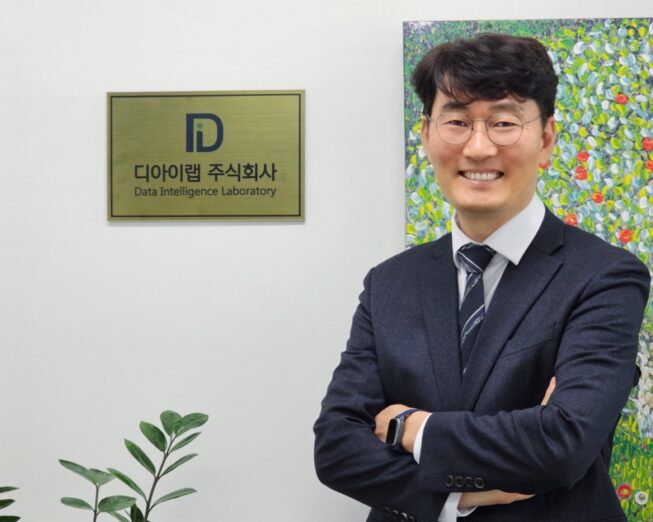
Myung Gwang-min, CEO of DI Lab, is South Korea's first weather forecaster. He has worked in the Air Force and private companies, handling a wide range of data. While serving as an Air Force meteorological officer in 2007, a lightning strike on Mt. Bukhan changed his life.
"While working in weather forecasting, I experienced how flawed the existing system was in responding to civilian weather risks. At the time, I was tasked with identifying the intensity of lightning approaching the Bukhansan area and relaying warnings to the relevant units. However, I was frustrated by the structural limitations that prevented me from conveying that information to civilians hiking."
A question lingered in my mind at that time: "The forecast was right, but why couldn't we prevent the accident?" DI Lab's "Data Intelligence" philosophy stemmed from this question.
Representative Myung stated, "The problem isn't the accuracy of the forecasts, but rather the structure that prevents forecasts from leading to actual decisions and actions." He added, "The gap becomes clear when looking at actual industrial settings. Some companies must halt operations even with just 1mm of rain, while others are fine with up to 20mm. Yet, existing weather services fail to account for these differences, delivering the same information to everyone."
From the beginning, DI Lab has focused on data that transforms decision-making, not on "better forecasts." Therefore, we define the threshold at which each industry and field actually becomes dangerous, and focus our forecasting resources on the specific time and point just before it is surpassed.
Currently, the Korea Meteorological Administration provides nationwide weather information at intervals of 5 to 15 kilometers. This is effective for wide-ranging phenomena like typhoons and monsoon rains. However, it has limitations in detecting localized heavy rain.
Representative Myung, who likened it to “trying to catch small fish with a big net,” criticized, “Because of these data limitations, accidents like the Gangnam Station flooding are repeated, only to be discovered after they have already happened.”
Looking at the broader observation area, precipitation observation data from approximately 3,400 locations, including local governments and public institutions, theoretically allows for much more granular observations. However, CEO Myeong stated, "The problem is data reliability," adding, "The average normal data rate from these observation stations is around 86%, and errors and missing data are frequent, limiting practical application." This is due to the frequent rotation of personnel and the administrative structure, which makes it difficult to devote sufficient expertise and time to equipment management and data review.
The costs are also significant. According to the Korea Meteorological Administration's 2026 equipment purchase plan, the budget for purchasing 24 meteorological observation devices for disaster prevention is 1.08 billion won. Each device costs approximately 45 million won. Maintenance service data shows that approximately 3.99 billion won has been allocated for two years to manage 709 observatories nationwide, or approximately 2.81 million won per station per year.
"If this observation network were rebuilt on a large scale and standardized using civilian technology, we believe we could reduce installation costs by a fifth and maintenance costs by half."
We are confident that we can install many more observatories with the same budget and manage them more closely.
"When our anomaly detection technology is added to this, we can secure high-quality data from the data collected from a dense observation network."
Representative Myung calls this "climate MRI." Just as diseases require precise diagnosis using MRI to be properly treated, recent climate anomalies require precise diagnosis using a dense observation network like MRI to properly prepare for them.
In reality, there are many cases where damage was extensive due to localized heavy rain because it was not clear exactly “how hard it was raining in a short period of time.”
The Seoul Metropolitan Government has invested approximately 1.4 trillion won in expanding flood prevention facilities in 33 flood-prone areas around Gangnam Station. If just 1% of this amount had been invested in securing detailed observation data in advance, wouldn't a significant portion of the damage have been prevented?
DI Lab first establishes a direct observation network at customer locations to accurately measure localized heavy rainfall. If the observation station is far from a customer's solar power plant or logistics center, the difference in observed rainfall can be 50-100%, or even more than 500% in severe cases. Furthermore, AI and platform technology rapidly collect, analyze, and predict data to minimize information lag. Weather forecasts become more volatile and less accurate the longer the forecast period, so minimizing lag improves forecast accuracy.
The next step is to quickly produce and update AI forecasts every 5 to 10 minutes.
“We can quickly identify risks by predicting where new heavy rain is developing and where areas of heavy precipitation are moving within 10 minutes.”
Finally, the impact of this analyzed and predicted weather information on clients is precisely analyzed and used to inform decision-making. For example, if 85mm of rain is expected over a three-hour period, Client A is informed that the plant will be operational, as the forecast falls below the 100mm/3-hour threshold. Client B, on the other hand, is informed that the plant will be shut down, as the forecast falls below the 60mm/3-hour threshold.
 .
.
DI Lab's strategy is to collect 'decision-making data' that can only be obtained in the field, combine it with weather data, and reconstruct it into industry-specific thresholds and cost functions. We regularly meet with our clients to ask them about which weather factors determine profit and loss in each industry, what values cause processes to halt, and who makes these decisions and under what time pressures. The most crucial element for domain convergence is understanding the customer's domain.
Ultimately, DI Lab's domain convergence involves learning the decision-making structure of an industry through data, thereby transforming weather forecasts into direct actionable guidance. This is why DI Lab can function as a decision-making engine, not just a forecasting model.
DI Lab's advantage in the global market is clear.
"Because large investments require large returns, Western solutions have no choice but to focus on large markets with high prices. Consequently, they are primarily developed as general-purpose services focused on developed markets."
Meanwhile, DI Lab reflects the unique characteristics of Korea, Asia, and developing countries. CEO Myung explained, "We have a model that can operate even in developing countries with incomplete data, using IoT sensing and anomaly detection technologies." He added, "We are also providing capacity-building services to address the challenges of data infrastructure and technical talent shortages in developing countries."
The company is currently working with Professor Moon Yong-jae's research team at Kyung Hee University to apply generative AI technology to geostationary satellite data to produce precipitation information more than twice as accurate as existing data. He added, "This technology is being used for early warning, water management, and agriculture in areas where observational data is scarce, such as Pacific island nations, Central Asia, and Africa."
The reason DI Lab aims to become a climate risk management company is clear. "The biggest challenge facing companies in the era of climate crisis is not the weather itself, but the uncertainty of when, where, and how their assets will suffer losses."
DI Lab's "Climate MRI" can be easily understood by comparing it to a medical system. If general weather information is like an X-ray, "Climate MRI" is like an MRI that precisely diagnoses an asset's climate vulnerability. It analyzes each asset, determining at what millimeters per hour a factory begins to flood and at what point the facility becomes most at risk.
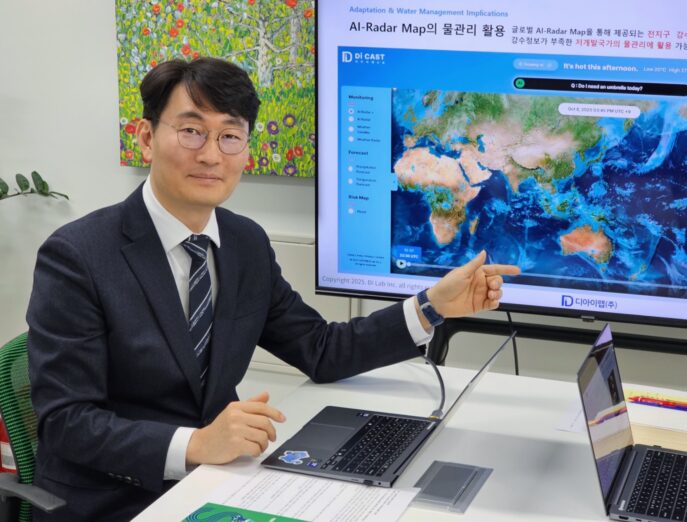
Finally, I asked him about his vision. CEO Myung envisioned a world where "our solutions become part of everyday life," and expressed his dream of "a future where hyper-personalized climate intelligence information is utilized not only for weather risk management and business purposes, but also for personal health management, sleep, coordination, and leisure."
You must be logged in to post a comment.