


Have you ever seen a solar power plant? The vast expanse of silver panels spread across fields and hillsides looks impressive. However, building such a power plant requires massive infrastructure construction. It's a capital-intensive project, requiring a significant investment of money and manpower.
A small startup called H Energy has set out to change the structure of the solar energy industry. It has grown to the point where annual sales are expected to exceed 100 billion won by 2024. How has H Energy become a significant player in the energy market?
First, I asked CEO Ham Il-han about his thoughts on the energy market.
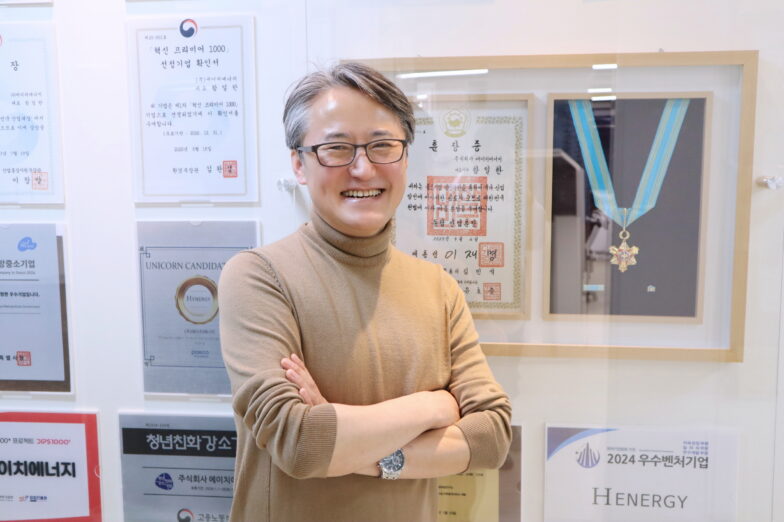
Q. The solar energy industry is a capital-intensive industry, so it's not something that just anyone can do. How did H Energy get into this industry ?
"We've redefined the solar industry from the ground up. If the existing solar industry is like running a large hotel, H Energy is like Airbnb, operating tens of thousands of rooms spread across the country. While running a large hotel isn't something anyone can do, anyone with IT skills can create a platform business like Airbnb."
Q. How was this business possible even though you are not an electrical expert ?
"Just by entering an address, we can find idle roofs for solar power plants and automatically generate a design plan. Even small-scale construction companies can build them. We recruit investors to invest in the designed power plants, operate them at peak efficiency, and sell the generated electricity to businesses. We've automated and standardized the entire process, from roof excavation to profit distribution, integrating each previously fragmented step. All of this is possible, even without a basic understanding of electricity, thanks to IT technology."
For more information, see ' The Present and Future of the Energy Sharing Economy Built by H Energy ' (Source: Venture Square, January 27, 2026).
H Energy viewed the solar energy industry as a platform industry, not an infrastructure industry. This redefined the problem. By redefining the problem this way, the task at hand became clearer.
Let 's change the ownership and distribution structure of energy .
H Energy's mission is to "change the structure of energy ownership and distribution." While the existing energy market focused on maximizing energy production with large capital, H Energy took a different approach. It opened the door to participation in the energy market, allowing anyone, regardless of their size or financial resources, whether small businesses or individuals. This shifted the structure of the energy market, where a small number of companies with large investments monopolized profits, and created a shared economy ecosystem where everyone can share in the profits.
If you have solar panels on the roof of your home, the electricity generated there is traded through H Energy's platform. You could be an investor, a building owner renting out your roof, or an individual investor receiving dividends from the profits. Your company building also has solar panels. H Energy manages and operates the power plant there. Individuals and companies are no longer mere consumers, but rather play a complex role as investors, producers, and traders. Ultimately, what H Energy is creating is not simply a "solar power platform," but the democratization of the energy industry. Until now, electricity trading has been dominated by large-scale power plants, large corporations, and governments, but on H Energy's platform, small merchants, ordinary citizens, and even apartment dwellers become players in the energy market. It's a world where anyone can invest, produce, and trade.
H Energy is a 180-person organization that is doubling in size every year. So, I was curious about how H Energy works.
Focus on the problem and fail fast .
H Energy's core value, which aims to revolutionize this market by competing with the existing infrastructure industry, is "Focus on the problem and fail fast."
“You have to fail hundreds of times in one night to succeed.”
Planning a project in the abstract, launching it a few months later, only to find customers unresponsive is a death sentence for a startup. It's crucial to immediately set a goal, take action, and identify and resolve issues along the way. So, how can we achieve rapid implementation?
Strategy comes from giving up.
Rather than asking, "What should I do?", I start by thinking, "What do I have to give up to achieve this goal?" Set an unattainable goal, then constantly ask yourself what you can give up right now to achieve it. This is because time and resources are finite. To stay focused, you must first consider what you can give up."
The birth of the service "SolarShare" stemmed from this very question. Conventional methods would have required perfection in every aspect of solar installation: precise design, rigorous testing, and expert electrical design consulting. If we had to perfect all of this, we wouldn't have been able to get started. To fail quickly, it's crucial to give up what needs to be given up and get started. When we launched SolarShare, we sacrificed accuracy. Even if we improved accuracy, it would still be problematic, but we gave up accuracy from the start? You're right.
SolarShare is a platform that finds idle space for solar installation. Simply enter the address of your roof, and it automatically generates an electrical design using Naver Maps, satellite photos, and a Large Language Model (LLM). Of course, it's not perfect. If the error rate is 10%, meaning 10 out of 100 errors are made, how can we overcome this problem? Trying to achieve 100% accuracy right away is too late. Solving the 90 problems that are currently possible and figuring out how to handle the remaining 10 simplifies the problem. Ninety out of 100 can be solved with technology, so start with those first, and then find solutions for the remaining 10. Surprisingly, solutions are often straightforward. Safety inspections are no exception. Traditionally, safety inspections in the electrical industry are conducted by people visiting each site. However, H Energy uses data to diagnose first. While the accuracy is lower than a human diagnosis, we can quickly implement the data-driven approach by prioritizing what data can do and only allocating human resources to areas where data is not feasible.
If you strive for perfection because you want to do well, you'll often end up failing at anything. In those moments, it's important to boldly give up what you can't do, focus on what you can, and get things done quickly. Then, the remaining problems will often be easier to solve than you might think.
A person who learns quickly and fails quickly
H Energy has a lot of team leaders in their 20s. There's a reason for that. They prefer people who can learn quickly and fail quickly. I'd have a hard time working at H Energy.
New employee onboarding lasts three months, and the key criterion for success is "change." Change encompasses both success and failure. We prioritize the process of rapid learning and problem-solving.
Building a sharing economy ecosystem for energy
What is H Energy's ultimate goal of creating a world where everyone can become an energy investor, produce energy, and consume energy?
When H Energy's platform becomes a reality, our daily lives will fundamentally change. First, individuals will become owners of their own energy assets. Electric vehicle owners will generate profits by selling the electricity they charged during the day at night, and personal solar power plants will be traded as investment assets, much like real estate, enabling substantial asset growth. Furthermore, the barriers to entry for investment will be lowered. Energy businesses that previously required massive capital will become accessible with small amounts of money, and the emergence of electricity futures and options markets will allow anyone to become an energy investor. Most importantly, the center of the local economy will shift. Electric vehicle charging stations will go beyond mere energy suppliers and become central to the local economy by linking them to local currencies, facilitating real-time energy transactions with neighbors. Ultimately, the world H Energy is creating will be a shared economy ecosystem where energy production and consumption are democratized, everyone becomes a leader in the energy market, and everyone shares in the profits.
You must be logged in to post a comment.