



– Ranked 2nd globally for models with less than 1 billion parameters in the global search benchmark RTEB
– Developed our own multilingual aerospace domain -specific search benchmark, ' Stella '
TelePIX (CEO Seongik Cho), a comprehensive space AI solution company, announced on the 3rd that its AI (artificial intelligence) model 'PIXIE-v1.0', which accurately searches aerospace technical documents, ranked high in a global performance evaluation.
PIXIE 1.0 is an aerospace domain-specific information retrieval model designed to enable semantic-based searches of highly specialized technical documents in areas such as aerospace, satellite, and defense. It is designed to facilitate natural language query searching of vast aerospace technical documents, including satellite design documents, technical specifications, and operation manuals. Developed to enhance the performance of SatCHAT, an agent AI solution for satellites, PIXIE 1.0, following the previously released PIXIE-Preview, focuses on quantitatively verifying domain-specific search performance.
This model recently ranked second globally in the Retrieval Embedding Benchmark (RTEB), a global search benchmark released through the Hugging Face platform, in the model category with fewer than 1 billion parameters. This category includes numerous embedding models released by global big tech companies and research institutes.
RTEB is a next-generation search benchmark that extends the Massive Text Embedding Benchmark (MTEB), the existing standard for evaluating embedding models. Rather than focusing on test data-driven score competition, it focuses on evaluating AI model information retrieval performance in real-world industrial environments. It can verify the practical industrial applicability of models based on high-difficulty domains such as law, finance, medicine, and code.
While most models, including the top model in the sector, are general-purpose models that cover multiple domains such as law, finance, medicine, and code, Telefix's Pixie 1.0 achieved top global performance despite focusing on the aerospace domain and Korean-English technical documents.
The company stated that these results demonstrate that high search performance can be achieved simply through domain-specific data refinement and improved learning quality, rather than simply expanding the model's scale. In particular, the company explained that semantic-based search performed reliably even in aerospace document environments rife with technical terminology and abbreviations, confirming its potential for industrial application.
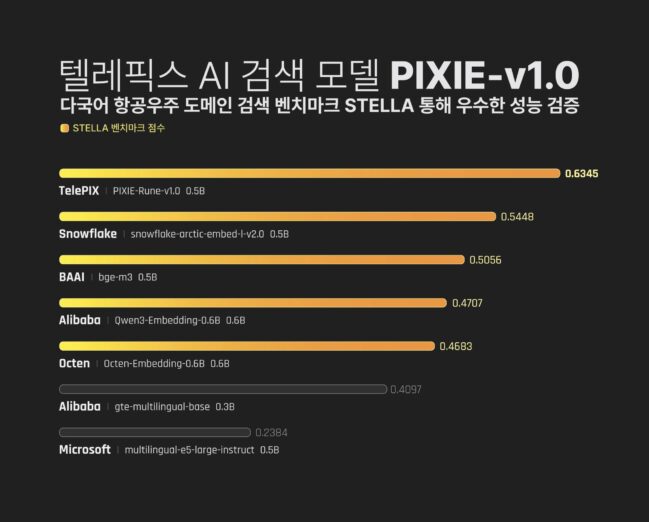
Furthermore, Telepix conducted an additional evaluation using its own search benchmark, "STELLA," to verify the search performance of multilingual aerospace domains, including Korean, which are not directly covered by RTEB. The results confirmed that Pixie 1.0 demonstrated excellent search accuracy relative to its parameter scale and had stably secured language- and domain-specific search capabilities. STELLA is a multilingual information retrieval benchmark built on specialized aerospace documents, and was designed to complement the practical limitations of the almost complete absence of public search evaluation criteria specific to the aerospace domain.
Telepix has released Pixie 1.0 as open source and expects it to be utilized as a core model for specialized technical document retrieval in AI systems based on Retrieval-Augmented Generation (RAG).
Telepix Kwon Darong-sae, Head of Data Science, said, “Pixie 1.0, which was released this time, maintained the direction presented in the preview stage, but focused on more stably improving the aerospace domain search performance, and achieved excellent results in the performance evaluation. We expect that Pixie and Stella will be used as basic data for future domain-specific information retrieval research and actual applications.” He added, “As an AI hardware and software integrated solution company specialized in the space domain, Telepix plans to focus on improving AI models and solutions that can be usefully utilized in the actual satellite industry.”
You must be logged in to post a comment.