



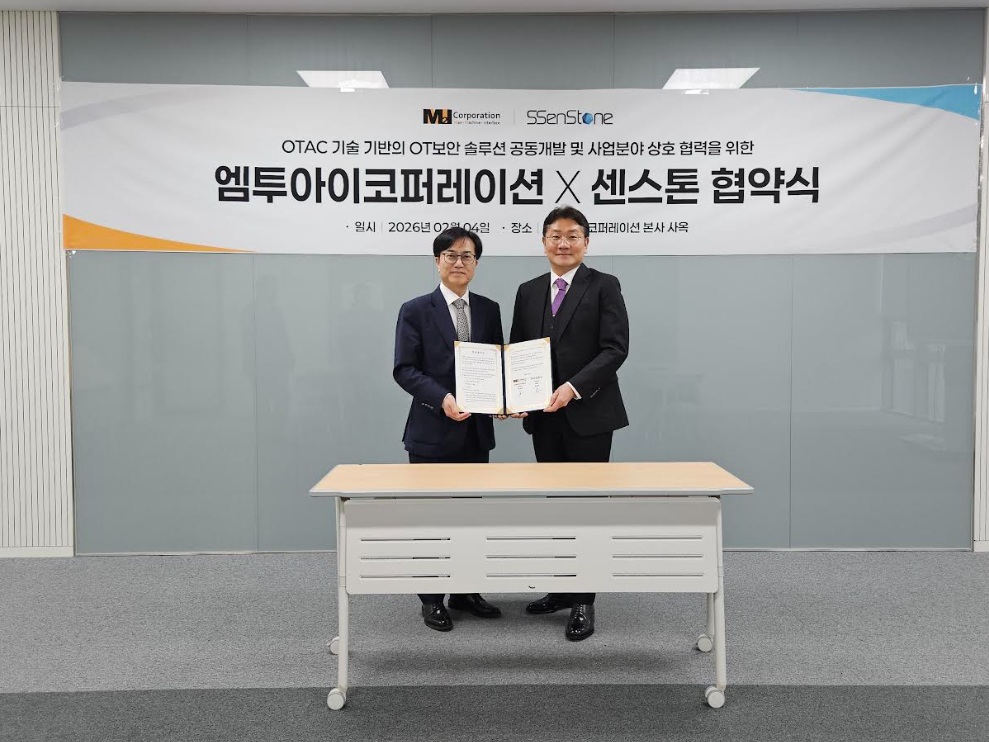
M2I announced on the 4th that it has signed a memorandum of understanding (MOU) with industrial security specialist Senstone for cooperation on industrial security solutions.
Through this agreement, the two companies plan to apply Senstone's OTAC (One-Time Authentication Code) solution to M2I's industrial gateway products, jointly develop industrial (OT) security solutions based on OTAC technology, prioritize cooperation in project acquisition, and pursue joint marketing.
The collaboration between the two companies is already yielding tangible results. M2I has developed the OTAC Gateway, which enables OTAC authentication solutions to be applied to legacy systems like PLCs and HMIs without requiring any modifications. Building on this, M2I is jointly supplying the OTAC Trust Access Gateway (TAG), an OT endpoint identification and authentication solution, with Senstone. The product is scheduled to be available to public enterprises in the first quarter of this year.
Senstone possesses endpoint-centric security technology that directly identifies and authenticates users and terminals at the point of connection in industrial OT environments. Through an authentication structure that can be applied without changing legacy settings, it controls access risks arising during remote and on-site access from a zero-trust perspective. Its core technology, OTAC, enables one-way authentication without real-time communication with the server and has secured numerous global patents.
An M2I representative explained that implementing an AI autonomous manufacturing environment requires an organic integration of automation equipment, robots, controllers, and AI technology. They added that they have been building a total smart factory solution and AI collaboration system through investments and acquisitions in robotics and logistics automation companies, as well as external collaborations. They added that an unsecured autonomous manufacturing environment can lead to risks, and that this collaboration will strengthen the security reliability of the entire process and enhance the competitiveness of AI autonomous manufacturing.
You must be logged in to post a comment.