



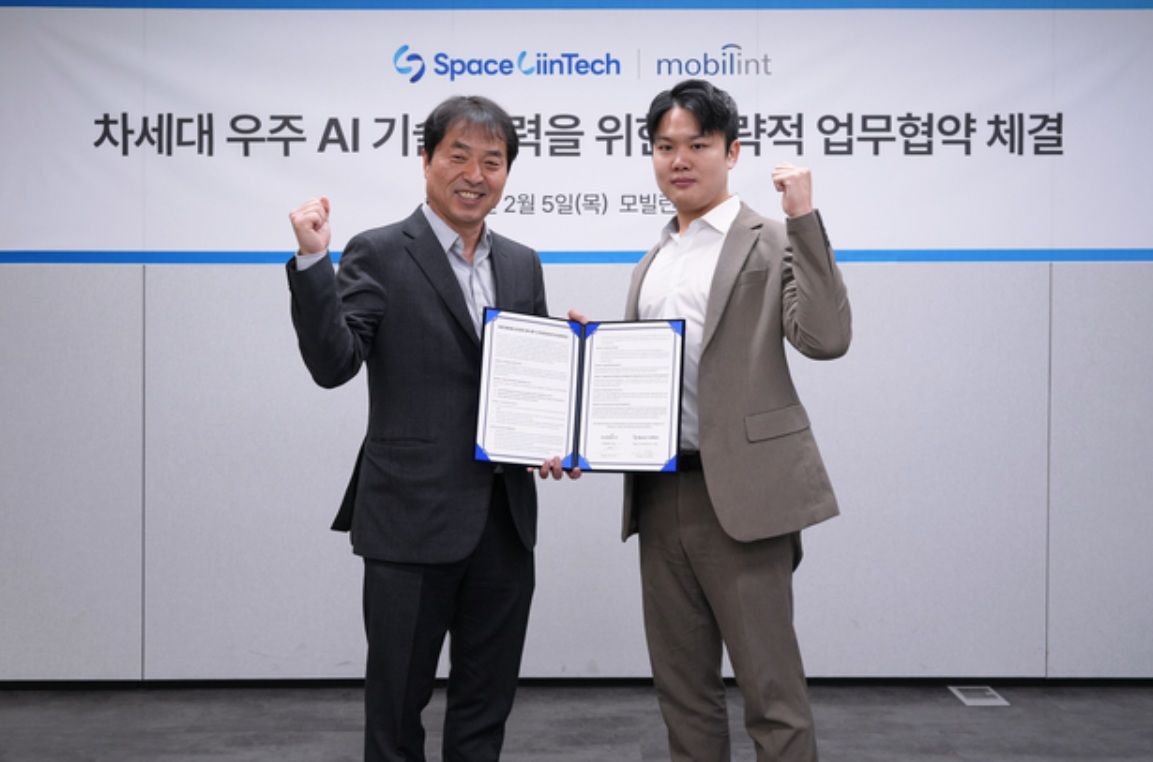
Space LiinTech (CEO Hak-soon Yoon), a space pharmaceutical company, announced on the 6th that it has signed a memorandum of understanding (MOU) with AI semiconductor company Mobilint and will collaborate to jointly develop AI-based space payloads and advance high-performance, low-power AI semiconductor solutions optimized for the space environment.
This agreement aims to strengthen cooperation and partnership across the space industry, leveraging each company's core technologies and capabilities. The two companies plan to jointly develop AI space payloads utilizing Mobilint's Neural Processing Unit (NPU) and optimize high-performance, low-power AI semiconductor solutions that can operate reliably in space environments. Furthermore, they plan to expand the scope of their collaboration to various space-related applications and establish a long-term collaborative system centered on technology development and validation.
SpaceLintec has been developing experimental platforms and payload technologies to automate pharmaceutical experiments in space environments. Recently, it has expanded its validation scope with a next-generation space pharmaceutical experiment module utilizing AI technology. The company expects this agreement to strengthen the data processing, monitoring, and autonomous operation capabilities of its AI-based payloads, thereby enhancing the efficiency and reliability of space experiment operations.
Mobilint possesses NPU-based semiconductor solutions optimized for edge AI environments. Based on its high-performance, low-power AI computing technology, it is expanding its application across various industries. The two companies plan to jointly address the technical requirements for implementing AI computing within the constraints of power, heat, and communication in space environments, and to gradually verify its practical applicability within the space industry.
Yoon Hak-soon, CEO of Spacelintech, mentioned the characteristics of the space experiment field that requires high automation and reliability in a limited resource environment, and announced that they will pursue joint development of AI-based space payloads by combining with Mobilint's NPU technology and aim to expand into a next-generation space bio research platform. Shin Dong-joo, CEO of Mobilint, said that since AI computation in a space environment is a high-level technical area, they will establish application cases in the space industry through this collaboration and expand the scope of utilization of AI semiconductor solutions.
Meanwhile, Spacelintech has accumulated experience operating automated protein crystallization experiments by conducting a demonstration of its space medicine research module, "BEE-PC1," on the International Space Station (ISS). Following this, it established a satellite-based protein medicine crystallization research system with the launch of its space bio research satellite, "BEE-1000." The company has designated this year as the first year of AI-based space medicine and plans to focus on enhancing process stability and reproducibility in microgravity environments through its space experiment module, which utilizes AI technology.
You must be logged in to post a comment.