



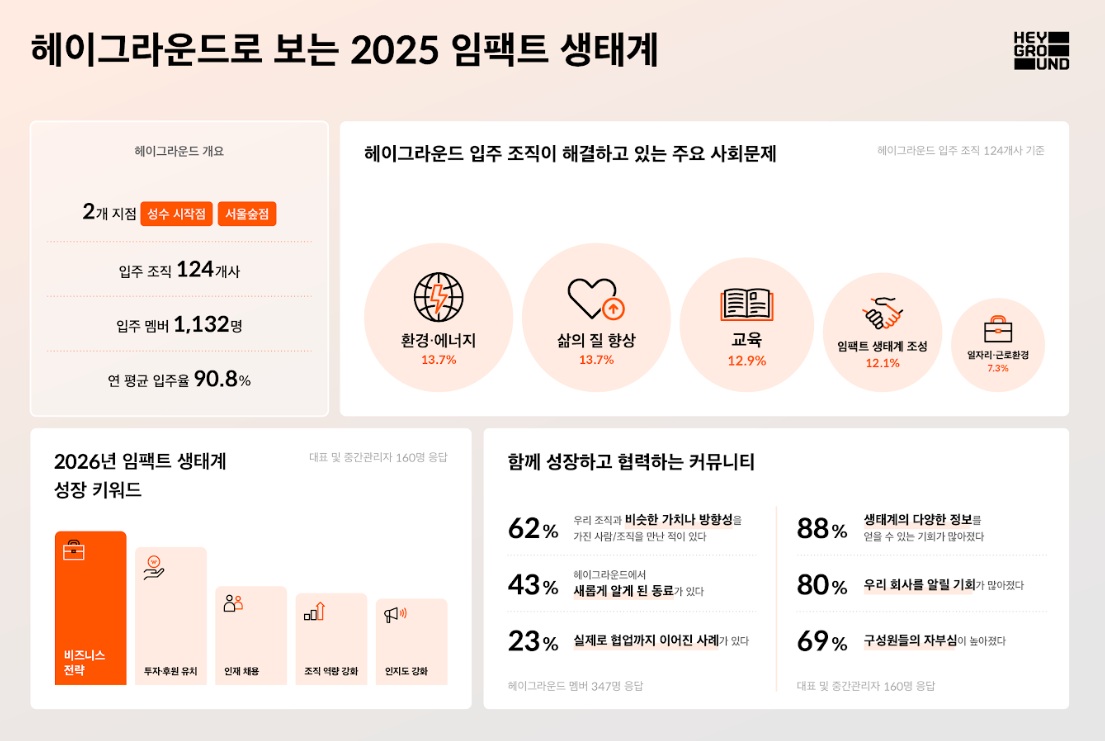
Heyground, the Seongsu-dong Impact Community Office, announced the results of its "2025 Impact Ecosystem Survey" on the 9th. The survey targeted 1,132 employees from 124 companies, including social ventures and non-profit organizations, located at Heyground, to understand their current activities and future prospects.
The survey results showed that the primary areas of activity for Heyground's resident organizations were environment/energy and quality of life improvement, each accounting for 13.7 percent (17 companies) of the total, recording the highest proportion. Education followed with 12.9 percent (16 companies).
This is interpreted as a reflection of the demand for climate crisis response and carbon neutrality, as well as the growing interest in improving citizens' quality of life and narrowing the educational gap amidst structural changes in society, such as low birth rates and an aging population. Furthermore, impact organizations active in diverse areas, such as job creation and ecosystem development, have also moved into the complex.
Key resident organizations include Climate Solutions, a non-profit organization that conducts climate policy research and legal activities; Root Energy, a regional energy transition platform; Sixty Hertz, a social venture that supports the expansion of renewable energy; Enuma, a global edtech company that develops AI-based educational software; and Future School, which operates the knowledge business platform Live Class.
Meanwhile, in a separate survey of 160 executives and mid-level managers, resident members cited refining business strategy as their top management priority for 2026. This is interpreted as reflecting the need to establish self-sustaining revenue models and operational systems amidst increasing uncertainty in the external environment.
In addition to establishing a business strategy, attracting investment and sponsorship, recruiting talent, and strengthening organizational capabilities were also identified as key challenges. The resident organizations appeared to be focusing on securing a stable foundation for growth.
A majority of respondents also stated that Heyground's community environment was beneficial to their organizational operations. Eighty-eight percent of respondents said that since moving in, they had increased access to information about the ecosystem. They also experienced positive effects, including increased public awareness (80 percent) and enhanced pride among team members (69 percent).
Through 2025, Heyground supported the professional development of 60 organizations and 149 individuals through a skills-up program designed to enhance their job competencies. Furthermore, Heyground Bricks, the event space, hosted an average of two events daily, expanding interaction between resident organizations and the external ecosystem.
In addition, Heyground is also used as a hub for domestic and international policy and global exchange. Since its opening, it has hosted meetings of the Presidential Committee on Job Creation and government meetings, and has become a space for sharing insights into social innovation, attracting royal dignitaries from overseas and representatives from global organizations.
“For impact organizations, the community is a core infrastructure for growth beyond exchange,” said Go Ji-hye, team leader of Heyground. “We will continue to serve as the hub of the impact ecosystem to ensure that collaboration among resident organizations leads to tangible results.”
You must be logged in to post a comment.