



There's a company that helps freelancers, riders, part-time workers, and multi-jobbers with their tax refunds, much like employees of large corporations file their year-end tax returns. As of July 2025, Jobis&Villains boasts 24 million cumulative subscribers, has reported over 2 trillion won in refunds, and currently offers "Samjjeomsam," a service used by 80% of the economically active population.
Jobis&Villains accelerated its business diversification throughout 2025. Following the establishment of the lucky tech platform "Luckyz" as a subsidiary and the launch of the premium financial education platform "Samjjeomsam Campus," the company expanded its reach by acquiring "BLQ," a used phone purchase and refund service provider, and "MicroProtect," an insurtech company specializing in property insurance.
I'm excited to see how this new service will help me find all my hidden money. So, how do these "villains" work? And why do they call themselves "villains"?

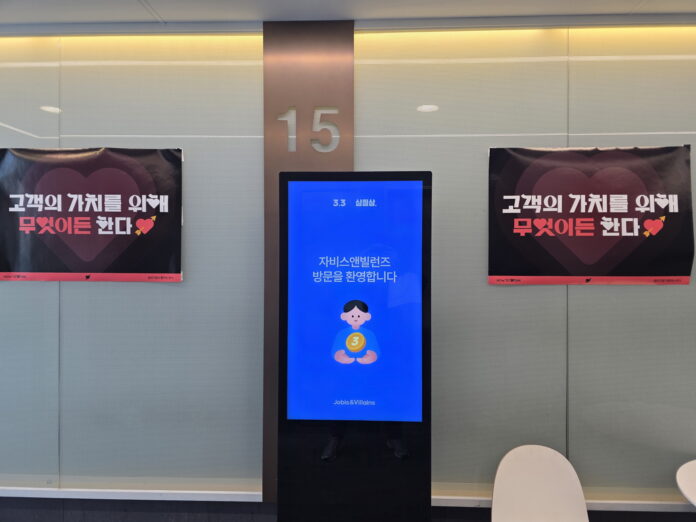
We do whatever it takes to provide value to our customers .
The mission clearly captures our core values. Jarvis is a reference to the AI assistant "Jarvis" from the film "Iron Man." He perfectly obeys every command and works tirelessly behind the scenes to support his master, symbolizing our core value of "doing whatever it takes to ensure customer value."
Villains are bad guys. Iron Man features many villains. And you don't have to look far; there are plenty of them in the workplace, too. These are people who cause stress to coworkers and negatively impact the healthy organizational culture. Eight out of ten office workers believe they have an office villain. But Jobis&Villains calls itself a villain. Why, of all people, do they call themselves a villain?
"Villains aren't noble. They get their hands dirty and don't shy away from dirty work. The same goes for CEOs and leaders. If it's for the customer's benefit, they have to put aside all nobility and dignity and do whatever it takes."
It would be really helpful to have a villain like this.
Being a villain also has another meaning. It means being a supporting actor who thoroughly supports the customer as the protagonist. Good movies have great villains who highlight the protagonist. A great villain can also determine a film's success.
It's true that customers are the most important entity. A company exists because of its customers. When introducing a company, we always start by explaining who the customer is and what problems they face. However, not many companies adhere to this obvious principle.
"Putting the customer first is a given. However, when it comes to putting it into practice, we encounter many obstacles. Maintaining this value is harder than you might think."
The most appealing slogans are the most common, but I'm not sure they're the most difficult to execute.
Finding core values from grown people
Jobis&Villains' core value of 'filling and sharing' may seem simple at first glance, but it actually embodies a deep and complex corporate philosophy.
Like other companies, CEO Kim Beomseop also tried to establish a mission, vision, and core values. He collected, analyzed, and benchmarked slogans from companies like Amazon and Baedal Minjok. However, the core values he created, while plausible, were nothing more than dead phrases that no one remembered. Even the CEO himself couldn't remember them. He knew this wasn't going to work.
I pondered how we could create core values that everyone could relate to and that would truly reflect the way Jobis&Villains works. Instead of declaring, "These core values are necessary, these core values are important," I shifted the question to, "How have we worked?" It was an inductive approach, not a deductive one. CEO Kim thought about the people who had grown within the company and observed what they had in common. He collected each person's characteristics into keywords, then combined and refined them again. The final word that remained was "filling and sharing."
Filling is the desire for growth
Infilling refers to the desire for personal growth. These are people who don't stop at "good enough" when providing customer service. They constantly consider what's inconvenient and how to make things easier, constantly seeking areas for improvement. This personal infilling doesn't stop at individual growth; it extends to team and organizational growth.
But here's the problem. I wonder if you know anyone like that. People who are overly greedy. Just being around someone so greedy makes you feel drained. Their greed tires those around them. They impose their standards on others and undermine teamwork. As you can imagine, this kind of greed is unsustainable, for both individuals and teams.
Sharing is an altruistic heart
Sharing isn't about charity or donations, but about putting customers first. It's about helping team members without considering your own needs. Sharing is believing that the work you do together, even if it doesn't come immediately, will eventually pay off, and even if it doesn't, it's a positive contribution. Sharing is all about sharing rewards with employees as your company grows, sharing learnings at the project or team level, sharing lessons learned from failures, hiring great people and having managers coach you like a personal trainer, and solving customer problems through service.
But what happens if we overemphasize sharing? We all know people who only share and sacrifice. Companies are no exception. While customers are our top priority, focusing solely on them can lead to the company sacrificing its sustainability. The mindset that it doesn't need to make money for customers makes a business unsustainable.
The balance between filling and sharing
I've been thinking about it. In my case, how much would be the filling and how much would be the sharing? It seems like 70 points for the filling and 30 points for the sharing, or 30 points for the filling and 70 points for the sharing.
CEO Kim discovered a common thread among successful people: a balanced approach to these two qualities. They possess a drive for personal growth, but also prioritize the needs of their customers. They are ambitious, yet know how to temper their ambitions when they threaten teamwork. They are also adept at finding common ground between the company's ambitions and customer needs. 50% fulfillment, 50% sharing. People who possess this balance have shaped Jobis&Villains' present and are the key talents who will shape its future.
If there's something lacking in either filling or sharing, I should try to fill in that one more. For a 50-point score in filling and a 50-point score in sharing.
Boost your recruiting capabilities with records
So how do we identify talented individuals who have a balanced mix of giving and sharing?
"Getting to know someone is incredibly difficult. Even after years of working together, it's still difficult. So, I've been thinking about how I can gradually increase my chances of choosing a good person."
The answer was "records." While it's difficult to immediately identify a good candidate, we believed we could increase our chances of hiring. Jobis&Villains records the entire hiring process—from resumes and interviews to competency assessments, team fit, and culture fit—and uses these records to make final decisions. There's one rule for making final decisions: we strive to identify weaknesses in potential candidates and to identify strengths in rejected candidates. If there are any differences after joining the company compared to when we hired them, we also record these.
"Did we miss something in our hiring? Or did the company fail to secure that person?"
This is how I'm developing my recruiting skills through records. While it's difficult to identify good candidates, I can certainly improve my ability to identify them.
OKR, One-on-One , Decision-making Meeting
There are three management tools that Jobis&Villains uses to internalize 'filling and sharing' in the organization.
OKR: Growth-Focused Goal Setting
The most fundamental is OKR (Objectives and Key Results). While KPIs focus on "did we achieve it or not?" and end with a passing grade, OKRs focus on growth, asking, "How far can we go?" While KPIs ask, "Achieve the target of 100," OKRs ask, "We're at 100, but can we get to 120?" This is a way to realize the desire for "fulfillment" at the organizational level. However, it doesn't simply impose lofty goals. Leaders and teams work together to figure out how to grow and move forward together. This is where the value of "sharing" is embedded.
One on One: Growth Coaching
We also support individual growth through one-on-one meetings. We liken our managers to personal trainers. Unlike a personal trainer, who simply teaches methods and leaves, we continuously track how much each individual has grown, learned, identified weaknesses, and identified ways to improve next time. We then adjust the program accordingly. One-on-one meetings are both a way for the organization to "fill in" individual growth and a way for leaders to share their experiences with their juniors.
Decision-Making Meetings: Learning to Increase Probability
Kim likens decision-making to a "game of probability."
"It's like baseball. A single strikeout or home run doesn't mean much. What matters is recording each at-bat, learning from it, and improving your batting average. Failures become lessons learned through records, and they lead to better decisions in the future. This process of repetition gradually increases the likelihood of successful decisions for the entire company."
I also document the entire decision-making process. Why this agenda was important, what concerns were raised, and the final decision and reasons. Once the results are in, I revisit these records to reflect on whether my expectations were accurate and what I missed, thereby improving my decision-making capabilities.
'more'
I remember the "more" T-shirt that CEO Beomseop Kim wore during the interview. While he talked about the importance of balancing giving and sharing, I thought he was someone who prioritized giving over giving. I thought that was understandable because he was the CEO. I was mistaken. Jobis&Villains has also been consistently practicing sharing. Since 2023, we've been donating to young people preparing for independence, platform freelancers, low-income seniors, and women. It turned out that the "more" T-shirts were actually clothes that CEO Beomseop Kim had personally donated to his employees. "More" signifies the company's commitment to helping customers find even a little more of their rights, money, and time. It's a slogan typical of Jobis&Villains, who willingly serve as "secretaries" for those in economic blind spots.
Jobis&Villains practices fulfillment and sharing, going the extra mile to ensure customer value. Following Samjyeonsam, I wondered if they would create another irreversible innovation (a permanent change that cannot be reversed).
You must be logged in to post a comment.