



– A Korean language education solution created by a former economic broadcast announcer
Proof takes precedence over fun. A structure designed to ensure learning outcomes lead to advancement and employment.
– MOU with Vietnam VTC Online. Local pilot operation of the IOK Korean Language Contest.

With Korean pop culture gaining significant attention, the number of foreigners seeking to learn Korean is increasing. Over the past decade, the number of elementary and secondary schools teaching Korean in countries like Japan, the United States, and Thailand has more than doubled. In Vietnam, over 60 universities have opened Korean language departments, with approximately 30,000 students enrolled. This growing interest in Korean culture is leading to a surge in foreigners seeking to learn the language, and startups seeking to capitalize on this growth through educational initiatives are also on the rise.
Flipcoco CEO Soyeon Lee's resume alone is noteworthy. She previously worked as an anchor on various economic TV programs and ran a speech academy for announcers. She also completed a doctorate in policy studies and served as an adjunct professor. With such experience in both broadcasting and education, why did Soyeon Lee enter the Korean language education market for foreigners? How does Flipcoco, founded by Lee, differentiate itself from existing Korean language education services? We sat down with Soyeon Lee to hear about the company's founding and growth story.
Lee, a former announcer who worked for Korea Economic TV, Pax Economic TV, Maeil Business Newspaper, and Seoul Economic TV, has also operated an announcer academy. Through this, he developed a deeper understanding of the structure and delivery of the Korean language than anyone else. In an interview, Lee stated, "I realized that teaching others and observing their growth suited my personality." Based on this experience, Lee recognized the potential of Korean language education for foreigners and founded Flipcoco to implement a model of Korean language education where announcers teach directly.
■ 'Proof' takes precedence over technology
Flipcoco's service model felt familiar. It resembled Korea's TOEIC or TOEFL systems. The recent trend in Korean language education is edutech, armed with advanced technology. IT technologies such as artificial intelligence, apps, and data-driven learning management are at the forefront. While many companies focus on what content to provide using edutech, CEO Lee took a different approach. He focused on where Korean could be used. Flipcoco focused on designing a structure that would enable learning outcomes to lead to actual advancement in higher education and employment, rather than simply promoting Korean in a fun way. CEO Lee stated, "What's more important than learning Korean is being able to formally prove that proficiency. Demonstrating your achievements through competitions is what opens up future opportunities for international students and foreigners."
This representative believed that while the Korean language education market already has ample lectures and content, there's a relative lack of objective means of demonstrating learning outcomes. For international students and learners in particular, recognized achievement standards are crucial for Korean language proficiency to lead to practical opportunities like visa issuance or transfer, university admission, and employment. The strategy is to have learners demonstrate a certain level of Korean proficiency through credible competitions like the TOEIC or TOEFL in Korea. This will then be used to expand connections with universities, companies, and institutions, ultimately leading to tangible opportunities.
■ IPization of the Korean Language Contest
Flipcoco's chosen direction was to create a credible contest IP that would be recognized internationally. This process led to the creation of IOK. Like the TOEIC and TOEFL exams, IOK is a contest that formalizes the achievement of Korean language learning. Learners can objectively measure their Korean language proficiency with their IOK score. CEO Lee explained, "Saying you've learned Korean well and proving that proficiency through a contest are two entirely different things. IOK is a contest designed to help Korean language learning lead to practical outcomes like visa issuance or transfer, university admission, and employment."
While some might question whether a startup can create a credible competition, CEO Lee's actions have transformed possibility into reality. He chose Vietnam as his first stage. In October 2025, CEO Lee signed a memorandum of understanding (MOU) with VTC Online, a Vietnamese CT and media group, for cooperation in Korean language education. VTC Online will be responsible for promotion and operations utilizing its local network, while Flipcoco will be responsible for operating the IOK Korean Language Competition and educational programs. The two companies plan to pursue various initiatives, including hosting Korean language competitions, Korean-Vietnamese cultural exchange events, and joint development of digital educational content.
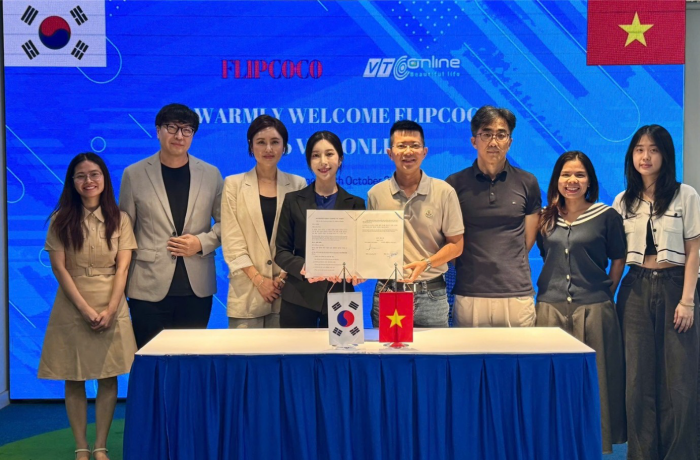
This representative stated, "Trust in the competition cannot be built alone, but must be built with partners recognized locally." The strategy is to secure institutional trust through joint operations with local media and education networks, rather than through private education companies alone. This collaborative approach allows IOK to expand beyond a single country. Starting with Vietnam, Flipcoco plans to expand its IOK-based model to Indonesia, Malaysia, Cambodia, Saudi Arabia, and other countries.
Verification, reliability, curriculum, and age-specific operation
IOK prioritizes verification, not lectures. Unlike traditional Korean language education, which focuses on the learning process itself—lectures, conversation, and grammar—IOK measures students' progress through a competition. The company also emphasizes its founder's strengths—standard Korean, pronunciation, and communication skills—as a former announcer. Another key differentiator is the company's commitment to "accurate Korean."
The second key differentiator is the reliability of the textbooks and contest questions. IOK textbooks are personally reviewed by experts with extensive Korean language education experience, and contest questions also undergo a separate verification process after being created. CEO Lee explained, "It's crucial that the people who create contest questions and those who review them are separate. We are strengthening the role of the reviewers to maintain a level comparable to that of existing accredited contests."
The curriculum is also diverse. The learning path is optimized for competitions, combining Zoom-based one-on-one classes, small group classes, assignment submission and feedback, and learning based on past and similar questions. Learners are grouped by difficulty and level, and the entire learning process is managed through assignments and feedback. Instead of focusing on flashy AI and app-centric technology, IOK opted for a web- and Zoom-based approach, reducing costs and prioritizing a structure that encourages learners to complete the course. This practical approach takes into account local payment environments and learning culture.
We've separated the program into Kids and Adults. IOK is divided into IOK-K for kids and IOK-A for adults. The Kids program focuses on fostering interest and immersion in Korean through animation and video-based content, while the Adult program focuses on practical Korean for practical use in areas like studying abroad and employment. CEO Lee stated, "For children, fun and immersion come first, while for adults, clear goals and outcomes are crucial. Contests and content structures tailored to age and goals determine learning effectiveness."
Building on this differentiation strategy, flipcoco plans to accumulate correlation data between IOK scores and the TOPIK Korean Proficiency Test (KOPT). This will allow the IOK score to be used as a benchmark for assessing expected Korean proficiency levels. This strategy aims to transform the learning experience beyond simply improving skills into a tangible indicator that can lead to subsequent steps like visa issuance, university admission, and employment.
■ Monetization and Growth
Flipcoco plans to refine its competition system by 2026, separating IOK-K for kids and IOK-A for adults, based on accumulated operational data and competition references over the past year. Furthermore, the company plans to expand the model to Indonesia, Malaysia, Cambodia, Saudi Arabia, and other countries starting in the second half of 2026.
Flipcoco focused on establishing a structure to objectively verify learning outcomes through competitions throughout 2025. The core goal is to translate competition results into tangible opportunities, such as university admission, employment, and settling in Korea. The lightweight, web- and Zoom-based operation model, taking into account the low credit card payment rates and preference for offline learning in local markets like Vietnam, will reduce costs and focus on a structure that encourages learners to complete the course. Flipcoco is also exploring entry into the B2B market through corporate partnerships. Sales are expected to begin in earnest in April 2026. The company has established a revenue structure centered on lectures, past exam question packages, and mock exams, and plans to continue its growth based on accumulated competition data and operational references.
CEO Lee stated, "If flipcoco helps increase the number of students who learn Korean, pass competitions, and successfully enter university or find employment, that would be the greatest reward." Amidst the trend of many startups arming themselves with edtech, CEO Lee chose the somewhat unfamiliar category of "contests." While this choice may not immediately be immediately glamorous, he believes it could have a significant impact if IOK becomes a key Korean language competition, particularly in Southeast Asia. Flipcoco's next steps in the global Korean language education market are drawing keen attention.
You must be logged in to post a comment.