



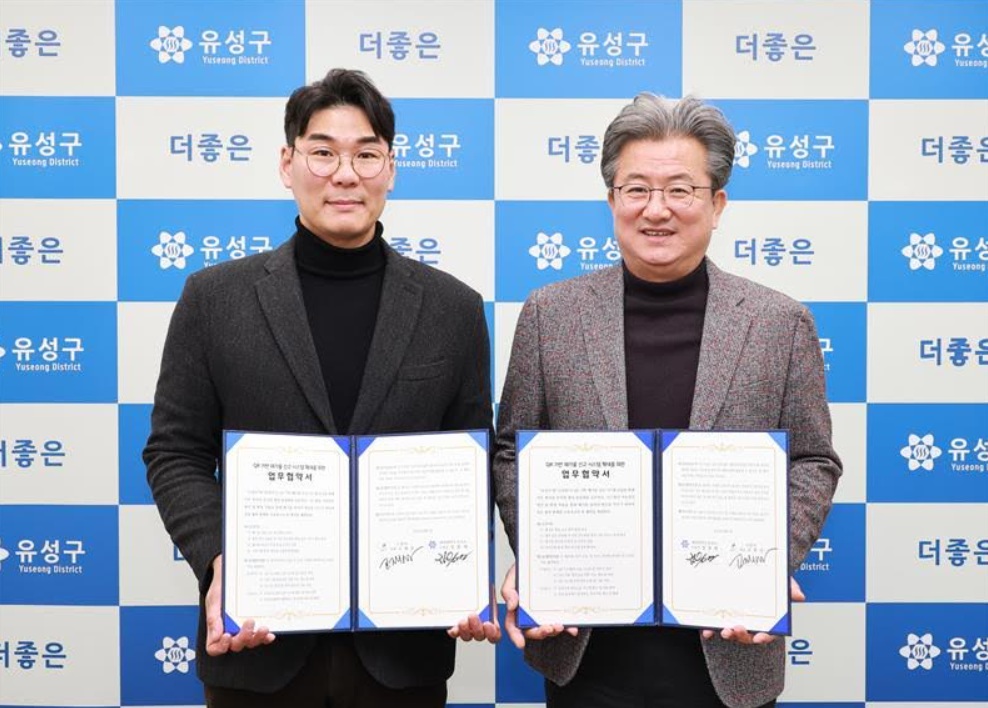
Environmental resource data company Gadat (CEO Jae-seong Ko) announced on the 11th that it signed a business agreement (MOU) with Yuseong-gu, Daejeon Metropolitan City (Mayor Yong-rae Jeong) on the 9th for 'Waste Data Digital Transformation (DX) and Resource Circulation Cooperation'.
This agreement was established to expand the conversion of waste data to DX and to publicize successful local-led digital transformation cases nationwide, based on the operational performance of the waste QR code application system that Yuseong-gu introduced early last year as the first of its kind in the country.
Through this agreement, Same and Yuseong-gu plan to ▲enhance the waste QR code application system and expand the operation of the nation's No. 1 service ▲establish a real-time collection and analysis system for waste generation and discharge data ▲expand the introduction of the 'Ppaegi' mobile service for easy disposal of bulky waste ▲support the establishment of data-based resource circulation policies ▲joint cooperation to increase the recycling rate.
Daejeon's Yuseong District, a basic local government with a population of approximately 370,000, has played a leading role in digital transformation of administration, leveraging its status as a science city. Since introducing a waste disposal QR code application system utilizing the "Bbaegi" platform last year, the district has achieved the highest usage rate and resident satisfaction nationwide, earning recognition as a prime example of local government-led digital transformation.
Mayor Jeong Yong-rae of Yuseong-gu said, “We will improve the convenience of residents by transitioning to DX in waste management and promote data-based resource circulation policies,” adding, “This agreement will serve as an opportunity to strengthen the competitiveness of Yuseong-gu’s environmental administration.”
CEO Ko Jae-seong said, “We will spread the culture of resource recycling based on the data technology of the subtractor and the national integrated management system,” and “We will increase the number of users of the subtractor service to 3.3 million this year and establish it as a sustainable service by passing the break-even point.”
Since its launch in 2019, Bbaegi has grown by over 40% annually, currently boasting 2.3 million subscribers and partnerships with over 80 local governments. It is Korea's largest environmental platform, with 2.3 million subscribers and convenient mobile app access to everything from bulky waste reporting to transportation and recycling. Cumulatively, Bbaegi has reduced carbon dioxide emissions by 17,000 tons, saved 4,500 tons of waste from incineration, and saved KRW 210 billion in costs. Furthermore, it boasts the largest subscriber count among waste management platforms in Asia, demonstrating its global competitiveness.
You must be logged in to post a comment.