



A vision AI approach that analyzes stays, revisits, and movement patterns in real time without storing video.
Expanding from the MICE market to the small business market, focusing on the core solution, "Live Review."
-SaaS transition in progress, connecting offline data to advertising, CRM, and decision-making.
Offline spaces have always been "empty data." While clicks and scrolls remain online, the details of who sat where, who came with whom, and how long they stayed in a store largely disappear. What remains is usually CCTV footage. But the moment footage is stored, it becomes a cost, personal information, and a shackle to scalability.
This is why MAZE, a visionary AI startup, has made the requirement of "not storing video" a prerequisite for its technology from the beginning. CEO Kisun Song summarizes this in a single sentence.
“ Leave only memories, not images. ”

For him, this choice isn't just a "moral declaration." To digitize offline customer experiences, cameras are ultimately necessary. The challenge lies in the fact that "if we can't stop filming, we have to strike a balance by immediately interpreting and discarding the incoming images." CEO Song is transforming offline spaces not with "AI that sees more," but with "data structures that remember only what's needed." His chosen solution prioritizes low power consumption over high performance , ethics over accuracy , and real-time over accumulation.
The question that began at the airport: "What if we had offline activity data?"
After majoring in aerospace engineering at Seoul National University, he continued his doctoral research at the Georgia Institute of Technology. His research focused on uncovering the "fundamental laws" of the US civil aviation network. Song's starting point wasn't stores, but airports. Why are airports laid out the way they are? Why do airlines merge and acquire? How are hubs formed? Under what conditions do direct and transit flights differ?
Ultimately, what was needed to unravel that complex system was people's "movement" data. However, aviation doesn't readily disclose data. It requires a limited sample, numerous assumptions, and a series of inferences to correct for omissions. Through this process, he became convinced: the moment offline activity data becomes available, the world can be described and predicted with far greater precision.
And that conviction extended even to minor inconveniences in life. "I went to the hair salon and realized I'd have to wait an hour and a half. If I'd known, I wouldn't have gone." "If there's no seating at a cafe I drive to, that experience isn't just a one-time thing."
The problem with offline experiences has always been the same: information to help you make decisions arrives late. Like navigation, if you could "know before you go," you could reduce unnecessary choices, but that's difficult in offline environments.
A paradoxical design that started with “AI can’t make money”
MAZE's rejection of a massive video storage and learning system isn't simply about cost savings. CEO Song explains, "Once video streaming storage, large-scale labeling, and storage/cloud costs become a factor, it becomes structurally difficult for startups to make money." Therefore, instead of accumulating video footage to achieve "100% accuracy," MAZE opted to make decisions based on minimal information only when necessary.
There are two key points. First, it must be possible to "re-identify the person" without storing the video. MAZE explains that it has developed an algorithm that quickly connects identical individuals without training data, without focusing on facial recognition. Even in environments with a large number of unfamiliar visitors, such as exhibitions, it can reduce "dummy IDs" in real time and analyze cross-visits.
Second, this entire process must be performed at the edge. The constraint that "videos aren't stored, so if you don't pull them out at that moment, you lose the opportunity" actually forced product design to be more rigorous.
As a result, MAZE opted for a strategy where, even though its image-based AI achieved 80-90% accuracy, it sacrificed the remaining 10% to spread its data over a much larger area at one-hundredth the cost. The technology's direction shifted from "collecting more" to "collecting less and using it better."
From MICE to small business owners, and the next step of ‘offline CRM’
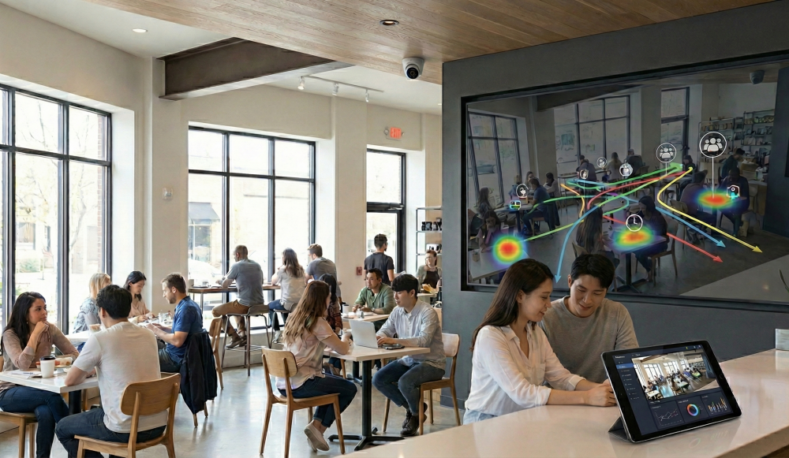
This design is implemented as a service in MAZE's vision AI solution, "Live Review." Live Review is a customer behavior analysis solution that analyzes visitors' dwell time, repeat visits, and movement patterns in real time in offline spaces without storing CCTV footage. CEO Song explains, "It doesn't record footage, but it interprets the flow of choices made within the space." This service first took root in spaces where consent was structurally feasible. Environments like MICE (Meetings, Incentives, and Incentives) where filming and data collection are clearly notified were the optimal market for MAZE. CEO Song explains, "We were able to commercialize it first in places where explicit consent was obtained at the entrance."
Since then, MAZE has expanded into the small business and restaurant industries. A recent PoC conducted in Reno, Nevada, USA, analyzed the real-time flow of thousands of visitors over a three-week period. CEO Song explains, "Within legally permissible limits, we can decipher behavioral patterns simply by observing a user's presence within a camera-friendly angle for a certain amount of time."
BM is also shifting from on-demand to SaaS. This shift is moving beyond one-time analysis or event-based use, to a form where stores can continuously monitor and utilize data for decision-making. CEO Song explains, "Offline data ultimately needs to be reusable to thrive, and even a 1% increase in sales immediately demonstrates its value."
The "offline CRM" he envisions goes beyond simple store analysis. CEO Song summarizes the limitations of online platforms by saying, "Getting people in is the hardest part." Unlike Netflix, which focuses on retaining customers, getting them to open an app has become increasingly expensive and difficult. Therefore, he views offline platforms as "new advertising and conversion platforms."
The time people spend in stores, the time they wait for their orders, and the moments at their tables are all connected to personalized content and offers. When conversions occur, store owners receive rewards, and advertisers pay based on performance. This is where the term "a new advertising platform that goes beyond push notifications" comes from.
The next stage is smart glasses and humanoids.
MAZE's next product direction is geared toward more general-purpose applications. CEO Song anticipates an era of explosive growth in devices equipped with vision sensors. In an environment where smart glasses, drones, robots, tablets, and various camera devices simultaneously generate video, he argues, "central analysis of tens of thousands of images will become impossible." Ultimately, the solution lies in ultra-low-power, ultra-high-speed recognition at the edge, and minimal data collection.
CEO Song explains that this isn't a solution limited to specific stores or industries, but rather a foundation for recognition technology that can be applied anywhere. He envisions a structure that provides SDK or APIs, allowing for access to various devices and services as needed. He explains that for humanoids and wearable devices to interact with humans, they need the ability to "understand and remember the person in front of them," and that the low-power recognition technology developed by MAZE can serve as a foundation for this process.
From local to global, from limited to universal
Since its founding in 2022, MAZE has attracted over 1.1 billion won in cumulative investment and is currently in the process of a pre-A bridge round. CEO Song also leaves open the possibility of "M&A or expansion focused on the US market." His three-pronged approach for this year is also striking: first, from local to global; second, from limited to universal; and third, from on-demand to SaaS.
What's interesting is that his ultimate vision doesn't end with just "MAZE." He envisions a long-term holding company structure similar to Alphabet. He also mentioned "a civilian aerospace transportation system that can be implemented using textbook theory" as his next startup idea. His logic is that, just as communications transformed our lives, changes in transportation will reshape society's timeline.
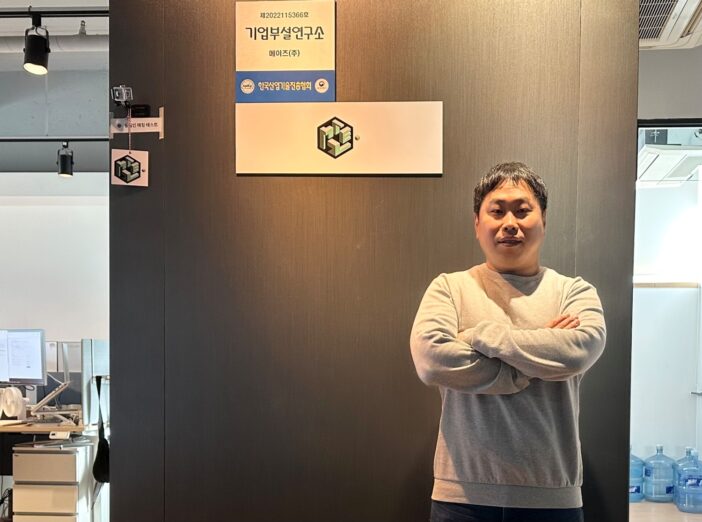
Offline data has been a "blank space," but MAZE doesn't simply fill that void. It aims to transform offline data into a database—without storing it, with less data collected, but with broader use.
Ultimately, the question MAZE poses goes beyond competing for technological performance or accuracy. To understand the offline world, it asks, "How much should we collect?" and "Where should we be willing to discard?" His perspective—that data is not inherently more powerful the more it is collected, but rather that it only becomes powerful when designed for its intended purpose—is consistently reflected in all MAZE's decisions.
MAZE's idea of being able to read offline without video is now established as an option and a new standard for handling offline data.
You must be logged in to post a comment.