



In the real estate market, "smart home" has long been nothing more than a fancy buzzword: advanced lighting controls, voice-activated appliances, automatic locks. Yet, many elderly people collapsed alone in their homes, often overlooked. Nursing homes are no different. Caregivers patrol the hallways alone every night, with no other option than to open doors. In the reality of caring for dozens of people on their own, blind spots existed, and tragic accidents repeatedly occurred in those gaps.
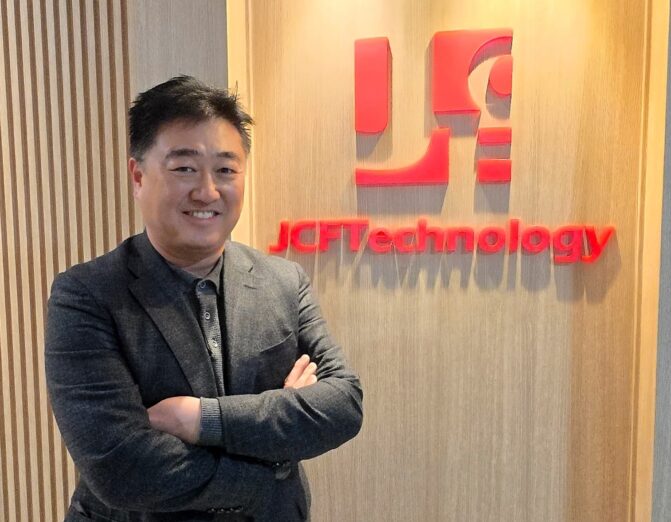
While PropTech focuses on real estate data analysis and transaction platforms, safety issues within living spaces have remained largely untouched by technology. JCF Technology is the company that has delved into this area. The company's non-contact biometric signal detection system, "MacCare," is now quietly installed in nursing homes and single-person homes nationwide, monitoring heart rate and respiration 24/7.
"In 2015, my father suffered a sudden stroke. Later, I asked him about it, and he told me there had clearly been minor signs beforehand, but they had ignored them. I felt a deep sense of regret and self-reproach, wondering what would have happened if I had known sooner."
For an engineer who majored in electronic engineering in college and spent 20 years researching and developing radar and communications at a domestic RF company, his father's stroke wasn't simply a family matter. His professional instinct kicked in. He wondered if the radar technology he had been working with could be used to read signals emanating from the human body. From that moment on, his research direction completely shifted. It was a moment when industrial technology transformed into technology that protected people. In 2016, CEO Kim Jin-myeong left his stable job and founded JCF Technology.
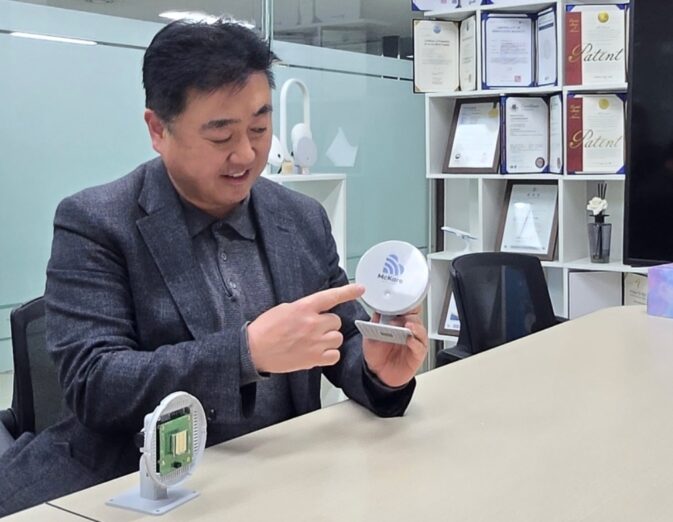
The principle of MacCare is surprisingly simple. The sensor emits a weak radio wave, consuming one-fiftieth the power of a smartphone. Even when lying still, the chest moves slightly due to heartbeat and breathing. These movements are smaller than the width of a hair, but the radar accurately reads them. This is why it can detect heartbeat and breathing without anything attached to the body. It doesn't capture images like a camera. Instead, it uses a thermal imaging sensor to capture body temperature as numerical data, identifies the shape, and links this to vital information. Neither the face nor the body is recorded. This is why seniors can live their daily lives naturally without feeling like they're being watched.
From a proptech perspective, the significance of this technology is becoming clearer. The value of a building is no longer determined solely by its location and area. Technology infrastructure that ensures occupant safety in real time is redefining the quality of space. Indeed, some financial institutions are incorporating ESG and smart building factors into asset risk assessments, and there are even concerns that residential safety data could be utilized in real estate financing reviews in the future. Safety technology is directly linked to real estate financing.
Difficult technological development
"In a laboratory, we can control conditions, but in a real-life home or nursing home, everyone's lifestyle and environment are different. In the process, we had to endure countless complaints and complaints from clients."
Problems like heart rate signals being lost in a single cough, signals mixing when multiple people are in the same space, and algorithms malfunctioning in various living environments—we encountered and fixed each problem one by one in the field. The result is today's MacCare. Hardware, signal processing, and AI analysis are organically integrated into a single system.
AI's role is remarkable. It doesn't simply detect abnormalities; it accumulates data over time to learn a person's unique patterns. Changes in breathing rhythm, a sudden increase in bathroom trips during the night, or an abnormal combination of heart rate and movement are identified as warning signs. Rather than alerting patients after an incident has occurred, it proactively identifies and alerts them to the evolving process. This represents a shift from reactive care to preventative care.
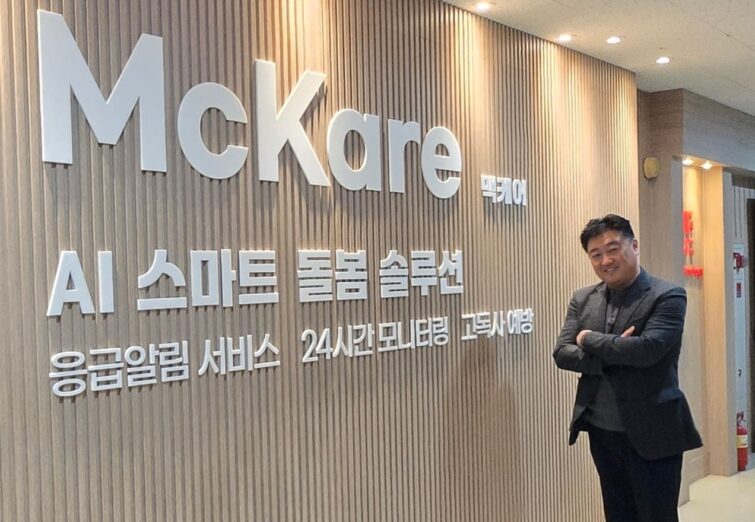
The market response was unequivocal. Following the Public Procurement Service's designation as an innovative product and the Minister of Trade, Industry and Energy Award in 2022, selection as a Global Small and Medium Enterprise in 2023, and the Minister of Health and Welfare Award in 2025, the company secured TIPS investment from Infobank and is currently preparing to secure Series A and B funding, targeting a domestic IPO in 2028.
Considering the inherent mission of PropTech—the integration of residential environments and technology—MacCare's potential for widespread adoption is even broader. With the advent of a super-aging society, demand for non-contact safety monitoring in areas like senior centers, public rental housing, and single-person housing is bound to explode. Solutions have already been implemented in local government care programs for the elderly living alone, public welfare facilities, and senior housing, and their scope is expanding to include industrial safety at large-scale construction sites.
Our potential has also been confirmed on the global stage. Meeting with over 100 international buyers at GITEX Dubai, the Barcelona Smart City Expo, and the Rehacare exhibition in Germany, we realized that aging is a global challenge. We have already entered the Japanese and German markets and are preparing to obtain FDA approval in the US. Our strategy is to expand into the Middle East through government-led smart city projects, Europe through home care and home monitoring, and the US through a health insurance-linked model.
The future that CEO Kim Jin-myeong dreams of is not grand.
“Our ultimate goal is to create technologies that help people age more safely and with dignity in their own homes.”
In an era where the value of space is measured through data, this company is quietly proving that the next frontier in proptech lies not in the convenience of real estate transactions, but in the safety of residents. An engineer's obsession, sparked by his father's stroke, is redefining the space known as home.
You must be logged in to post a comment.