



January 2026, at the CES exhibition hall in Las Vegas, USA. Foreign visitors flocked to the monitor stand in the Korean pavilion. It wasn't just any stand. It was the "Calm Stand," an emotional AI object that uses AI to read users' facial expressions, prevent forward head posture, and detect fatigue to provide aromatherapy and sound therapy.
The CalmStand uses AI-based camera sensing technology to analyze the user's posture, facial expressions, and biometric signals in real time. If forward head posture is detected, it automatically adjusts the height, and if fatigue increases, it activates aromatherapy or therapeutic sounds. This quiet sensing concept, which detects the user's condition without their awareness and responds quietly, allows the AI to optimize the work environment, simultaneously supporting posture correction and psychological well-being.
The company introducing this product is KOAS, the pioneer of office system furniture in Korea. Founded in 1984, KOAS has supplied furniture to the National Assembly, government offices, and major corporations for 41 years, making it a pioneer in the domestic office furniture market. KOAS furniture is featured in most major buildings in Korea, including LG Electronics' Magok headquarters, Nonghyup Central Bank's NH Tower, and KDB Industrial Bank's headquarters.
In January 2026, KOAS was named first in the furniture category of the "Korea First Brand Awards." In a survey of over 450,000 consumers, KOAS achieved a brand satisfaction score of 5.36 out of 7, surpassing its competitors and taking first place. That same month, KOAS became the first Korean office furniture company to participate in CES 2026, unveiling AI-integrated furniture.
This transformation of a traditional manufacturing company began with the joint management system established by CEO Min Kyung-joong and CEO Noh Byung-goo in September 2024. Immediately after taking office, the two CEOs delivered a clear message: "A market dominated solely by traditional furniture will be difficult. We must embrace a trend that integrates with AI." KOAS is now in full swing, transforming from a simple furniture manufacturer to a "worktech company" that integrates AI and IT.
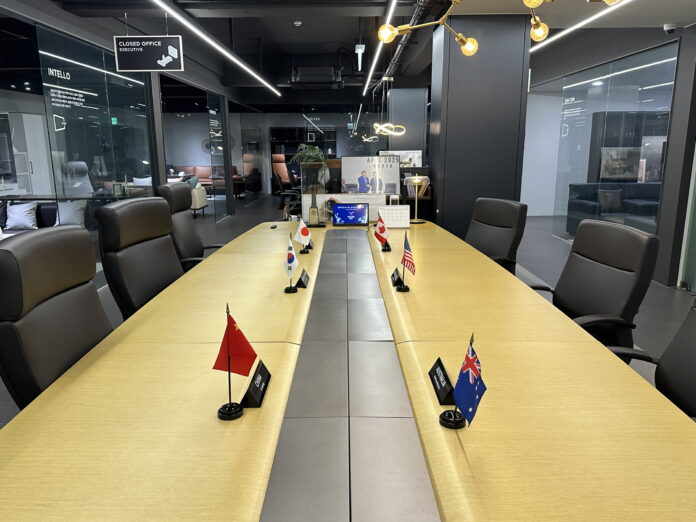
KOAS's selection as an official sponsor of the 2025 APEC Summit is a result of this shift. At the Gyeongju Hwabaek Convention Center, eco-friendly furniture made from trees damaged by the Gyeongbuk wildfires and premium chairs from the Maruon brand were displayed to welcome the world leaders. This marks a moment when a company with 41 years of tradition is recognized as a representative national brand.
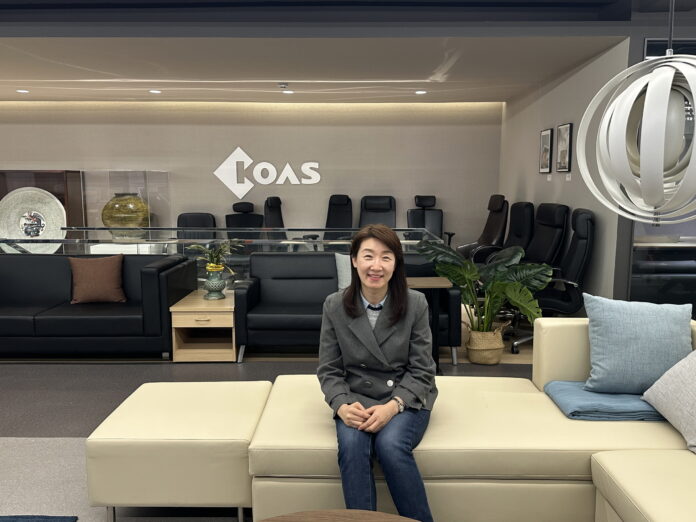
At KOAS headquarters in Yeongdeungpo-gu, Seoul, we met with Il Sook Kim, Head of the Management Innovation Team, to discuss KOAS's AI convergence product development, digital transformation, and communication strategy.
' Space Creator '… An era where furniture cares for people
Immediately after taking office, CEO Min defined KOAS as a "Space Creator," no longer a furniture manufacturer. A "Space Creator" refers to a company that transforms every space where people and work meet into an active interface. It's not about selling a single desk or chair; it's about making the entire space understand and respond to its users.
"We view furniture as an interface. There are clear pain points between people and space. While people have been accustomed to adapting to furniture, we're trying to change that. We're creating a better, more human-centered interface."
This involves a three-dimensional shift. First, the shift from product to experience. Just as the CalmStand reads a user's facial expressions to correct posture and detect fatigue to provide aromatherapy, furniture understands and responds to the user's condition.
Second, there's a shift from static to dynamic spaces. Previously, office spaces were static, with people adapting to the space. However, spaces created by space creators are alive and dynamic. AI lighting adjusts brightness based on fatigue, contextual automation systems automatically set the environment before meetings begin, and automated office systems learn users' daily patterns to suggest optimal work environments. Spaces understand people, proactively responding to their needs by proactively identifying them.
Third, the company is transforming from a furniture company to a platform company. KOAS views furniture as a platform that generates data and provides insights. It collects and analyzes data generated by individual devices, and uses this data to continuously improve the work environment. Beyond simply selling products, it creates a recurring revenue structure through subscriptions, data, and platforms.
Ultimately, a space creator is a company that goes beyond physical products and reimagines entire spaces with people at the center. By combining AI, sensors, and data analysis on top of the physical platform of furniture, they design spaces where people can work happier and healthier. This is the kind of space creator KOAS envisions.
KOAS's imagination extends beyond the office. Its AI-powered moisturizing desk, which addresses dryness in the office, connects with the beauty and cosmetics industries, while its eye-tracking-based smart desk for eye care extends to the healthcare and vision fields. Its environmental monitoring and control systems can also be applied to smart farms and industrial settings. This scalability is possible thanks to the physical platform of furniture.
KOAS's vision of becoming a "space creator" goes beyond simple product innovation. It signifies a transformation from a traditional manufacturing company to a work tech company that integrates AI and IT. Director Kim stated, "KOAS creates not just furniture, but an interface between people and work. To create such products, a culture must be built within the organization."
Digitalizing 41 years of accumulated knowledge
The first thing Director Kim felt when he joined KOAS was the 'tacit knowledge of the manufacturing industry.'
"It was truly amazing. Manufacturing requires a whole new level of knowledge. From selecting the right materials to the equipment and processes, creating a perfectly finished piece of furniture from start to finish isn't something just anyone can do. That expertise was fully embedded within the KOAS members."
The problem was that this tacit knowledge was fragmented. The nature of manufacturing meant many employees were long-term, and the accumulated expertise and experience of each individual was not shared as an organizational asset.
"In manufacturing, everything is interconnected. From planning and material purchasing to production, delivery, and after-sales service, the entire process is organic. If each department operates independently, it directly impacts quality and profitability. However, there were barriers between departments, and information was fragmented."
Director Kim's diagnosis was clear: communication is key in manufacturing, and interdepartmental collaboration and information sharing are essential, especially to move from traditional furniture to AI-integrated furniture. To achieve this, the company introduced the collaboration tool "JANDI" late last year. The results began to manifest in concrete data. While individual claims may seem simple, accumulating these records allowed the company to analyze which types of problems recur in which projects, enabling real-time problem sharing and resolution. Tacit knowledge, once scattered among individuals, began to transform into organizational data.
“ Let KOAS’s experience become KOAS’s knowledge ”
"Previously, we communicated via KakaoTalk. There was no distinction between work and personal life, and work history wasn't managed. The biggest change since implementing JANDI is the assetization of data. Searching is seamless, and the Drive feature allows the entire team to share important data. Finding past data and information has become much easier."
Director Kim repeatedly emphasizes one thing to his team members: documentation and sharing. "I tell them to document their work processes. It's not about keeping their experiences to themselves, but about creating knowledge that anyone can search. Rather than focusing on departmental responsibilities, we focus on the collaborative process."
This isn't just a slogan. It's being implemented in practice. Currently, KOAS has over 20 active "topics," divided into project and task force meeting units, serving as communication channels between members. Everyone, from CEOs to new hires, participates, with executives assigned "tasks," and field staff freely expressing their opinions. The ability to intuitively determine who has reviewed and who hasn't has significantly accelerated decision-making in tasks that require interdepartmental collaboration. Project-based work, in particular, relied on past history. Previously, information was scattered across personal computers, shared folders, and KakaoTalk chatrooms, making even finding it difficult. The introduction of JANDI began to resolve this issue.
“ Key talent is someone who is good at finding information.”
“A key talent is someone who records their work well and makes it searchable by colleagues.”
Director Kim explained his HR philosophy this way: When tools are introduced, fatigue and complaints inevitably arise. He calls these people "B-level talent." In contrast, "A-level talent" is someone who utilizes tools effectively and quickly finds what they need amidst the vast amount of information.
"When conversations get long, I use JANDI's AI summary feature. I set a timeframe and ask it to distill only the tasks my team and I need to accomplish, and the AI neatly organizes my to-do list. It's also useful for reviewing work, and I use the News Connect feature to monitor industry trends and summarize key points. JANDI AI handles everything from topic-specific conversation summarization, task extraction, and sales data analysis all in one place."
Happy space , healthy future
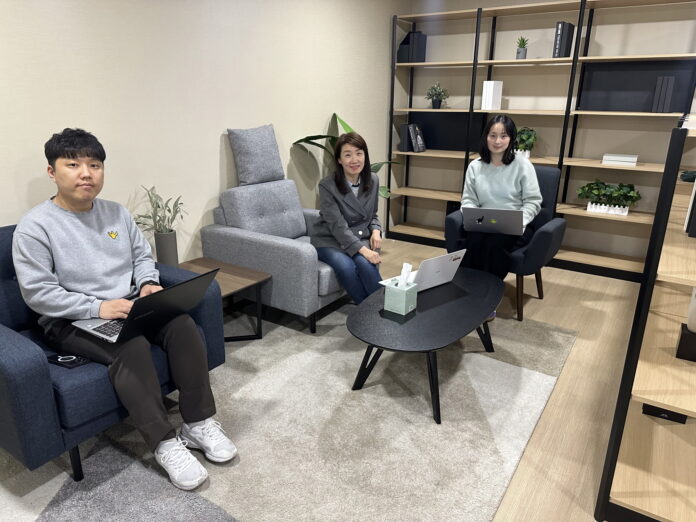
"Happy Space, Healthy Future." This is KOAS's slogan. We begin each monthly meeting by chanting this slogan. It's not just a slogan. This philosophy is embodied in an organizational culture that respects people and in our products as space creators.
Director Kim stated, "KOAS doesn't simply create furniture; it creates an interface between people and their work." He added, "To create such products, a culture must be built from within the organization." He continued, "This year's goal is clear: to transform KOAS's experience into KOAS's knowledge. To transform a culture of reporting into a culture of learning. And in the process, to develop key talent."
The transformation of a 41-year-old furniture company into a worktech company hinged on people, not technology, and culture, not systems. The future of manufacturing lies not in AI itself, but in how people utilize it. The changes KOAS is demonstrating are aligning with this very goal.
You must be logged in to post a comment.