



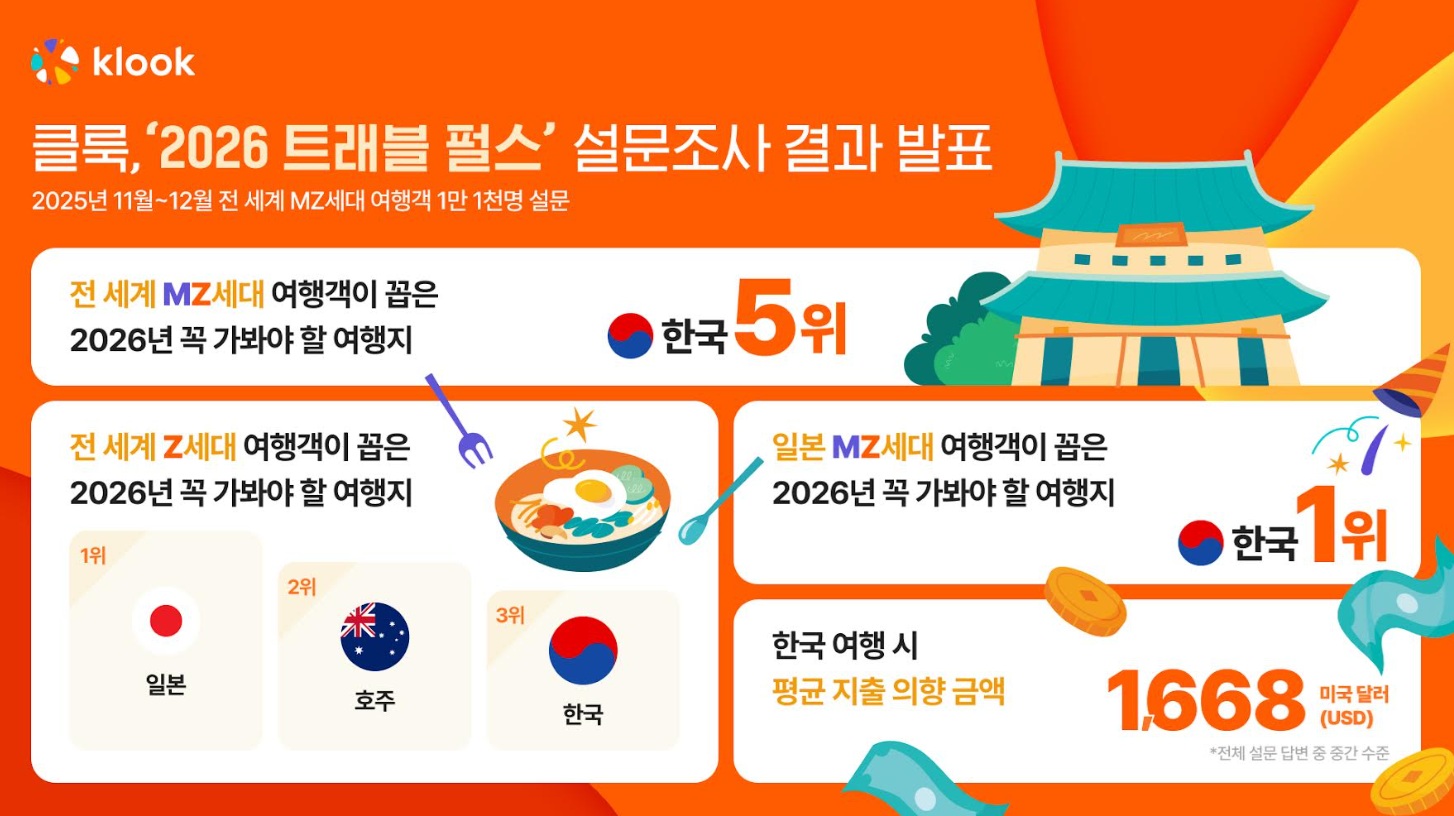
Klook , a global accommodation, transportation, and activity booking platform, announced on the 23rd that Korea ranked 5th overall as a 'must-visit travel destination in 2026' according to the 2026 Travel Pulse survey conducted on MZ generation travelers around the world.
Among Gen Zers, it ranked third, following Japan and Australia. In Japan, both Millennials and Gen Zers ranked Korea first. Furthermore, in the "Other Countries I Want to Visit" category, Korea tied with Hong Kong for fourth place overall. Respondents from major Asian countries, including Hong Kong, Taiwan, Indonesia, the Philippines, Thailand, and Vietnam, ranked Korea first, demonstrating that it has established itself as a preferred travel destination beyond a specific event.
Korea also demonstrated competitiveness in terms of travel spending. The average willingness to spend on a trip of seven nights or more was US$1,668, a mid-range figure according to the survey and higher than Japan (US$1,572). This suggests that Korea is chosen as a travel destination focused on content and experiences rather than price.
Compared to last year's survey, Korea's ranking has also risen. In the 2025 survey, it ranked 8th among travelers from the Asia-Pacific region, the US, and Australia. However, its rise in this survey demonstrates growing global interest.
To stimulate inbound tourism, Klook is strengthening its consulting and operational support for travel partners and collaborating with its global offices to develop Korean travel promotions tailored to each country's needs. Furthermore, through its New Business Development Team and a Memorandum of Understanding (MOU) with the Korea Tourism Startup Association, Klook is working with local tourism startups to develop new tourism products.
“The results of this survey demonstrate that travelers’ preference for Korea has expanded and our competitiveness in the global travel market has strengthened,” said Lee Jun-ho, Klook’s Korea Country Manager. “We will use Klook’s global network and marketing capabilities to support positive perceptions of Korean travel, leading to increased demand for visits to Korea.”
- See more related articles
You must be logged in to post a comment.