



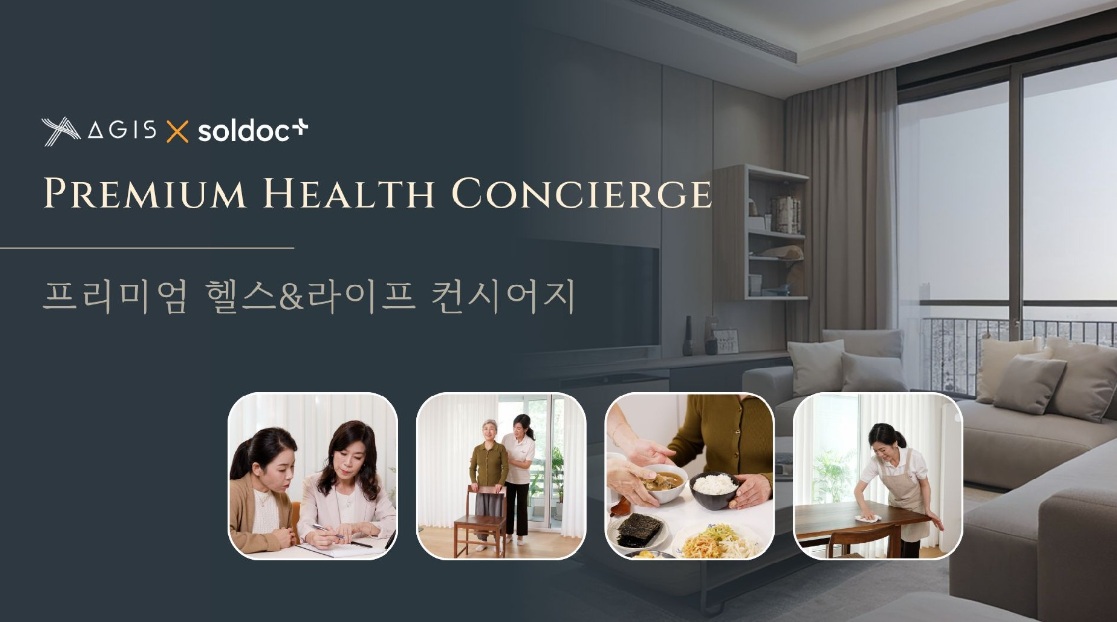
Non-face-to-face medical treatment platform Soldoc Co., Ltd. (CEO Minseung Kim and Hoik Lee) and senior care and healthcare company Aegis (CEO Guseulgi) announced on the 24th that they have signed a business agreement to establish a preventive community care model that provides continuous medical care and care to apartments and senior residences.
The two companies plan to move beyond a treatment-focused approach after hospital visits and implement an operational model that combines prevention, management, and healthcare linkage, all within residential settings. This agreement focuses on establishing a community-centered healthcare and care system, aligned with the integrated support policy for regional care, including healthcare and nursing, scheduled to take effect in March 2026. The key is to apply this prevention and management-focused model to residential settings, reducing unnecessary medical use and care costs and delaying the onset of functional decline.
The model proposed by the two companies redefines community centers within apartments and residences as health management hubs. These centers function as health concierge hubs staffed by professionals, providing integrated health data measurement, consultation, remote care linkage, and programs for exercise, cognitive, emotional, and lifestyle care. This approach aims to create a seamless healthcare system within the living space, where measurement, consultation, management, and care linkage operate within a single, integrated lifestyle.
Soldoc links personal health records (PHRs) collected through devices within the community to medical professionals, and Ages uses these data to provide personalized prevention and management services. Data is managed according to standardized protocols, and operational results are structured to be accumulated and reported.
This model aims to address the limitations of existing senior housing facilities, which are designed for healthy, independent living. This often leads to evictions or transfers if residents experience mobility difficulties or an increased risk of falls. The two companies explained that the design allows residents to continue receiving preventative and management-focused care in their existing living spaces, without the need for separate institutionalization. Senior residences allow residents to select and combine service modules, allowing for tailored operation to individual health and budget.
In terms of operational approach, the design allows complex and residence operators to gradually introduce necessary functions without directly hiring permanent staff, thereby reducing fixed costs. This model is applicable not only to senior residences but also to general apartment complexes, where the number of single-person elderly households is increasing.
The two companies plan to launch a pilot project focused on apartment communities and senior residences, then establish a standard operating model for each type based on operational data and performance, and expand the scope of application.
- See more related articles
You must be logged in to post a comment.