



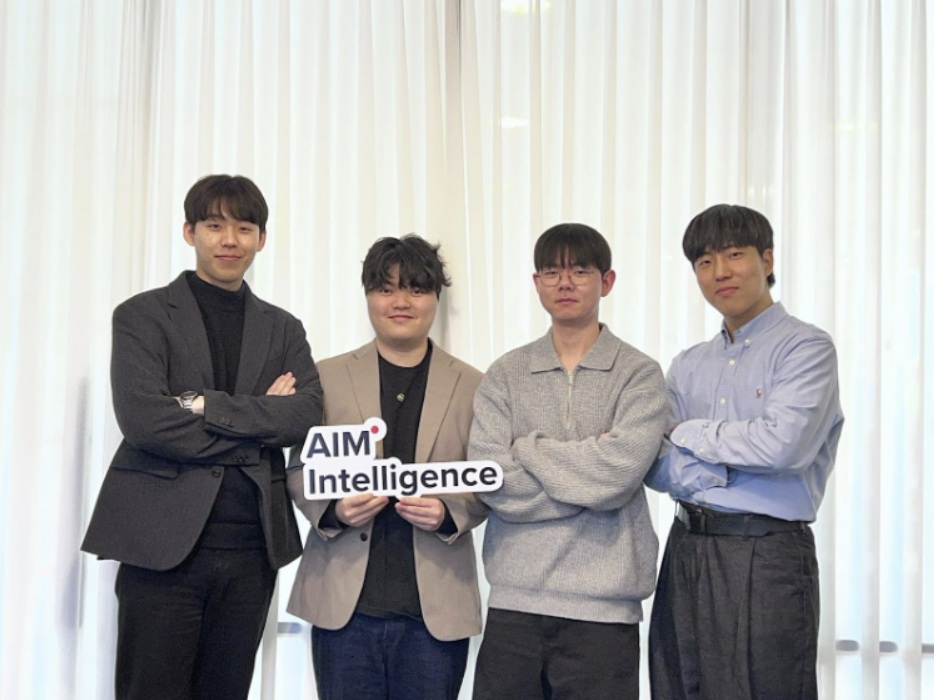
A research paper involving AI security specialist Aim Intelligence has been accepted for the main track of ICLR 2026, an international academic conference in the field of artificial intelligence.
Aim Intelligence announced on the 27th that its paper, "Jailbreaking on Text-to-Video Models via Scene Splitting Strategy," which analyzed the security vulnerabilities of text-to-video (T2V) models, was officially accepted by ICLR 2026. ICLR is an academic conference where the latest research results in the fields of machine learning and deep learning are announced. This year, approximately 19,000 papers were submitted, and approximately 28% of them were accepted.
Recently, T2V models, such as Google DeepMind's Veo2, Luma Ray2, and Hailuo, which generate images solely through text input, have been rapidly spreading. However, systematic verification research on the safety of these image generation models has been criticized as still in its infancy. Against this backdrop, the research team analyzed structural vulnerabilities that could bypass the T2V model's safety filters.
The "SceneSplit" technique proposed in the paper divides a single harmful prompt into multiple individual scenes, then sequentially combines them into harmless versions. The study found that even if individual scenes pass the safety filter, the overall context can potentially lead to policy violations when the scenes are connected.
For example, combining seemingly unproblematic descriptions like "smoke rising into the sky," "people lying on the ground," and "red liquid" can create an image reminiscent of an explosion scene when combined as a whole. This suggests that existing safety filters, when focused on single prompts or individual scenes, may not adequately reflect the overall narrative context.
The research team evaluated five T2V models using 220 prompts across 11 safety categories, including pornography, violence, and illegal activities. The results showed that SceneSplit-based attacks achieved a success rate of 70-80%, significantly higher than the 0-10% success rate of existing single-prompt-based attacks.
This study is significant in that it suggests the need to advance the safety assessment of video generation AI beyond the static approach centered on keyword blocking to a comprehensive understanding of the context and narrative structure between scenes.
The research was conducted jointly by Park Ha-eon, CTO of AimIntelligence, along with researchers from Yonsei University, the Korea Institute of Science and Technology (KIST), and Seoul National University, and supervised by Professor Kim Soo-hyun of Kyung Hee University. The paper is currently available on arXiv.
CTO Park Ha-eon stated that as generative AI expands into multimodal and physical AI, the safety verification system must also evolve into a structural and contextual evaluation, and that he will continue to conduct preemptive research on structural vulnerabilities in generative AI systems and advance response technologies.
- See more related articles
You must be logged in to post a comment.