



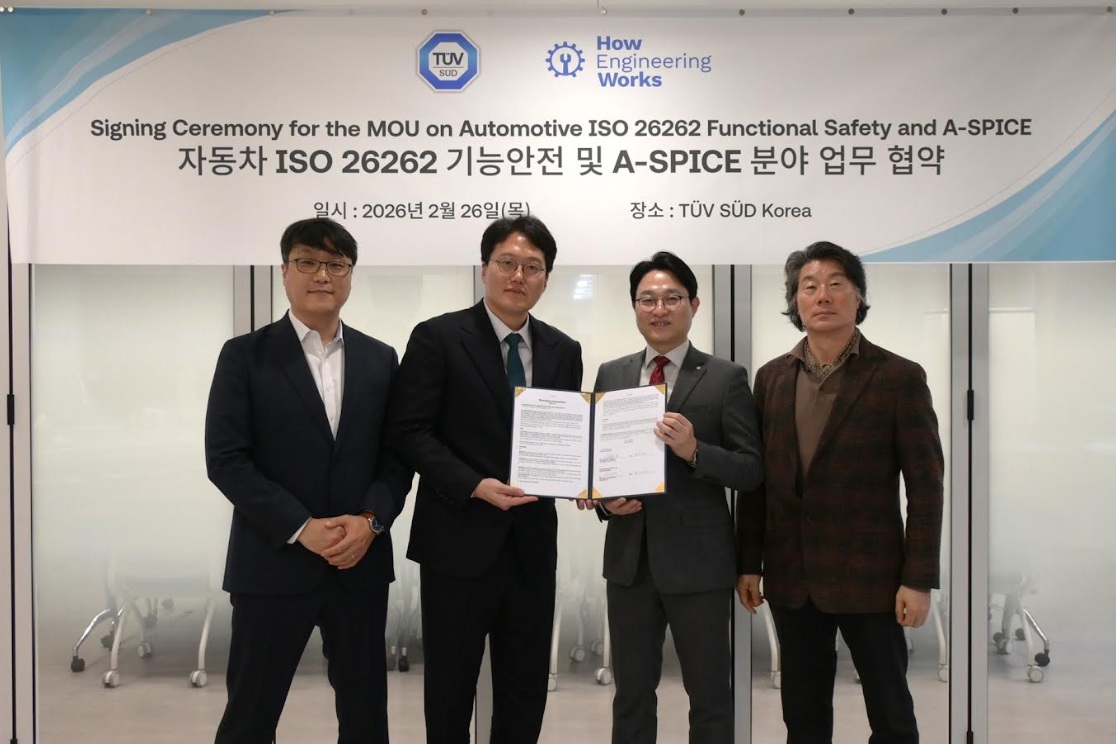
Global testing and certification body TÜV SÜD announced on the 27th that it has signed a memorandum of understanding (MOU) with How Engineering Works for cooperation in the fields of automotive functional safety and Automotive SPICE.
Through this agreement, the two companies will establish a collaborative system encompassing technical consulting, process assessment, and certification services in the areas of ISO 26262, the international standard for automotive functional safety, and Automotive SPICE (A-SPICE), the automotive software development process assessment standard. Based on this, the two companies aim to support domestic auto parts manufacturers and automotive fabless companies in establishing quality systems that meet international standards and strengthening their reliability and competitiveness in the global market.
As the automotive industry accelerates technological advancements in areas like electrification, autonomous driving, and automotive semiconductors, functional safety and software process capabilities are emerging as key competitive factors. ISO 26262 and A-SPICE are recognized as essential requirements for collaboration with global auto OEMs and Tier 1 companies.
ISO 26262 is an international functional safety standard established to systematically analyze and manage risks that may arise from failures in automotive electrical and electronic systems. A-SPICE, based on ISO/IEC 15504, is an automotive embedded software development process evaluation model widely used by global automakers and parts manufacturers.
TUV SUD Korea has supported the establishment of international standards systems for domestic companies, leveraging its global network and independent assessment and certification capabilities in the ISO 26262 and A-SPICE fields. How Engineering Works provides production-level functional safety and engineering services in the automotive, semiconductor, and industrial systems industries, and has completed a variety of projects.
The two companies plan to establish an integrated support system encompassing technical consulting, process improvement, evaluation, and certification, and to strengthen their collaboration with global OEMs, Tier-1s, and semiconductor customers. They plan to expand their collaboration to include automotive semiconductors, SoCs, ADAS, electrification, and autonomous driving systems.
- See more related articles
You must be logged in to post a comment.