



Strengthening recycling transparency with Payot, an IoT-based smart clothing collection solution.
– Securing trust from citizens, businesses, and local governments through the Sejong Smart City demonstration project.
– Challenges to expand circular economy infrastructure in conjunction with global smart cities

"Clothing waste is not trash, it's a resource," said Greenloop CEO Han Kang-jin at an office on Ojeong-ro in Bucheon, Gyeonggi Province.
Seeing opportunity in a pile of discarded clothes
The reason Han Kang-jin, CEO of Greenloop, decided to start his own business was simple. He discovered new possibilities in the piles of clothing people were carelessly discarding. "I believed that clothing wasn't simply trash to be thrown away, but a resource that could be reused," Han explained. "However, at the time, the clothing waste disposal process was poorly managed, and the recycling structure was unclear."
To solve this problem, he brought out "IoT and data." This was the moment Greenloop, an integrated platform that revolutionized the existing can collection system and connected everything from disposal to collection, sorting, distribution, and ESG reporting, was born.
The once-unfamiliar IoT-based smart clothing collection box is taking hold thanks to citizen participation.
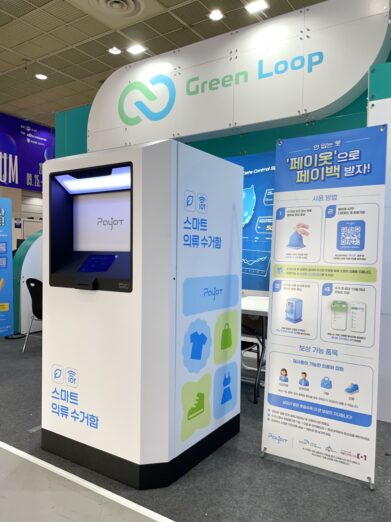
Greenloop's signature feature is the IoT clothing collection box, "Payiot." When a user places a garment in the bin, the amount, weight, and user information are automatically recorded, and compensation is even provided.
Greenloop CEO Han Kang-jin said, "With existing methods, it was impossible to even know who emitted what. But our service records data and converts it into ESG indicators, enabling local governments and companies to transparently manage their performance."
The Sejong Smart City demonstration project demonstrated that this system can function effectively in the real world. However, the biggest challenge wasn't technology, but people. "It was an unfamiliar experience for citizens, and coordinating stakeholders proved challenging. So, we persuaded them by offering rewards to citizens, ESG data to local governments, and new collection channels to stakeholders," said Han.
The data accumulated through the Payot service goes beyond simply increasing recycling rates. The solution's greatest innovation, "transforming clothing recycling into tangible results and value," presents a new paradigm for clothing recycling.
Trust Built on Data and Global Expansion
Data-driven verification quickly led to trust. Following the Sejong Smart City demonstration project, Greenloop has proven both its commercial viability and technological prowess through collaborations and field trials with various companies and local governments, including Hyundai Engineering & Construction and Hyundai Department Store. However, CEO Han Kang-jin hasn't stopped at these domestic achievements. His focus is now shifting beyond the domestic market to the global market.
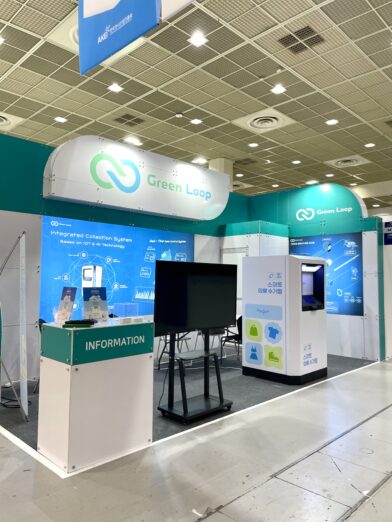
A representative explained, "Our ultimate goal is to create a circular economy model that leads the individual carbon credit market. To achieve this, we are developing and enhancing AI-based demand forecasting and classification optimization algorithms. This will not only increase operational efficiency, but also, in the long term, expand our business to include not only reusable clothing but also discarded clothing, enabling the distribution of customized materials."
Greenloop and CEO Han Kang-jin are currently in discussions regarding overseas smart city projects in Thailand, Dubai, and other countries.
CEO Han Kang-jin expressed his ambition, saying, “Ultimately, we want to establish ourselves as a company that builds a global circular economy infrastructure.”
Startup Leadership Proven Through Action
Environmental startup founders often face criticism for "greenwashing." CEO Han Kang-jin was no exception. However, over time, he found true transparency and execution as his weapons of choice. "At first, I was looked at as if I were a fraud," CEO Han said. "But in times like these, we need to prove our performance with actual data, not just talk about 'ESG.' When we demonstrate this through action, trust is built and social value is created."
He delivers the same message to aspiring entrepreneurs. One representative advised, "The more difficult and challenging a problem is, the more transparently you address it and take on the challenge with swift action. If you do so, you will inevitably achieve results. I hope many entrepreneurs, including myself, will join us in this challenge and create a sustainable world."
Unlike simple donation-based models, Greenloop's IoT clothing collection boxes are connected to the "Payiot" app. Citizens can locate the collection boxes via the app, place their unwanted clothing in a bag, and receive rewards in the form of points based on the value of the clothing. This approach adds economic incentives for clothing recycling and is recognized as a "circular economy participatory service" that goes beyond simple donations.
Attention is focused on whether Greenloop will be able to simultaneously realize its future "smart city innovation services" and "citizen-participatory environmental policies."
You must be logged in to post a comment.