



Development of the world's first Bluetooth, biometrically authenticated hardware wallet, 'D'CENT'… Supports over 100 mainnets, used by approximately 910,000 people in over 220 countries worldwide.
Hardware wallet sales are expected to reach KRW 11.7 billion by 2025, in line with the growing demand for self-custody.
Beyond a 'Storage Wallet', it has evolved into an 'Action Wallet' capable of performing on-chain actions.
"A wallet is no longer a safe to store assets. It's where the act of withdrawing, spending, exchanging, and managing assets begins."
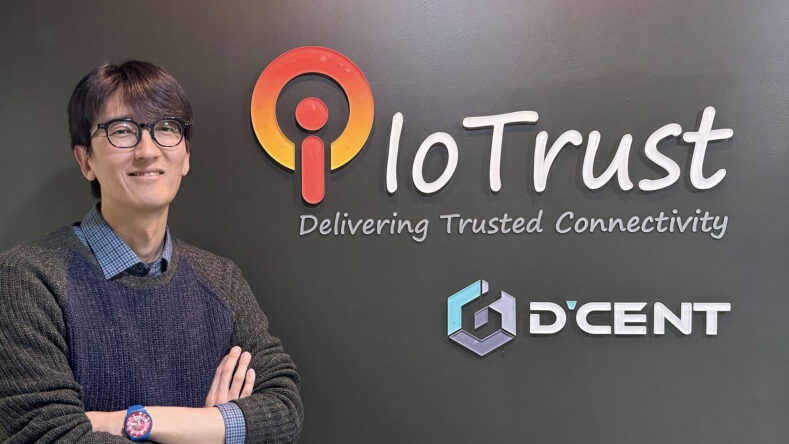
These are the words of Yoo Min-ho, co-founder and CSO (Chief Strategy Officer) of iotrust. In 2018, iotrust launched the blockchain digital asset wallet "D'CENT." D'CENT allows individuals to store and manage digital assets like Bitcoin and Ethereum directly, rather than entrusting them to an exchange. Coins purchased on an exchange are stored in the exchange wallet, but cold wallets like D'CENT allow individuals to retain their private keys, ensuring complete ownership of their coins. It's like storing gold in a chest of drawers, which provides a certain level of security, but as your assets grow, you need a safe.
The product lineup consists of three products: the world's first fingerprint-based hardware wallet with Bluetooth and biometric authentication, an NFC-based card-type hardware wallet, and a mobile app wallet.
D'CENT is evolving beyond a simple "Storage Wallet" for storing assets to an "Action Wallet," enabling users to perform on-chain actions like swaps, staking, and DeFi directly from within the wallet. iotrust describes this as "AX (Action Experience)," which refers to the entire experience of users performing on-chain actions within the wallet.
In addition, iotrust signed a strategic partnership with SentBe last December and plans to integrate the off-ramp feature into its wallet, launching it within the first quarter of this year. An off-ramp refers to the process of converting cryptocurrency holdings into fiat currency (conversely, an on-ramp refers to the process of converting fiat currency into cryptocurrency). This allows users to exchange stablecoins for Korean Won or US Dollars and remit them to overseas accounts, effectively creating a bridge between the blockchain world and the real-world financial system within the wallet.
"The possibilities for using crypto assets are expanding. iotrust's vision is to make these experiences more natural and seamless."
910,000 users worldwide … Support for over 100 mainnets
D'CENT currently supports over 100 mainnets and 4,600 tokens, covering most of the top 200 coins by market capitalization. It has approximately 910,000 users in over 220 countries worldwide, and is expected to surpass one million users soon.
Since purchasing a hardware wallet itself presupposes a serious interest in digital assets, the user base is distinct. Looking at the age distribution, over 60% are over 35, and the proportion of users who prioritize long-term holding and portfolio management is overwhelmingly higher than traders seeking short-term profits, according to CSO Yoo.
"D'CENT users are characterized by 'additional purchases and long-term holding,' rather than 'immediately selling after receiving an airdrop.' This is why we've observed numerous projects where token holdings increase by over 100% or remain held long-term, even after large-scale airdrops or campaigns."
iotrust has more than doubled its hardware wallet sales to KRW 11.7 billion year-over-year, and has begun exceeding its monthly break-even point (BEP) since the second half of last year.
This growth was also fueled by the unique characteristics of the US market. Following the FTX incident, demand for self-custody—the practice of storing digital assets on one's own—significantly increased, leading to increased acceptance of hardware wallets. Furthermore, the passage of the US stablecoin bill, the GENIUS Act (a cryptocurrency regulation bill that establishes a comprehensive regulatory framework to integrate stablecoins into institutional finance), in July of last year fueled a market-wide upturn.
However, shortly after founding iotrust in 2017 and releasing its first product in late 2018, a long ordeal awaited them. Simultaneously with the launch of D'CENT, the price of Bitcoin plummeted by over 80%, from $20,000 to $3,000, ushering in the crypto winter. For a small Korean startup with little brand recognition, selling in the security-conscious US market was no easy feat.
During Crypto Winter, iotrust focused on two things: enhancing product competitiveness by gradually increasing the number of supported blockchain mainnets, and promoting the D'CENT brand through the mainnet community. Each new mainnet integration expanded the range of assets D'CENT could manage, naturally increasing exposure to the user community holding those coins.
CSO Yoo described this period as "building trust." Strengthening product competitiveness and establishing a foundation of trust during a market freeze laid the foundation for subsequent growth. The zero wallet hacking incidents since the service's launch in 2018 are the result of this tireless effort. That trust truly paid off in the summer of 2020, ushering in the so-called "DeFi Summer." As the decentralized finance (DeFi) ecosystem exploded in popularity, personal wallets became essential for accessing it. With the foundation built over a year and a half meeting new demand, D'CENT reached an inflection point in its early growth.
CSO Yoo attributed this achievement to being "ready when the market arrived." He focused his energy on marketing and product improvements during the first half of 2025, and the synergy began to materialize in the first half of last year.
"The timing of the market's recovery coincided with our preparations. While we couldn't have predicted the passage of the Genius Act in July, our prior preparations paid off, allowing us to continue our growth."
' Carry-on safe '
D'CENT's key differentiator lies in its "mobile friendliness." Back in 2017 and 2018, most hardware wallets required a USB connection to a PC. iotrust believed that as digital assets became more widespread, people would carry wallets with them. Therefore, they focused on two key features: smartphone connectivity via Bluetooth, and biometric authentication using fingerprints instead of passwords.
“We are the world’s first hardware wallet with Bluetooth and biometric authentication.”
The depth of security is also a competitive advantage. D'CENT is equipped with a dedicated security chip (Secure Element), similar to those used in credit cards and SIM cards. Certified to CC EAL5+, this chip can detect and defend against physical attacks, such as attempts to read internal information using X-rays or bypass PIN verification codes using external electrical shocks. Private keys are generated and stored completely offline within the device, never exposed to the outside world.
"Installing a security chip doesn't guarantee absolute security. Attacks come from all directions, so secure coding techniques that can block both physical and side-channel attacks must also be implemented."
From corporate vaults to AI agents
iotrust is focusing on two macro changes this year: the increasing adoption of crypto assets by corporations and institutions, and the rise of AI in crypto asset management. In response, iotrust is pursuing a two-pronged strategy. For the institutional market, iotrust is upgrading D'CENT Enterprise. To prepare for the era of AI agents, iotrust is participating in standardization efforts and incorporating AI-capable functions into D'CENT.
In the US, the Genius Act, a bill regulating stablecoins, has passed, and the Clarity Act, which addresses market structure, is awaiting Senate review. In Korea, the Framework Act on Digital Assets is currently in the consultation phase with relevant agencies. With these institutional safeguards in place, the path is now open for institutions to actively participate in Bitcoin purchases and DeFi activities.
While D'CENT implements AX centered around personal wallets, wepin (Wepin) is a B2B SaaS solution that embeds wallet functionality within corporate services. When companies create Web3 services like NFT memberships or pedometer rewards, it's difficult to require users to install a separate app and create a wallet. The wallet should be seamlessly integrated into the service. However, since wallets handle assets, they are inherently technically complex and require high security. Wepin is the cloud-based solution that bridges this gap.
Separately, iotrust is also preparing "D'CENT Enterprise." When companies need to purchase Bitcoin or store and transfer crypto assets, personal wallets have limitations. A corporate vault with institutional-level security and management systems is needed, and D'CENT Enterprise is poised to fulfill that role.
The emergence of AI is bringing about another level of change. CSO Yoo believes that when AI engages in economic activity, blockchain will be the most suitable asset management tool. People won't hand AI their credit card numbers and tell it to "take care of it." Instead, he envisions a structure where AI agents autonomously conduct economic activities on a blockchain-based, programmable asset system, with humans monitoring and ultimately retaining control.

As a major global wallet player
The digital asset wallet market is growing rapidly. According to Business Research Insights (February 2026), the global cryptocurrency wallet market is projected to grow at a CAGR of 29.81% from $5.43 billion in 2026 to $56.74 billion in 2035. Fortune Business Insights (February 2026) also forecasted a CAGR of 26.7% from $14.84 billion in 2026 to $98.57 billion in 2034. Key factors driving this growth include increased cryptocurrency adoption, increased digital wallet use following the pandemic, and advancements in generative AI.
iotrust is expanding its presence in the global market by offering both convenience and security. Unlike most hardware wallets that use a numeric PIN, D'CENT features fingerprint biometric authentication, enhancing both usability and security. A built-in secure element protects internal keys from physical damage or unauthorized access, and it's optimized for mobile use. Furthermore, it goes beyond simple storage to analyze and utilize assets, enabling a streamlined process for generating profits. Security features such as warnings against malicious addresses and phishing sites are also being enhanced. As the scope of digital asset management expands to include individuals, institutions, and even AI, demand for D'CENT is expected to grow.
The journey of wallets evolving from second-generation Action Wallets to third-generation Intelligence Wallets and fourth-generation Agent/Autonomous Wallets has already begun. As the starting point for on-chain actions, the role of wallets becomes increasingly crucial as technology advances. Amidst this transformation, iotrust, armed with its AX strategy built on a user base of 910,000 and nine years of trust, is poised to establish itself as a leading global wallet player.
You must be logged in to post a comment.