



MarkVision (CEO In-Seop Lee), an AI-based brand trust building solution company, announced on the 9th that it has published the '2026 State of Brand Integrity Report', which analyzes brand infringement cases and response strategies occurring in the AI environment.
This report highlights the need to move beyond the traditional approach of simple deletion or blocking and instead approach brand protection from the perspective of "building brand trust." MarkVision explained that brand protection activities are not simply operational tasks, but rather a core strategic element directly linked to corporate growth.
The survey targeted 96 decision-makers and relevant managers at global business-to-consumer (B2C) companies with annual sales of over $10 million as of January of this year. Participating companies spanned a wide range of industries, including fashion, home appliances, beauty, healthcare, and consumer goods.
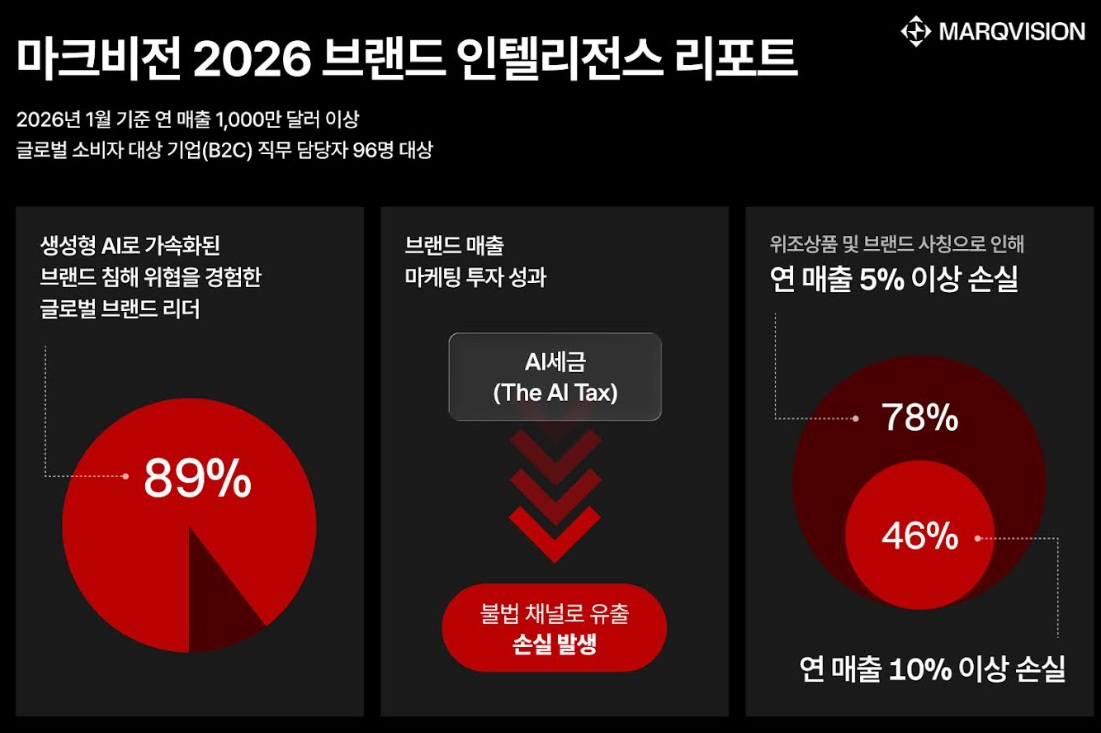
According to the survey, 89% of respondents said generative AI has increased the risk of brand infringement. MarkVision explained this structural loss, as resources invested in marketing activities or sales growth are being diverted to illicit channels, using the concept of "The AI Tax."
The report analyzed that generative AI technologies are rapidly replicating brand assets such as product images, shopping malls, domains, and marketing content, diverting consumer demand that should flow through regular distribution channels into unofficial channels. In this environment, brand protection activities can become a critical management factor affecting sales stability and demand management.
In particular, the phenomenon of "viral hijacking," where content and strategies are copied directly, was found to be on the rise as social media campaigns spread. Fifty-seven percent of respondents reported discovering impersonating accounts or websites within a week of a campaign's spread, and 24% reported detecting such instances within 24 to 48 hours. Furthermore, 54% reported discovering counterfeit products within a week.
These issues, according to research, lead to financial losses for companies. Seventy-eight percent of respondents estimated that counterfeit goods or brand phishing cost them more than 5% of their annual revenue, with 46% reporting losses exceeding 10%. Indirect impacts also emerged, including damage to brand reputation (67%) and increased customer support costs (52%).
The report also presented findings that contradict the prevailing perception that the conservative stance of finance organizations is a factor hindering increased brand protection investment. In fact, the survey found that 66% of finance organizations either recognized the need for or supported brand protection activities. However, the lack of clarity about how investment benefits translate into business outcomes, such as sales protection or cost reduction, was identified as a major factor delaying investment.
Furthermore, 82% of the surveyed companies said they plan to increase investments in building brand trust within the next year, while none of them said they would reduce their investments. This finding suggests that brand protection activities are recognized as an essential investment area in corporate management.
To address these changing circumstances, MarkVision also proposed key metrics for measuring brand trust-building performance. These include the "Market Saturation Rate," which indicates the percentage of illegal or abnormal results displayed in brand searches; the "Mean Time to Respond" (MTTR), which is the average time it takes to resolve a breach from discovery; and "Revenue Protected," which represents revenue secured through brand protection activities.
Lee In-seop, CEO of MarkVision, explained that brand protection in the AI environment is not simply a post-event response, but has become a core management task that affects sales stability and brand trust. He stated that the company will focus on building a technology-based environment that enables global brands to respond more quickly to IP infringement threats.
Recently, global companies are strengthening their technological investments and response strategies to protect intellectual property rights, including online counterfeit goods, brand phishing sites, and digital content theft, as generative AI spreads.
- See more related articles
You must be logged in to post a comment.