



If you're familiar with DCENT (D'CENT), chances are you're interested in cryptocurrency. DCENT is a personal wallet that allows you to store, manage, and utilize digital assets like Bitcoin and Ethereum. It's essential for storing your assets directly, rather than on an exchange. Just as gold is somewhat secure when stored in a closet, but a large amount requires a safe, a software wallet is like a "closet," while a hardware wallet is like a "safe." Your interest in DCENT likely means you have a lot of digital assets you'd like to store in a safe.
iotrust is the company behind DCENT, the world's first fingerprint-based cryptocurrency wallet. Launched in 2018, DCENT currently boasts 910,000 users in 220 countries.
I met with Yoo Min-ho, co-founder and CSO (Chief Strategy Officer) of iotrust. When I asked him to describe iotrust's organizational culture, he simply described it as "square culture." The square! As a writer, the first thing that came to mind was the Agora of ancient Greece, an open space where citizens gathered to discuss and share information. It also brought to mind Choi In-hoon's novel "The Square," which I read as a child. If you're a traveler, you might think of Rome's Piazza di Spagna. Let's explore what square culture is. Before that, let's take a look at iotrust's mission and vision.
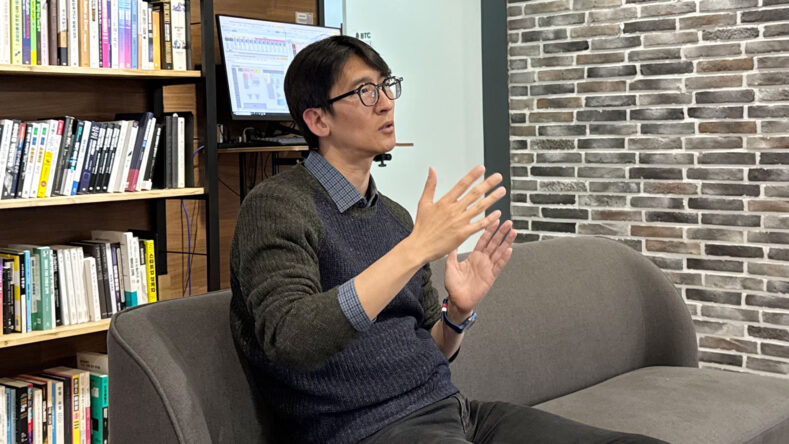
“ Continuously surprising users”
To understand iotrust's mission, we first need to imagine the future of finance. An interesting analogy emerged in the interview: "Finance is becoming like content." Think about it. Back in the day, there were only a few TV channels, and people's content consumption patterns were also divided into several categories. Now, however, each person is presented with completely different content. This is because content itself has become extremely fragmented as individuals have begun to create it.
iotrust believes that finance is heading in this direction. Until now, finance has been about choosing from a few banks, insurance companies, and deposit products. But with blockchain, anyone can create financial services, and the options are vastly expanded. Therefore, iotrust's mission is to surprise users with services that are hyper-personalized. Just like Iron Man's nanosuit perfectly fits the wearer's body, it adjusts to fit a different person when worn. This is precisely the kind of finance that iotrust envisions: a financial experience that's unique and personalized for each individual.
A world where each individual becomes their own bank .
iotrust's vision is "a world where each individual becomes their own bank." Every wallet created by iotrust is self-custody, meaning users manage their own assets. As this experience builds, each person will ultimately have their own bank. A world where people can act as banks without banks. Isn't that a pretty impressive vision?
Now, let's talk about iotrust's square culture.
Everything in the square
Q. Please explain the square culture.
"A public forum culture refers to a work style where decisions and discussions take place in an open space. For example, every member can see how many units DCENT sold in which country yesterday. We openly share all information so everyone can access it. The same goes for communication. Requests for work are made in an open space. We ensure that even those in the finance team are fully aware of what the development team is working on."
Saying "let's make it public" doesn't really resonate. Just because a company discloses information doesn't mean that kind of culture will automatically develop. It seems like a culture that requires the participation of its members. I asked if there was a specific space called a "public square."
Q. When we say plaza, we mean a space where people gather . Is there such a physical space ?
"Slack is a 'public square.' In startups, ideas are constantly surfacing and new creations are frequently happening. Every time an idea strikes, we say, 'Let's meet and talk,' and all the results of those meetings are recorded in Slack. Everything from beginning to end is recorded in the public square. Working in the public square isn't just about public Slack channels; it's about creating a system where data and meeting minutes flow throughout the organization. The essence of the public square isn't simply about using Slack; it's about fostering a flow of information."
Q. What are the rules of plaza culture ?
"There's a communication rule called ADS that underpins the plaza culture. ADS stands for Acknowledge, Do, Share. When we see a tag or request, we leave a mark of 'seeing' with an emoji or thread (A). We take responsibility for agreed-upon tasks (D), and we transparently share progress and results through Slack and documents (S). The structure allows everyone to see at a glance who's working on what and where they're at in the plaza."
Q. What else is happening in the square ?
"Every morning, members share what they completed the previous day and what they're working on today in the Slack #stand_up channel. Anything to discuss or any issues they encounter are immediately discussed here. If necessary, we schedule meetings to coordinate direction. It's important to take initiative and pursue a defined problem, not just because someone else told you to. Our meetings are also unique. We meticulously record why we gathered, what was discussed, how decisions were made, and who was doing what and by when. The meetings themselves become learning assets for the organization."
Q. I think there might be negative consequences if everything is revealed.
"Communicating in a public space can be daunting. Code reviews, in particular, involve exchanging feedback, asking for changes. Doing this in a place where everyone can see it can easily feel like public criticism. However, by conducting reviews publicly, we've naturally developed a culture of humor and mutual encouragement. When code is uploaded, we assign reviewers, and when a Slack tag appears, we exchange opinions. Sometimes, we engage in in-depth technical discussions, while other times, it becomes a cheer-up moment filled with jokes and encouragement."
He said that initially, transitioning to this culture was quite difficult, as it required a fundamental shift in the way we worked. However, the proactive approach to problem-solving, coupled with the encouragement of those around us, has become a ingrained part of IoTrus' culture. He said that various projects are being experimented with within this atmosphere.
Information is transparent , communication is natural
iotrust has six core values that align with this open-air culture: "Transparent information," "Natural communication," "Excellent performance," "Responsible work," "Enjoyable work," and "Honesty with colleagues."
"Information transparency" and "communication is natural." These two principles are the core and root of iotrust's organizational culture. When information is transparently disclosed, it naturally reveals who is doing well and who is lacking. This inevitably raises the bar for performance, fosters accountability, and fosters honest feedback. This structure allows the remaining values to grow naturally within the foundation of transparency.
People who are good at communicating in public spaces
What does iotrust look for most in hiring? The answer is clear: "Communication skills in public settings." However, communication alone isn't enough. You also need to possess practical skills to match those communication skills. Can someone be good at communication but not at work? That's not possible.
However, communicating in public places is a culture that requires some adjustment. It's not easy to discuss and discuss opinions in front of a large crowd. That's why they emphasize this point particularly during the onboarding process.
How do you evaluate it?
"Everyone sees that those who are doing well are doing well, and everyone sees that those who are lacking are lacking, so the process of consensus among leaders is streamlined. Since open communication is the default, there's no special reward, but feedback is clear for those who aren't. What if something happens at the company and you can't find a trace of it in Slack? I see it as a sign that their presence in the public square is diminishing."
AI: Not a Nice-To-Have, but a Matter of Survival
iotrust's second core culture is AI utilization culture, or AX (AI Transformation).
“It’s not just a nice-to-have; it’s a matter of survival for startups.”
iotrust's AX is largely divided into three stages.
The first stage is where individuals freely interact with AI. The company's policy is to subscribe to new AI services, try them out, and then cancel when they no longer need them. After about a year of this approach, nearly all employees are now able to create their own automation tools using Claude Code. The development team uses AI for code refactoring, test code generation, and log analysis, while the design and marketing teams use generative AI to quickly explore image and video concepts. The people culture, finance, and sales teams also use AI to draft regulatory documents, create job postings, and write reports.
The second step is to automate the work process itself with AI agents. Being able to use AI effectively on an individual is a completely different story than integrating it into a company's workflow. This is where the power of the square culture comes into play. Slack conversations, meeting minutes, and Jira task records are all archived in the square, which is incredibly helpful for the AI agent to understand the context. There's no need to get lost from the start. The square culture has become a solid foundation for AX.
The third step is to integrate AI into the service itself. iotrust deals with digital assets. While it's easy to ignore a recommendation algorithm in a shopping mall that suggests the wrong product, it's a completely different story if AI makes a mistake in the wallet where assets are handled. Therefore, in this area, we're prioritizing caution over speed. We're currently preparing an early version of a service that integrates AI into our services.
The AI movement that started with a B- grade poster
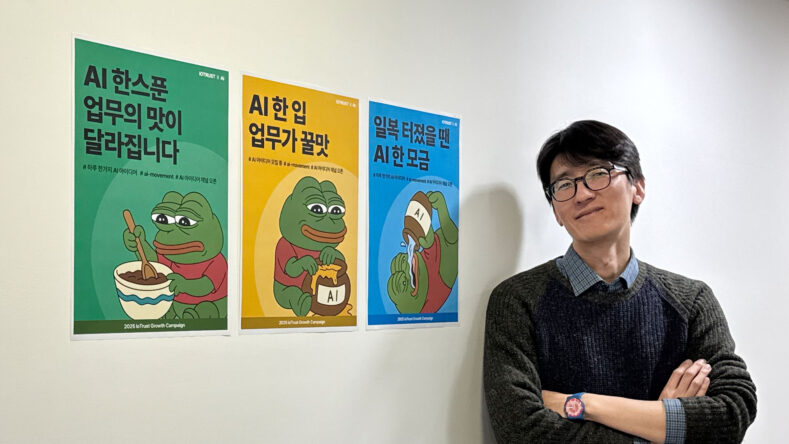
What's interesting is the process of implementing AX. iotrust took a somewhat unconventional approach to promoting the importance of AI. They placed B-grade posters created with AI throughout the office. They say it started with the humorous line, "Let's even create these posters with AI."
Slack has a dedicated channel for the AI movement. Information is constantly exchanged, from proposing new AI-related ideas to sharing updates from Claude Code. This constant visibility of information leads to greater interest, and this increased interest leads to more information being shared, creating a virtuous cycle.
Furthermore, at monthly town hall meetings, executives personally explain AI, the market, and strategies. It serves as a forum for the entire organization to learn together. Sometimes, individual employees even take the initiative to present their insights, transforming them into learning assets for the organization. Now, nearly every employee is independently developing AI tools. A year and a half of steady seed-planting is finally bearing fruit.
From the Plaza to AI , Connected Culture
What struck me most during my interview with iotrust was that "public square culture" and "AI utilization culture" are not separate entities, but rather interconnected. The data and context accumulated through transparent communication within the plaza become the foundation for AI utilization, and AI further enhances the plaza's efficiency, creating a virtuous cycle. iotrust's philosophy isn't "Let's use AI a lot," but rather "Let's use AI effectively, enabling a small team to move faster and more accurately."
iotrust's core value, "Transparent information, natural communication," wasn't just a slogan. It was a way of working, practiced every day in the digital forum called Slack. And within that forum, a new colleague, AI, began working alongside us.
A world where each individual becomes their own bank. It sounds like a distant future, but with this team working in the plaza, I think we might get there sooner than we think.
You must be logged in to post a comment.