



The travel industry, which has been slow to digitalize, is undergoing a major transformation in the airline distribution structure.
Expanding automation of travel agency reservation and ticketing operations through NDC and API-based connectivity technologies.
NUUA Drives Global Expansion with AI-Based Aviation Back-Office Solutions
The travel industry is considered one of the four major global industries, but when looking at IT systems alone, it's often considered a legacy industry. In many cases, core operations like flight reservations, ticketing, and refunds still rely heavily on human intervention.
Travel tech startup NUUA launched with the goal of transforming this structure through technology. Choi Chung Yeol, Chief Strategy Officer (CSO), co-founded the electronic contract service "Glosign" and has experience exiting the business. He spoke about structural change in the travel industry, saying, "What's more important than technology is accurately identifying the problem."

From contracts to flights… Entrepreneurs who solve problems
Choi Chung Yeol, CSO, previously co-founded Glosign, an electronic contract service. Glosign was launched to address the time and cost issues associated with paper-based contracts. Paper-based contracting processes were inherently cumbersome, requiring cumbersome document management and inefficient workflows. International contracting, in particular, presented numerous barriers, including language barriers, legal procedures, and contract management issues. Glosign recognized the need for a solution to address these challenges.
Glosign grew with the goal of digitally transforming this contracting process, and experienced an exit in the form of a stake sale to a publicly traded company just a year and a half after its incorporation. CSO Choi says this experience confirmed that the most important factor in a startup's growth is not the technology itself, but the ability to define the problem.
"Entrepreneurship is ultimately a process of constantly encountering new problems. What matters is how persistently you solve them."
His reason for choosing the travel industry as his next venture was similar. He believed that industries that haven't yet fully transitioned to digital transformation have more challenges that can be solved with technology. Just as with electronic contracts, airline distribution was also a sector that hadn't fully transitioned to digitalization, and he explained that the travel industry, in particular, had low IT utilization relative to its size.
"Many travel agencies still handle business through phone calls, messengers, Excel, and email. I felt it was an industry far removed from IT, and so I realized there were many problems that could be solved with technology."
How is the airline distribution structure changing after GDS?
The core infrastructure of the airline ticket distribution market is still the Global Distribution System (GDS).
A GDS is a global reservation system that provides airline seat information and fare data to travel agencies. Leading operators include Amadeus, Sabre, and Travelport. For decades, it has played a central role in airline ticket distribution, establishing itself as a core infrastructure connecting travel agencies and airlines worldwide. Recently, with the addition of new technology standards and data connectivity methods, the airline distribution structure is gradually expanding.
CSO Choi explained this change as follows:
"Existing GDS systems originated from a text-based terminal environment. In contrast, the recently introduced NDC (New Distribution Capability) is an API-based system, allowing for more flexible use of images and other diverse data."
NDC is a next-generation airline distribution standard promoted by the International Air Transport Association (IATA). It is designed to expand the data connection between airlines and travel agencies through APIs, enabling the delivery of a wider range of product information. This structure allows for the sale of not only seats but also various ancillary services. Various services, such as seat upgrades, extra baggage, in-flight Wi-Fi, and meal options, can be packaged as a single product.
CSO Choi explained that airline distribution is recently evolving toward utilizing multiple channels, including GDS, NDC, and LCC Direct API.
"While airline distribution data was previously centered around GDSs, various connection methods, such as NDCs and LCC Direct APIs, are now being utilized together. Integrating and automating this data into a single platform is a key trend in recent aviation distribution technology."
He added that these changes are not about replacing existing infrastructure, but rather about integrating various data sources to enrich the airline product offering.
Technology that connects complex air distribution
NUUA plays a role in connecting the aviation distribution structure with technology amidst these changes.
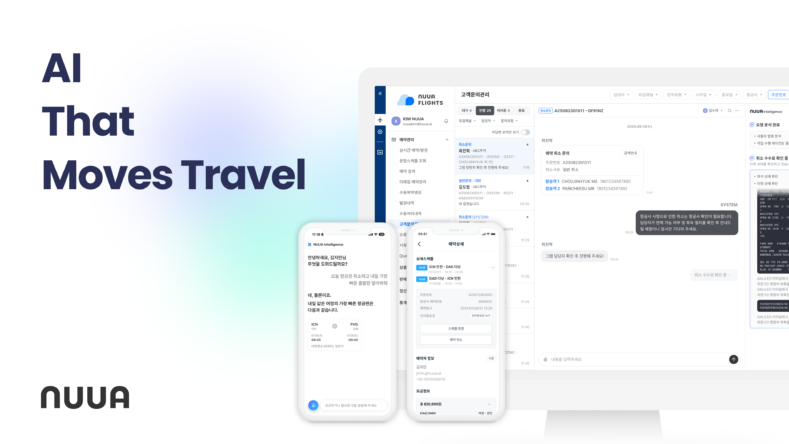
The company is developing an airline distribution aggregator technology that integrates airlines' NDCs with existing GDSs and low-cost carrier (LCC) systems. Furthermore, it offers "NUUA Office," an airline back-office solution used by travel agencies in their actual operations, as a SaaS offering.
"Most travel agencies don't have their own airline back-office system. NUUA Office automates tasks like reservations, ticketing, and refunds, improving operational efficiency."
He particularly emphasized the high technical difficulty of the aviation domain. Aviation is one of the most complex sectors in the travel industry, with numerous regulations and exceptions and complex system architectures. Consequently, developers with aviation development experience are scarce. Consequently, many travel agencies rely on external technologies rather than building their own systems. This explains the growing need for platforms that technically connect airline distribution. These structural characteristics naturally create high barriers to entry in the aviation technology market.
"Aviation is a market with complex regulations and data structures, making it difficult for inexperienced developers to access. Therefore, once you've built the technology, it's a market where you can actually become competitive."
"The work of 10 people can be done by 1-2 people"… AI is transforming airline ticketing.
NUUA is also recently expanding its AI-powered workflow automation capabilities. This approach allows AI to handle complex, rule-based tasks, such as calculating ticket change policies or refund fees. Ticketing is a typical rule-based task, requiring simultaneous review of various conditions, including fare rules, airline policies, and fee rules. Since even a small mistake can lead to financial losses, experienced personnel are essential.
CSO Choi sees the need for automation in changes in the workforce structure.
"Since the COVID-19 pandemic, many people working in airline ticketing have left the industry. It's not easy to find experienced talent these days."
The labor shortage is particularly acute for small and medium-sized travel agencies. Some travel agencies operate by sharing the costs and jointly hiring a single ticketing agent. In this structure, automation is seen as a technology that can go beyond simply improving efficiency and transform the very way the industry operates.
"By introducing an automated system, we can create a structure where one or two people can handle the work of ten people. This isn't just about cutting costs; it creates a foundation that allows travel agencies to focus on more important tasks, such as customer service and product planning."
NUUA, a technology that started from a problem and is now heading towards full-scale growth
NUUA secured a Series A investment of 13 billion won in 2024, laying the foundation for technological advancement and global expansion. The company is pursuing expansion into the Japanese and Asian markets, centered around its Singapore subsidiary.
CSO Choi Chung Yeol said this about the conditions for growth of technology startups.
"Problems are more important than technology. And direction is more important than speed."
He explains that focusing solely on technology itself makes it difficult for a company to achieve long-term growth. Even for technology companies, focusing solely on technology can lead to missing the fundamental market problems. Ultimately, what matters is the problem being solved.
Having seen the potential of digital transformation through his experience founding and exiting the electronic contract service Glosign, he is now focused on transforming another legacy industry—the travel industry—with technology. NUUA aims to expand beyond ticketing and reservations into a platform that automates all aspects of travel agency operations. The plan is to build an infrastructure that supports travel agency decision-making by connecting ticket distribution data with back-office operational data.
CSO Choi describes NUUA's current stage as "preparing for growth." Over the past several years, the company has focused on building its technology foundation and validating its products in the market. This process has also led to the firm's conviction that its approach to automating airline distribution is correct. The travel industry is a classic example of a legacy industry that has lagged behind in digital transformation, with many areas still reliant on manual processes and complex operational structures. CSO Choi believes this structure could actually present opportunities for technology companies.
"The travel industry still has a lot of room for change. The market is evolving at an ever-increasing pace, and I believe there's a lot NUUA can do within that pace of change."
You must be logged in to post a comment.