



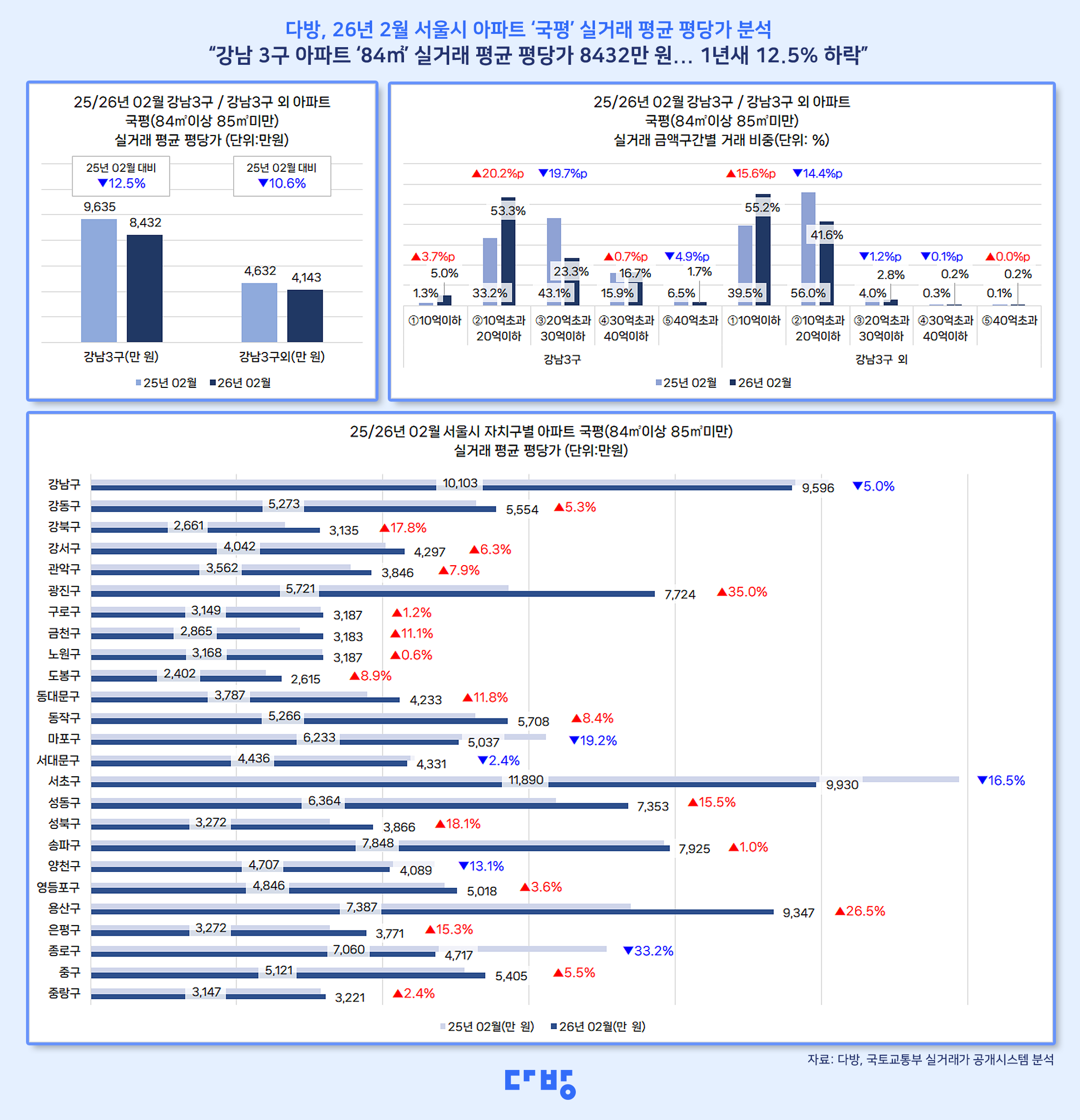
Based on data from the Ministry of Land, Infrastructure and Transport's Real Estate Transaction Price Disclosure System, Dabang compared and analyzed the average price per pyeong (unit of area) of apartments measuring 84-85 square meters in Seoul in February 2025 and 2026. The sales price was calculated per pyeong by converting 1 pyeong to 3.3 square meters.
The analysis found that the average price per pyeong of apartments in Gangnam's three districts fell 12.5% from 96.35 million won in February 2025 to 84.32 million won in February 2026. In areas outside Gangnam's three districts, the price fell 10.6% from 46.32 million won to 41.43 million won over the same period.
The decline in per-unit prices was primarily attributed to changes in the proportion of transactions by actual transaction price. In the three Gangnam districts, the proportion of transactions in the KRW 2 billion to KRW 3 billion range decreased by 19.7 percentage points, from 43.1% to 23.3%, indicating a decline in high-priced apartment transactions. Conversely, the proportion of transactions in the KRW 1 billion to KRW 2 billion range increased from 33.2% to 53.3%.
In areas outside of Gangnam's three districts, the proportion of transactions worth 1 to 2 billion won decreased from 56.0% to 41.6%, while the proportion of transactions worth less than 1 billion won increased from 39.5% to 55.2%.
By district, Jongno-gu recorded the largest decline, dropping 33.2% from 70.6 million won to 47.17 million won. This was followed by Mapo-gu (19.2%), Seocho-gu (16.5%), Yangcheon-gu (13.1%), Gangnam-gu (5.0%), and Seodaemun-gu (2.4%).
As of February 2026, the district with the highest average price per pyeong of apartments in Seoul was Seocho-gu (KRW 99.3 million), followed by Gangnam-gu (KRW 95.96 million) and Songpa-gu (KRW 79.25 million).
A representative of the teahouse said, “In the past year, apartment transactions worth over 2 billion won in the three districts of Gangnam have decreased, while the proportion of transactions worth under 1 billion won has increased in other regions.” He added, “It is believed that a combination of factors, such as changes in transaction amounts and supply and demand situations, have influenced the decline in the national average price per pyeong.”
In the Seoul apartment market, regional price gaps and changes in average price per pyeong are continuously observed as transactions in high-priced apartments decrease and transactions in mid- to low-priced apartments increase.
- See more related articles
You must be logged in to post a comment.