



Research with Scholastic, documentation with Wright… Connecting fragmented knowledge labor into one
– “Opening a world where anyone can research with 'VIBE Research'”
-“Domestication of AI applications is crucial.”
Global AI search startup Liner, following the independent launch of its existing research-focused AI, "Liner," as "Liner Scholar" in January, unveiled a new business document-focused AI, "Liner Write," last month. Liner Scholar and Liner Write operate on the same technology, but have separate user interfaces for optimal user experience.
Liner, the foundation of both services, boasts a massive academic database of 460 million articles worldwide. This is more than double the industry standard of 200 million research-specific AI services. Drawing on this vast academic database, Liner provides data based on reliable sources, minimizing the hallucinations often seen in generative AI. Liner's core competitive advantage lies in its ability to minimize these hallucinations. It currently boasts 13 million users in over 220 countries.
Liner is currently the only AI application among Korean startups to be listed on a16z's global AI web product list. It was the first in Korea to obtain the 'Responsible AI' badge and has secured SOC 2 Type II and HIPAA certifications, establishing a top-tier global framework in the fields of security and ethics.
While Korea's AI policies focus on chip and model development, applications are the most important factor for transforming the lives of ordinary people. Given our current reliance on foreign services, the localization of AI applications is a critical task.
Luke Kim, CEO of Liner, emphasized that the most important aspect of AI is the localization of applications. Citing the example of Google changing the name "Gulf of Mexico" to "United States Gulf" on Google Maps in accordance with President Trump's executive order, CEO Kim explained how directly applications influence users' perceptions.
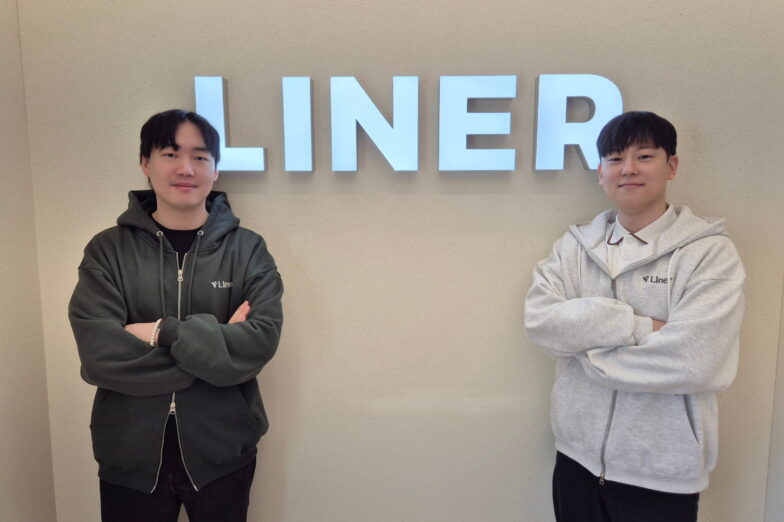
We met with CEO Luke Kim at the Liner office in Mapo-gu, Seoul, to discuss the technology and business applied to Liner Lite and Liner Scholar, the knowledge labor revolution, and the challenges of localizing AI applications.
Innovation in information search as innovation in knowledge work
Let's revolutionize information exploration.
The phrase "Reinvent the Knowledge Work" is inscribed on the back of the Liner team's hoodie. This is Liner's vision. So, what specifically does the "innovation in information search" that Liner speaks of mean?
Kim explained that the very question of what information seeking is has evolved over time. There was a time when being able to find books in the library and having a good memory were considered skills, and with the advent of the internet, being adept at Googling became a competitive advantage. After 2015, the ability to subscribe to newsletters and curate YouTube channels became information power, and recently, being adept at AI has become the ultimate information seeking skill. But a further shift is taking place. Previously, the act of finding information and utilizing it were completely separate: searching on Google, gathering data from academic databases, and writing in a word processor. Each change in tool resulted in a loss of context, and the repetitive transfer of information was time-consuming. However, with the advent of AI, these two processes—finding and writing—have begun to merge.
The vision of "innovating information search" has now virtually become synonymous with "innovating knowledge work." Both Liner Scholaro and Liner Lite are products designed to innovate knowledge work. We are moving in the direction of increasing the productivity of knowledge work through AI.
Liner aims to connect the fragmented processes of knowledge work within a single platform. Its structure seamlessly connects information discovery with AI search, in-depth analysis with Liner Scholar, and document completion with Liner Lite. When the entire process—from exploration to analysis, and from analysis to output—is integrated, innovation in information exploration truly becomes innovation in knowledge work itself. This is why Liner Scholar and Liner Lite were designed as a single ecosystem, not as separate services.
Innovation created by user experience
Liner Scala's proven, academic database-based hallucination-minimizing technology continues to be implemented in Liner Lite. When writing business documents requiring expert knowledge and logical structure, Liner Lite delivers highly reliable results based on verified information and accurate sources. CEO Kim explained the background behind the launch of Liner Lite as follows:
"As I refined my Liner Scholar skills, I discovered I was also adept at logical writing. I was able to produce not only academic papers and research papers, but also high-quality business documents like business plans, sales proposals, newsletters, and government-funded project proposals. Logical structure is key in business documents, just like academic papers. Liner's honed strengths were clearly evident."
Just as important as technical strength is the user experience. Currently, most AI writing processes are fragmented. The AI generates a draft, then copies it to Notion or Google Docs, edits the document, and then resubmits the revised version to the AI for further editing. This requires constant switching between tabs, frequently interrupting the writing flow.
Generative AIs like Claude and ChatGPT are good at drafting documents. The problem is that the revision request process is complicated. Sometimes, when I ask to fix just a specific sentence, an unrelated sentence is modified, and there are many cases where I only want to make minor adjustments, but the entire document is rewritten from scratch.
Liner found the answer to this inconvenience, which anyone who writes with AI has likely experienced at least once, in the world of developers.
As a heavy user who writes extensively with AI, I'm acutely aware of the inefficiencies of existing methods. Developers use 'Cursor' to combine a coding editor and AI on a single screen. They write code in the editor, ask the AI questions right next to them, and the AI's edits are immediately reflected in the editor. I believe this kind of UX is essential for writing as well.
Liner Lite combines an editor and AI into a single screen. Enter instructions into the AI within the editor window, and it edits, adds, and deletes content in real time within the document. Users simply review the AI's suggested edits and decide whether to accept or revert them. There's no need to switch between tabs or repeat copy-and-paste.
“ We will usher in the era of ‘ VIBE Research ’ ”
"I wish we could live in a world where anyone can do research. Research is about creating new knowledge based on existing knowledge, but currently, only a small group of people, like university professors and graduate students, can do it. If a world were to emerge where even middle school students could conduct research like professors, the horizons of human knowledge would expand tremendously."
CEO Kim explained this with the concept of "Vibe Research." Just as Vibe Coding enabled non-developers to create software simply by giving instructions to AI, Vibe Research aims to enable anyone to collaborate with AI to conduct academic-level research. There have already been practical examples. Last year, at "Agents4Science 2025," the world's first AI author conference hosted by Stanford University, a first-year student at the Korea Science Academy wrote a paper using only Liner Scholar and was selected for the "Spotlight" award, which is given to only the top 11 papers. This case of a high school student with no research experience completing an international conference-level paper in just one month demonstrated that Vibe Research is not just a slogan, but a reality.
Accuracy is paramount for achieving Vibe Research. Liner's accuracy has already been proven in numbers. The Liner Pro Reasoning model scored 95.3 on the SimpleQA benchmark, surpassing both OpenAI's GPT-4.5 (62.5) and Perplexity's Deep Research (93.9). In terms of speed, Liner completes Deep Research in just 1-2 minutes, compared to 3-10 minutes for competing services.
This high level of accuracy is possible thanks to the data assets Liner has accumulated since 2015. Experts and researchers around the world have personally selected, summarized, and stored high-quality data from web documents, accumulating this data over a long period of time. This data has been utilized for post-training to build a search engine based on "human-verified data." The Liner search engine features a proprietary "in-house ranker model" that selects and prioritizes the most reliable sources. This advanced ranker technology dramatically reduces unnecessary computational costs by precisely filtering only the core information required for answers, while simultaneously maximizing the accuracy of answers, completing Liner's unique technological moat.
Furthermore, the Liner search engine is integrated with eight core components specialized in analyzing and processing user queries. The entire process, from question analysis to final answer generation, is managed by these eight specialized components. As a result, Liner's core technologies are integrated into an information retrieval structure that achieves world-class accuracy.
From a user experience perspective, we also focused on ensuring source-based reliability. Liner's answers provide citations for every sentence, along with links to cited documents, quotations, and previews. This structure not only allows users to immediately verify the reliability of the answer, but also allows them to seamlessly conduct additional research based on the same source.
Targeting the B2B Market with a Two-Track Strategy: Korea and the U.S.
Liner has focused on the US market from the beginning, aiming for a global service. Its presence on US universities is particularly notable, with approximately 10% of UC Berkeley's students signing up with their official school email address (.edu). Over 90% of its users are international, and 60% of its paid subscribers are from the US. Liner has been included in the web service category of Andreessen Horowitz's (a16z) "Top 100 Generative AI Consumer Apps" list, published every six months, for four consecutive years since 2024. Liner is the only Korean startup on the list of AI web products.
Starting in the second half of 2024, Liner is adopting a two-track strategy, focusing simultaneously on Korea and the US, as users in Korea, India, and Southeast Asia begin to rapidly increase. Liner is particularly focused on the B2B segment in the Korean market, as demand for Liner's core asset, RAG (Augmented Search Generation) technology, is rapidly increasing in the enterprise market.
Liner's search engine has over 500 million indexed papers. We already have the technology to generate results from 500 million files without any illusions. Most companies, on the other hand, want RAGs for tens of thousands, or at most a few hundred files. Until last year or the year before, many companies attempted to build their own RAGs, but most of those projects were unsuccessful. Now, we're shifting our focus to collaborating with companies that excel at RAG. Because Liner already has advanced technology, I think companies are interested in our engine."
In February of this year, Liner announced its full-scale expansion into the "Enterprise Intelligence" market by hiring Kang Jeong-gu, former Head of Global Business at Kakao Entertainment, as Head of AI Strategy. The company envisions evolving beyond an information exploration tool into an "AI business partner," where AI connects and analyzes internal corporate knowledge to provide insights and actions.
When people think of AI in Korea, foreign services like ChatGPT, Cloud, and Gemini often come to mind. Meanwhile, Liner has quietly but surely established its own niche. With 13 million users in over 220 countries, four consecutive appearances on a16z's "Top 100 Generative AI Consumer Apps," and a SimpleQA score of 95.3, these figures speak for themselves. This means Korea has AI applications that can compete head-on with global big tech companies.
You must be logged in to post a comment.