



Cubic has been selected as a supplier for the '2026 AI Integrated Voucher (Cloud Voucher) Support Project' promoted by the Ministry of Science and ICT and the Korea Information & Communication Technology Industry Promotion Agency (KIPA). Through this project, domestic small and medium-sized enterprises (SMEs) and middle-sized companies can adopt Cubic's AI data solutions by utilizing government support vouchers worth up to 200 million won per company.
While various success stories have recently emerged among individual users and startups through the use of AI agents, the adoption of AI in enterprise environments remains relatively slow. In a July 2024 report, Gartner projected that more than 30% of generative AI projects are likely to be halted during the pilot phase, and a survey published by McKinsey in 2025 indicated that the percentage of companies that have expanded AI across the entire organization remains at around 6%. The industry identifies data management and utilization environments as one of the main causes of this gap.
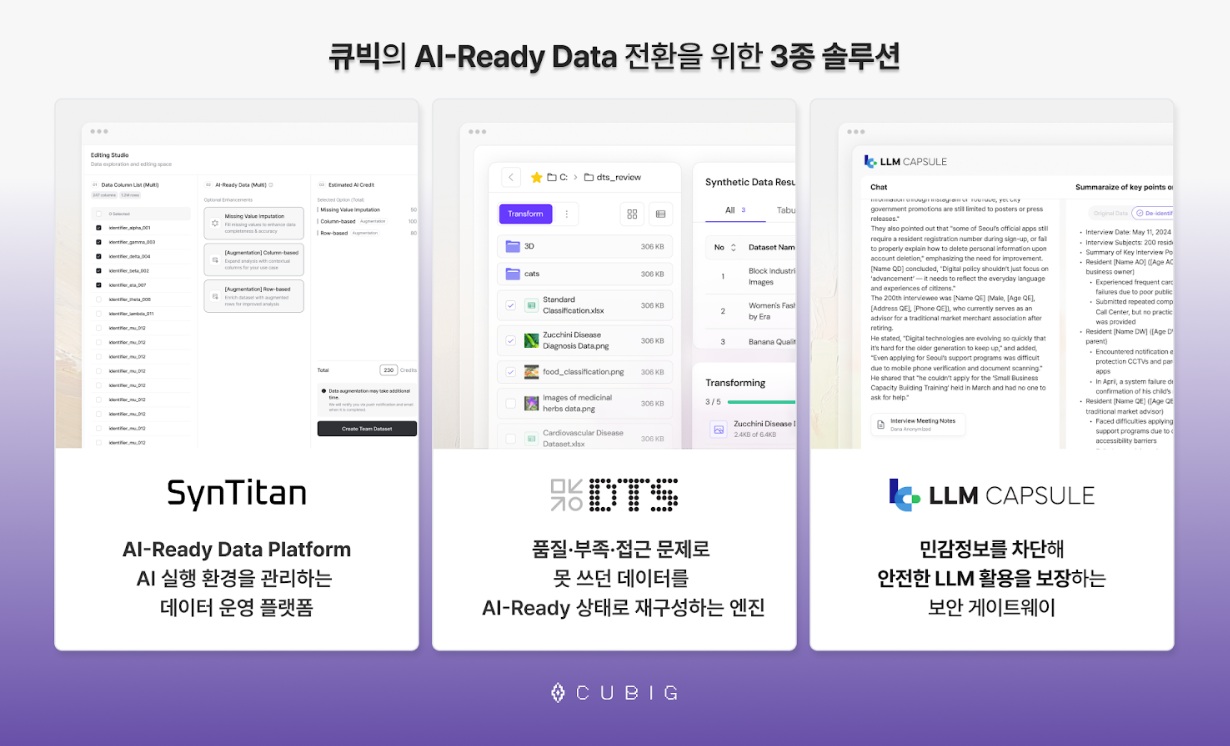
Cubic identifies three major factors delaying corporate AI adoption: data connectivity, data quality, and the transition from pilot phases to actual operations. First, it is often difficult to directly connect with external AI models due to the presence of internal customer information or confidential data. Cubic's 'LLM Capsule' is a security gateway solution that enables integration with AI models without exposing such data externally. In standard cloud environments, it can connect with both external and internal AI models, while in segmented networks, it operates by integrating with dedicated internal AI models.
The second challenge is data quality. Biased, missing, or error-containing data can reduce the usability of AI. Cubic's 'DTS' is an engine that reconstructs data into a form suitable for AI utilization, while 'SynTitan' is an AI data platform that comprehensively handles processes such as data diagnosis, verification, error correction, restoration, and standardization.
Another challenge is the process of expanding from an AI pilot project to a real-world operating environment. Discrepancies can arise between the data organized during the pilot phase and the continuously changing data environment in actual business operations. SynTitan is designed to provide a management system capable of stably managing data status and responding to changes in the operating environment.
As AI agent technology becomes more widespread, security issues are also emerging as a major concern. Recently, there have been instances where advisories for caution have been issued regarding certain AI agent platforms, citing risks such as the potential leakage of internal documents or the processing of files without user consent. Cubic explained that SynTitan provides a structure in which it acts as a protection layer between the AI agent and the source data, ensuring that the agent utilizes only protected data without directly accessing the original source.
Through this AI voucher program, small and medium-sized enterprises (SMEs) and mid-sized companies can adopt Cubic's solutions, such as LLM Capsule, DTS, and SynTitan, within a government subsidy limit of up to 200 million won. The recruitment schedule for participating companies can be checked through the official channels of the Korea Information & Communication Technology Industry Promotion Agency (KIPA), and consulting regarding implementation is also available through preliminary consultations.
"The biggest obstacle in the process of adopting AI in companies lies in data management issues rather than the models themselves," said Bae Ho, CEO of Cubic. "I hope this voucher program will serve as an opportunity for small and medium-sized enterprises to establish their data infrastructure and apply AI to their actual work environments."
Recently, the domestic industrial sector has seen a trend of expanding government-led digital transformation support projects, such as the establishment of data infrastructure and AI utilization support programs, to promote the adoption of AI by companies.
- See more related articles
You must be logged in to post a comment.