



Anyone who has put a house on the market knows this. No matter how good the location or how reasonable the price, when it just won't sell, it really won't. The problem is that there is no way to know why it isn't selling. All you can do is leave it to one or two agencies and wait for a buyer to appear. All you have are dark, hastily taken cell phone photos by the agent and a price determined by intuition.

Jeong Cheol-min, CEO of Selling King, who dropped out of his master's program in computer science at KAIST to jump into real estate investment, keenly felt this frustration while accumulating 22 selling experiences over 10 years.
“Combining my personal experience with client sales, I have directly and indirectly handled over 150 sales. Since the average person sells less than five times in their lifetime, they cannot be considered professionals. When I interview clients, I find that they submit requests with poorly taken photos and rely entirely on brokers they know, handling everything from pricing to sales strategies.”
From the perspective of the experienced CEO, it was frustrating. They complained that they were struggling because sales weren't going well, but it seemed like they could sell much faster with just a little more attention. That led to founding the company. In the early stages of the business, while interviewing subscribers of 'Sadari TV,' the YouTube channel run by CEO Jung, three problems were discovered.
First is when the photos are terrible or non-existent. Second, they list the property with only one agency near their home and wait indefinitely. Finally, they rely entirely on the agent for the price or list it at a price that will not sell.
We accurately propose a sellable price based on actual transaction and asking price data. We even have experience successfully selling properties listed too low by raising the price.
If the probability of selling is 0.1% when listing in one place, the probability increases dramatically if listed in 150 to 250 places. Since customers have to manually handle brokerage requests, they can only list 50 places even if they spend a full day on it, but the "Selling King" uses technology to complete requests for over 200 places within an hour.
The biggest problem with the existing brokerage method is that they simply list properties on large platforms and wait for buyers to come. Just as people often purchase items they stumbled upon in advertisements rather than searching with a specific purpose when online shopping, real estate—one of the most expensive assets—paradoxically waits only for platform traffic.
“As brokerage shifted online, I believed that property promotion required digital marketing. However, real estate agents are not experts in photography, editing, or advertising. They lack the resources to invest in such areas. Therefore, we act as an advertising agency that promotes sellers' listings to agents and prospective buyers.”
He emphasized, “I contact real estate agents near the property individually, obtain their consent, and then deliver the listing,” adding, “This process is also automated, so it is processed much faster than for the average person.”
Brokerage in Korea is divided into exclusive brokerage, where commissions are received from both the buyer and the seller, and joint brokerage, where one party acts as an agent. If a "King of Sellers" directly delivers a listing, the broker can receive commissions from both sides, doubling their profits. The explanation is that if there is a buyer, there is an incentive to prioritize showing the "King of Sellers'" listings.
Real estate agents can receive property photos, detailed information, building registers, and even certified copies of the land registry at no extra cost and upload them immediately. Licensed real estate agents are the most important partners for Maedowang.
The "Seller King" operates a brokerage firm but uses it solely for promoting listings and does not engage in brokerage directly. Brokerage is handled directly by the commissioned agent. The compensation received by the Seller King is akin to advertising agency fees. The initial retainer is 100,000 to 200,000 won, and upon success, it is 0.25% (minimum 1.1 million to maximum 3.3 million won).
Since founding the company, we have completed an average of over 6 transactions per month, totaling more than 200 cumulative deals. Cumulative revenue has exceeded 300 million won. I vividly remember a client case from the early days of the business. It was a public housing apartment in Jinju, Gyeongnam, priced at 50 million won. Upon consulting with the client, I found that they had listed the property with only one or two real estate agents, relying solely on them, at a price far removed from actual market value. It hadn't sold for a year.
It wasn't easy because the lease still had time remaining, but the buyer turned out to be another tenant living in the complex. We promoted the property to every single real estate agent in Jinju, and one of them happened to know that tenant personally.
The "King of Sellers" submitted listings without exception, reaching even networks inaccessible due to information asymmetry to facilitate transactions. He explained, "You might think we are simply listing a lot of properties. However, we introduce listings meticulously, like weaving a spiderweb, and communicate continuously with real estate agents," adding, "The key is to ensure that even a single prospective buyer can view our listings."
CTO Ju-seong Lim, whom we met through the Antler Korea Batch 3 program, is an AI expert. He rapidly built the initial Sell King system using AI. Since then, he has continued to improve corporate processes using AI.
“If you look solely at our service, ‘Maedowang,’ it might seem like a simple PropTech company, but thanks to CTO Im Ju-seong, it is closer to an AI company with the AX DNA implanted from the start. We are reducing costs by introducing AI into many internal processes.”
While operating "Sell King," I noticed another problem. I make phone calls to nearly 500 brokers a day. Consequently, even with contact information saved, it was difficult to remember the entire communication history and identify who was who. That is why I created "MomoCall." It is a follow-up agent app that summarizes call and text history and assists with customer management and note-taking. Most call summary apps on the market provide one-time summaries and do not link to task processing; however, MomoCall summarizes and processes tasks while retaining the full context of previous calls with the customer.
It was first introduced last November. It maintains an 84% retention rate and a 19% paid conversion rate. It has been launched in six countries globally.
“When communicating with real estate agents, there are times when they forget a property listing or leave customer service unsatisfactory. Believing that AI can significantly improve this, we launched MomoCall. I believe that if it becomes the standard app for agents, it will elevate the level of brokerage services in Korea.”
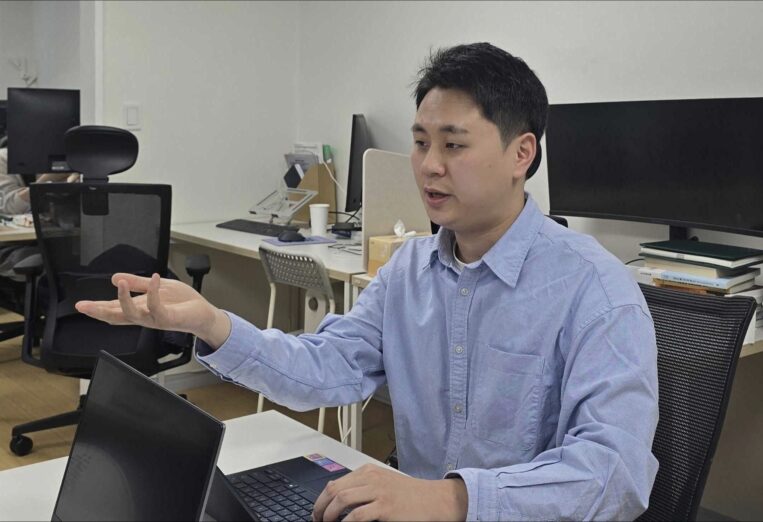
Ultimately, the goal is to elevate the selling experience for sellers and the brokerage experience for brokers to a higher level through Maedowang and Momocall. I advised junior proptech entrepreneurs, “Instead of creating the service you want to do, discover problems that customers find so troublesome that they are willing to pay millions of won for them.”
It is difficult to change existing customs in the real estate sector. With the demographics of market participants not being young and regulations being stringent, it is not easy for new services to take root. Nevertheless, I believe the reason services like "Maedowang" can emerge is that the suffering of customers is unique. Just focus on what their real problems are.
An engineering graduate who dropped out of KAIST and sold 22 houses has launched *Maldowang* and *Momocall* to break the information asymmetry in the real estate brokerage market. Attention is focused on how the tenacity of an entrepreneur who sold in two months what took a year to sell will change the real estate transaction market.
You must be logged in to post a comment.