


The stock market is hot these days. Looking at stock price graphs has become a daily routine. Although economic indicators such as GDP, the price index, unemployment rates, interest rates, and the trade balance are released every day, they do not feel tangible to us; however, looking at the movements of stock indices gives us the feeling that we can grasp the flow of the real economy at a glance.
If we can quantify the invisible in this way, wouldn't we be able to understand its flow much better? There is a saying that "if you can't measure it, you can't manage it." If we can make invisible organizational culture visible in this manner, it seems it would be helpful in building a positive organizational culture. In fact, there is a team that measures its organizational culture at every moment, much like a stock market index, and grows that culture based on those numbers. This is the story of Liner, a global AI search startup.
Liner operates a unique system called the 'Culture Market.' Five core values are listed like stocks, measured by their price, and all team members can monitor their fluctuations in real time. When actions align with the core values, the stock price rises, and the team member who performed such actions comes to hold the corresponding stock. Conversely, a 'circuit breaker' is triggered for actions detrimental to the organizational culture. Dividends on the held stock are also paid out every six months. By establishing a dedicated role called 'Culture Investor' to oversee this system, Liner has transformed the previously abstract concept of organizational culture into a visible and measurable entity.
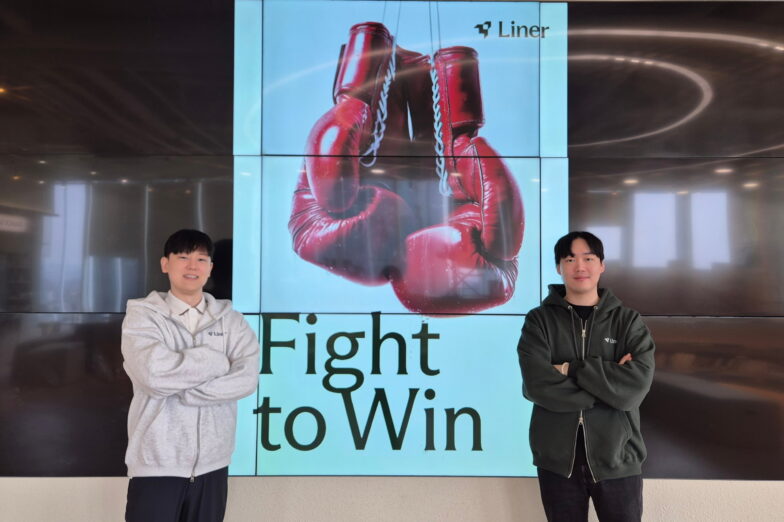
To cover Liner's unique organizational culture, I met with Liner's CEO Luke and Culture Investor Ben to discuss the company's culture.
First, let's find out what kind of company Liner is.
What is a liner ?
You are using several generative AIs, aren't you? We have reached a point where we can no longer work without AI. I use various AIs myself, but there is one I absolutely must use when writing articles: Liner. Industry scales and the status of legal systems must be accurate. It is problematic if they are wrong. However, many AIs invent plausible figures through hallucination. If you have ever been fooled by an AI, you will understand. Liner is different. Equipped with a global academic database of 460 million records, it produces fewer hallucinations and provides sources at the sentence level. Thanks to this, I can drastically reduce the time spent on research.
Liner started as a web highlighting service in Silicon Valley in 2015 and has now grown into an AI search and research platform used by 13 million people in 220 countries worldwide. It is also the only Korean AI startup to be named to the 'Top 100 Generative AI Consumer Apps' selected by Andreessen Horowitz (a16z) for four consecutive years. Currently, it operates two AI agent services: 'Liner Scholar,' specialized for academic research, and 'Liner Write,' specialized for business document creation.
Liner aims to enable anyone to collaborate with AI to conduct academic-level research. Luke explains this using the concept of ' Vibe Research '.
Just as VIVE Coding enabled non-developers to create software with AI, VIVE Research means that anyone can conduct academic research using AI.
In fact, at 'Agents4Science 2025,' the world's first AI author conference hosted by Stanford University last year, a paper written entirely by a first-year student at the Korea Science Academy was selected for 'Spotlight,' an honor given to only the top 11 entries. This means a high school student with no prior research experience completed a paper of international academic conference caliber in just one month. This is an example of Vibe Research becoming a reality.
'Liner Lite,' newly introduced last month, is an AI agent specialized for business document creation, built upon Liner's AI search technology, 'Deep Research.' Previously, writing with ChatGPT or Claude required repeating the cumbersome process of receiving a draft, copying it, pasting it into Notion or Google Docs, editing it, and then uploading it back to the AI for correction. Liner Lite eliminates this complex process by combining the editor and AI into a single screen, much like the cursors used by developers. Users can interact with the AI in real-time within the editor window to modify, add, or delete content, and if an existing document file is uploaded, it updates only the content while maintaining the formatting. Technically, since it runs on the same engine as Liner Scholar, it retains the strength of low illusion rates based on a vast source base, making it a service specialized for business documents requiring logical structure, such as business plans, sales proposals, press releases, and government support project plans.
Now, let's talk about Liner's core values.
5 Core Values
- Liner First
- Fight to Win
- Just Do It!
- Caring Candor
- Have Fun.
Liner's core values are five.
Liner First . It is the principle that the entire team comes first, before the individual. Ben, the Liner culture investor, explains it this way.
“This is a core value that Liner particularly emphasizes. As a team grows, it is inevitable that people will say, ‘This happened because I did well,’ or ‘I created this,’ but at Liner, such things rarely happen. We are not competing over individual returns; rather, we are a community bound by fate, working to increase the value of the funds Liner has jointly invested in.”
Fight to Win . Liner is not simply competing against other Korean startups. It is going head-to-head with big tech companies that everyone knows. It is a rare Korean startup competing against global AI services such as ChatGPT, Perflexity, and Gemini. Luke explained as follows:
To become a successful startup in Korea, a fighting spirit, a competitive mindset, and a thirst for victory are essential. The spirit of "Fight to Win" is not to take comfort in the process of having "worked hard," but to keep seeking better solutions until you create a business impact.
Just Do It ! As an organization at the heart of the mega-trend of AI, rapid execution for innovation is vital. It refers to an attitude of putting ideas into action immediately when they arise, rather than spending time on approvals and paperwork. The idea is that missing an opportunity by hesitating and wondering, "Should I do this?" is the surest form of loss. The concept of opportunity cost in investing is at play here as well.
Caring Candor . Are you familiar with "Radical Candor," the trend popular in Silicon Valley? It is a culture adopted by many startups in Korea. Liner has added "Caring" to it. If extreme honesty is misunderstood, it can degenerate into a culture of lashing out without any regard for others' feelings. We aim to be a team that is sufficiently honest while still being considerate of others. The idea is that while we offer constructive criticism, it must be underpinned by the trust that "I sincerely wish for your success."
" Have Fun." This is a core value that Luke particularly emphasizes. It embodies the desire to enjoy the process itself, not just the results. He says he wants to build a team where, when Liner succeeds, people can say, "I was happy to be with them," rather than, "The results were good, but the process was painful." Liner does not believe that intensity implies useless seriousness or solemnity. Joy and humor are not a waste; rather, they are the best strategic assets that enhance the team's psychological safety and creative energy.
Liner has systems called Culture Investor and Culture Market. What exactly are these systems? The key lies in internalizing and practicing core values.
Culture Investor
Liner has recently created a new role called Culture Investor. Ben is Liner's Culture Investor. So, how is this different from the existing 'People Team' or 'Culture Team'?
The People Team and Culture Team focus more on the concept of 'managing' organizational culture. An 'Investor,' literally, is someone who 'invests.' We incorporated the concept of 'Invest' into culture based on the idea that culture is an area where a company needs to invest heavily, and that this investment should not be made by just one person, but by all team members working together . Luke explained it this way.
“It is the result of careful consideration to grow our culture in our own unique way—to the point where others would wonder, ‘What is that?’—rather than simply following what other startups do.”
The specific roles of a culture investor can be broadly categorized into three areas.
First is the design and operation of the Liner Culture Market. We list five core values like stocks, create a system where praise and recognition activities on Slack are reflected in the stock price, and conduct a survey of all team members every six months to measure actual compliance with the core values, followed by stock price adjustments.
Second is the diagnosis and development of the culture. We use data to identify which core values are strong and weak, determine why they are declining, and suggest directions for improvement.
Third, it is to establish a "one team" culture that encompasses both the Korean and U.S. teams. The goal is to connect the Seoul headquarters and the San Francisco branch through a single culture. One of the tasks planned in this role is to return stock value in the form of dividends, packaged as Liner cards, as gifts that can be used by families.
Now, let's take a closer look at how the Culture Market is operated.
Culture Market
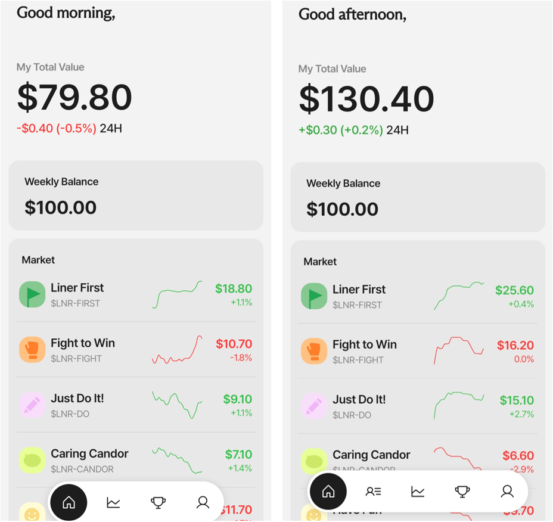
Culture Market applies the concept of stock investment to organizational culture. We list core values like stocks, press the 'buy' button for colleagues' positive behavior, and diagnose the health of the organization by watching the price fluctuate. In other words, Liner Culture Market is literally a stock market for culture. We have 'listed' five core values for $10 each. We have implemented this as an actual app, and all team members use it. Let me explain how it works.
There is a 'Culture Investing' channel on Slack. When a team member acts in alignment with a core value, and another team member expresses praise or gratitude using that core value icon, the stock price of that core value goes up. The praised team member acquires one share of that stock. For example, if 'Liner First' is currently $25, a team member praised for a Liner First action would own one share worth $25. Conversely, the stock price may drop on days when praise is infrequent.
We conduct a survey of the entire team every six months. We investigate how well each core value is being upheld and which specific behaviors are performing well and which are not. Stock price adjustments occur based on the results. Even if the stock price has risen due to a lot of praise on Slack, it can plummet if the survey results indicate that it has actually weakened. It follows the same principle as stock prices adjusting in the real market after earnings announcements.
There is also a 'Circuit Breaker' system. Yes, it is the same circuit breaker used in the stock market to temporarily halt trading when stock prices plummet. Liner has established 'investment taboos,' meaning five behaviors that must absolutely never be done. These include office politics, blaming others, rudeness, gossip, double standards, and hindering others. While other companies might overlook these behaviors with the excuse that "it is a company, so this is unavoidable," Liner reportedly has rarely experienced such incidents to date. Furthermore, they plan to continue managing the situation through this circuit breaker mechanism to prevent such negative corporate culture from developing in the future.
As of the time of this report, Liner First has risen to $25. Perhaps because it is an organization with many team players, it is recording the highest stock price. On the other hand, Kering Candor has fallen to $6.80, dropping below its $10 IPO price. This implies that there is still room for the culture of giving each other feedback to develop further. Seeing this in numbers allows you to identify at a glance which cultures are strong and which are weak.
Ben explains it this way.
“Culture is an abstract concept, you know. When I ask team members, ‘What is our team culture like?’ some talk about working from home, while others talk about team dinners. Everyone answers differently. In fact, that isn’t the core culture. We wanted to make our culture visible and measurable so that we could continuously develop it.”
The app allows you to check not only the cultural health of the entire organization but also your individual contributions. You can see at a glance, like a portfolio, how much you contribute to the culture, which core values you strongly align with, and who in your team best practices them. It is like checking a culture portfolio, just as you would check your personal portfolio in a stock trading app. Additionally, the accumulated shares are returned every six months in the form of 'dividends'.
Culture Market started in January 2026, so it has only been about two months, but I hear that a culture of mutual praise and recognition is already in operation. I asked if I, as an outsider, could invest in Culture Market, but they told me that wasn't possible.
A smart and capable person
What kind of person is Liner looking for? Luke says this:
“You must be smart. High intellectual capability is required to contribute and not fall behind in the ever-changing AI market. Rather than someone who is merely smart, we prefer individuals with the execution skills to put their own ideas into action and produce results. Furthermore, as all work involves collaboration, we have high standards for character.”
The AI market Liner belongs to is a place where yesterday's cutting-edge technology becomes obsolete today. It was 2023 when ChatGPT was released, but in just three years, the world has completely changed with AI agents, VibeCoding, and Deep Research. To move forward in such a market by contributing to something, rather than simply staying afloat, you must be “tremendously intelligent,” as Luke puts it.
However, someone who only has good ideas in their head is not the talent Liner is looking for. You must be someone who puts ideas into action and produces results from that execution. The core value 'Just Do It' exists for a reason. You are someone who immediately puts ideas into action as soon as they come to mind. What Liner is looking for is not someone who thinks, but someone who 'makes it happen'.
Character is also important. Everything we do at Liner is ultimately a collaborative effort. No matter how outstanding an individual's capabilities are, they are meaningless if they cannot collaborate with the team. The fact that our core value, "Liner First," is at its highest value signifies that this organization is filled with team players. Having high standards for character does not simply mean being a "nice person," but rather refers to someone who possesses an attitude of naturally prioritizing the success of the entire team over individual performance.
The common thread among those who possess all the capabilities mentioned earlier is that they are ultimately people who live their lives to the fullest. Since a group of people who want to leave a mark on the world are gathered here, they immerse themselves intensely without being told to. I believe the strength that enables Liner to survive while competing with Big Tech ultimately stems from the energy generated by these people.
What is more important than core values is how to make them come alive, yet most organizations simply post them on the wall and call it a day. Liner was different. They created a system that listed core values like stocks, invested in colleagues' behavior, measured the health of the culture through the stock price, and even returned dividends. They transformed the abstract and invisible concept of 'culture' into a measurable and investable asset .
What is the essence of investment? It is the act of investing resources based on the belief in future growth rather than immediate profits. Liner’s approach to investing in culture follows the same logic. While revenue may not increase immediately, we believe that a good culture attracts good people, and good people produce good results. As a Korean AI startup, I hope Liner competes with global big tech companies and emerges victorious through its strong culture.
You must be logged in to post a comment.