



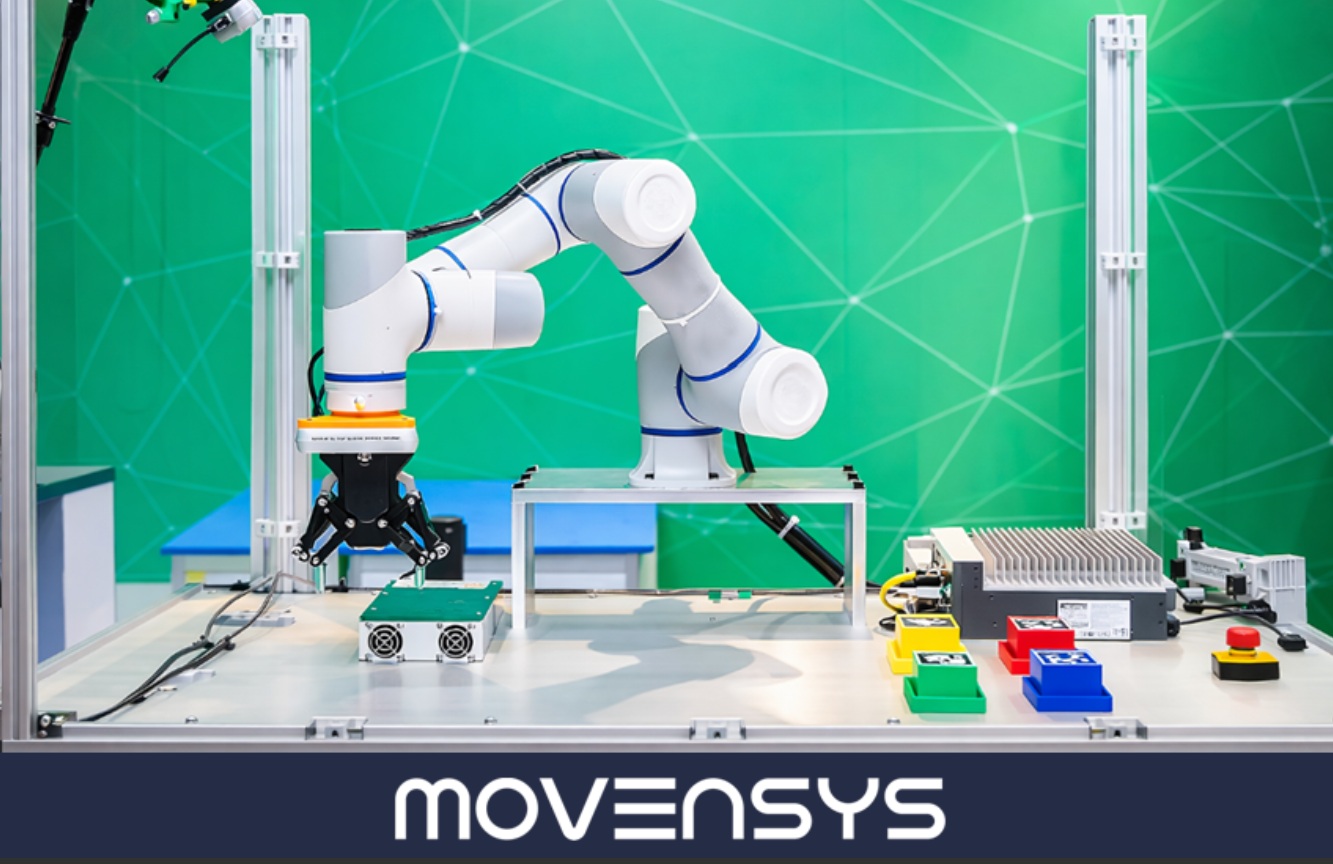
Movensys announced on the 17th that its research on the Physical AI real-time execution stack was selected for the NVIDIA GTC 2026 poster session and presented on-site.
NVIDIA GTC is a global technology conference held annually in San Jose, California, where technologies and application cases in the fields of AI, robotics, digital twins, and accelerated computing are shared. Movensys' research, which approaches the Sim-to-Real Gap—a core challenge in Physical AI systems—from the perspective of real-time control, was selected as a final presentation topic after passing a highly competitive selection process.
Currently, most Physical AI systems separate GPU-based computing modules that perform AI inference from controllers responsible for robot motion control. Consequently, latency occurs throughout the entire control loop due to communication and scheduling delays caused by network connectivity. This results in a temporal discrepancy between AI decision-making and actual robot movements, imposing limitations on real-time synchronization and control stability.
To address these structural limitations, Movensys developed a real-time motion control stack based on the WMX software motion controller. This stack provides a real-time execution layer that connects the NVIDIA Isaac-based application layer and the robot control layer with low latency through EtherCAT-based real-time communication and ROS2 interfaces. This minimizes latency between the AI inference layer and the robot control layer, enabling an execution structure where intelligence and control are closely coupled.
In comparative experiments using the Isaac Manipulator in a Jetson Orin environment, the Movensys real-time stack demonstrated a performance that reduced the Modified Atomic Error (MAE) by approximately 85% compared to the existing external robot controller architecture. This result demonstrates the importance of a real-time control layer in reducing the gap between AI decisions and actual actions in Physical AI systems.
Movensys' soft motion technology originated from MIT research and is being applied in industrial automation fields, such as semiconductor manufacturing equipment. This research presents an approach to building a Physical AI execution infrastructure by combining this industrial real-time control technology with a Robot Foundation model-based software stack. The presentation also introduced scalability possibilities, such as a sensor-based adaptive fine-tuning structure utilizing the real-time execution stack.
Movensys stated, “In physical AI systems, the key is not only the AI model but also real-time infrastructure capable of stable execution in real-world environments,” adding, “We will continue to pursue the development of a physical AI execution platform applicable to next-generation robots, based on industrial control technology.”
- See more related articles
You must be logged in to post a comment.