



– Presenting a sustainable alternative through mushroom mycelium technology amid worsening food insecurity due to the climate crisis
As extreme weather events become more frequent due to climate change, global food security is threatened. Existing agriculture requires a large amount of water and land, and it is difficult to solve nutritional imbalance problems with plant-based proteins alone. In particular, securing a stable source of protein remains an urgent task in developing countries such as Africa.
In the midst of this, a solution utilizing mushroom mycelia has emerged. Mush&, located in the Jeonju Deokjin-gu Research Special Zone, has developed mycelia technology that can produce highly functional ingredients with limited resources. The company explains that in a project conducted in Kenya, it showed results that improved farm income by four times.
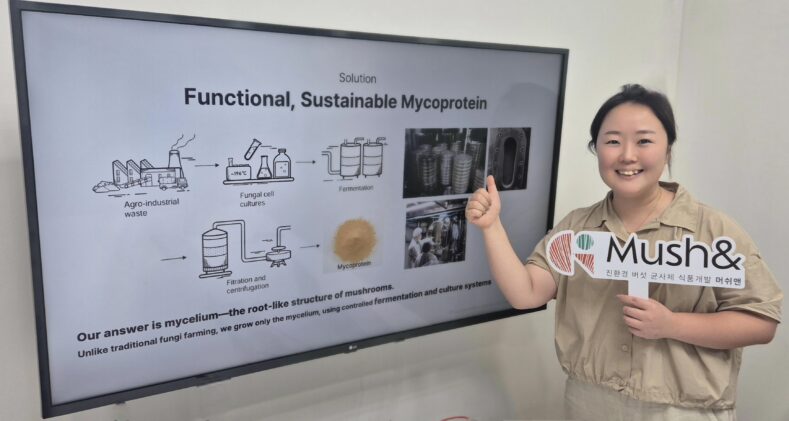
CEO Jeong Ji-hyeon (31) said, “We will solve the nutritional imbalance of humanity with mycelium-based alternative proteins and create a sustainable food system that responds to the climate crisis,” adding, “Our goal is to become a science-based food company that challenges for the Nobel Peace Prize.”
This six-person startup aims to grow fivefold from 300 million won in 2024 to 1.5 billion won this year. Based on mushroom mycelium technology, it is expanding its presence in the functional food, cosmetics, and pet food markets. It is also expanding into the global market by entering Kenya through the KOICA program.
Business items created by Malawi experience
CEO Jeong Ji-hyeon began the interview by showing a mushroom mycelium sample in a laboratory filled with various incubators and microscopes. “This is the core material of the future food. It is on a completely different level from existing plant-based proteins.”
His startup story begins in Malawi, Africa. CEO Jihyun Jeong, who had been conducting mushroom research at domestic and international research institutes, carried out the ‘Project to Improve Local Community Food Security through Mushrooms’ in Malawi as a principal researcher in 2019.
“The sight of children harvesting mushrooms with smiles changed my life,” CEO Jeong Ji-hyeon said with a smile as he recalled the time. “Mushrooms can be grown with limited resources, and they can provide both protein and functional substances. At that time, the vague idea of ‘solving humanity’s food problem with mushrooms’ turned into a specific business idea.”
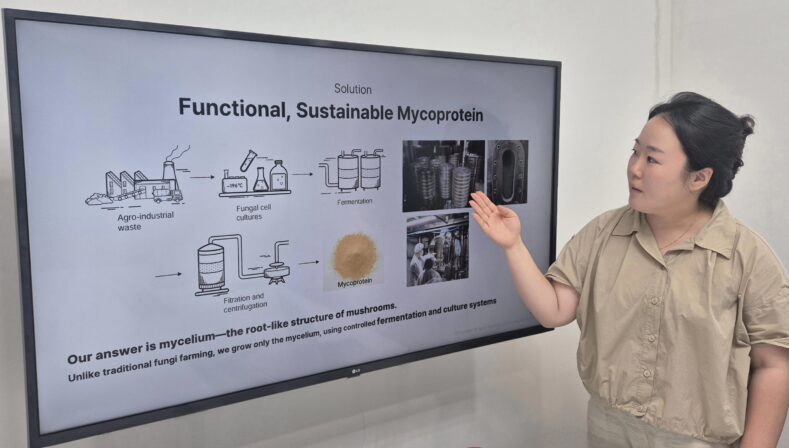
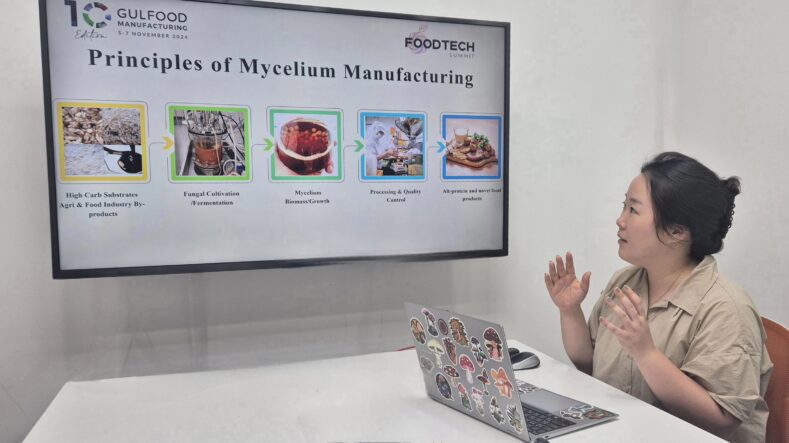
Founded in 2021, Mush&’s core is a different approach from existing mushroom processing. “Instead of growing mushrooms, we directly cultivate mycelia and design functionality. Like bioengineering.” Currently, we have 25 mushroom strains and 7 raw materials.
He emphasizes three strengths of mycelium: the fact that it naturally contains highly functional ingredients such as β-glucan and ergothioneine, its sustainability as it uses little water and land in the production process, and its potential for use in various industrial fields.
“We have accumulated technology through joint research with domestic and foreign universities, the Rural Development Administration, KAIST, etc.” On one side of the lab, various strain samples were neatly arranged, and each label had its functionality and application fields recorded in detail.
However, there are challenges. Commercialization of mycelial culture technology and establishment of a mass production system are still homework. The key is how to manage the technical and economic risks that may arise in the process of moving from the research stage to commercial production.
Kenya Performance and Global Expansion Strategy
Mush&’s global capabilities are being verified in Kenya. Through the KOICA CTS program, we are operating a smart mushroom model farm in cooperation with Kenya’s JKUAT University.
“In the first stage of CTS, we directly cultivated and distributed high-temperature pine mushroom spawn locally. As a result of tests conducted on general farms, productivity increased significantly, and cultivation training was provided to more than 200 people.” CEO Jeong Ji-hyeon said that farm income improved fourfold.
The technical approach is noteworthy. He added, “We have been evaluated by KOICA and the local government for our digital agricultural technology that combines Starlink-based connectivity and mobile environmental control systems.” We are currently supporting the CTS Phase 2 project and are proposing a vertical mushroom farm model to solve climate and agricultural problems.
“This project is not just ODA. It is an opportunity to demonstrate that Mush&’s technology can make a real contribution to solving the climate and food crises.”
The global market entry strategy is a ‘local partnership-centered model.’ The goal is not simply to export products, but to build an ecosystem that connects local production and distribution. “I want to create a sustainable business model with local partners.”
This year, we plan to focus on entering the Singapore and Indian markets. However, there are many challenges to overcome, such as responding to regulations in overseas markets, finding local partners, and overcoming cultural differences.
Jeonju area-based organization and 5x growth target
When asked why he chose Jeonju when many startups are flocking to Seoul, he answered, “It was a strategic choice.”
“Jeollabuk-do is the Mecca of the agricultural and food industry in Korea. It is a region with a solid agricultural and biotechnology industry infrastructure and research base.” In fact, Mush& is complementing the limitations of early-stage startups through collaboration with specialized agricultural and biotechnology organizations in the Jeollabuk-do region.
The current organization is composed of four axes: R&D, business development, production technology, and overseas business. Six dedicated staff members and several external partners are working together. CEO Jeong Ji-hyun’s leadership philosophy is “sharing context and respecting autonomy.”
“We only set the overall direction so that each member can maximize their expertise, and we trust and leave the execution to them.” In the office, we could see a horizontal communication culture centered on roles rather than job titles.
Mush&'s growth plan in numbers is aggressive. The sales of about 300 million won in 2024 were achieved through raw material ODM supply, alternative food raw material development, and R&D project orders. This year's target is over 1.5 billion won, and the company plans to grow 5 times compared to the previous year.
“This year, we have three key strategies: entering the global market, improving functional raw materials, and securing new B2B partners.”
The area we are focusing on the most is functional foods. We are expanding our B2B ODM supply centered on food ingredients that have been scientifically verified for their functionality, such as immune health and blood sugar control. In the future, we plan to launch differentiated product lines in cosmetics and pet food, and we are also preparing to expand our B2C brand.
However, there are concerns that in order for small-scale startups to achieve such ambitious growth goals, they must first secure sufficient capital, build a stable supply chain, and establish a quality management system.
We are also working on IP strategy. “We refined technology positioning and IP mapping through the IP-R&D strategy establishment project. This has led to actual domestic and international partnerships and export consultations.”
Currently, we are strengthening open innovation cooperation with the University of Helsinki, Finland, the Mahajana Institute of Technology, India, Seoul National University, and various bio ventures.
“Within 10 years, I want to grow into a mycelium platform company that can stand shoulder to shoulder with global food companies. Through Mush&, I will achieve my dream of becoming a ‘science-based food company that challenges for the Nobel Peace Prize.’ I believe that solving the food problem is the most direct way to contribute to world peace.”
CEO Jeong Ji-hyeon's confident vision and specific overseas expansion results are noteworthy. However, whether a small startup can compete with global conglomerates and continue sustainable growth will likely depend on future execution and market response. It remains to be seen whether the small challenge that began in Malawi can actually lead to changes in the global food system.
—
This interview is part of a series planned in collaboration with startup media Venture Square, targeting excellent startups recommended by the Association in celebration of the 30th anniversary of the establishment of the Venture Business Association. It will be divided into three areas: 'AI·Data·Digital Solutions', 'Bio·Food·Local Brands', and 'Content·Culture·Web 3.0'.
You must be logged in to post a comment.