




“Another Excel task…”
This is a daily routine that anyone in the real estate development industry has experienced. To review 20 or so business sites in the metropolitan area, it takes 1-2 days for each site, and several weeks just for the overall comparative analysis. There are countless instances where even a small error requires the entire work to be done again from the beginning. In the meantime, good investment opportunities often go to competitors.
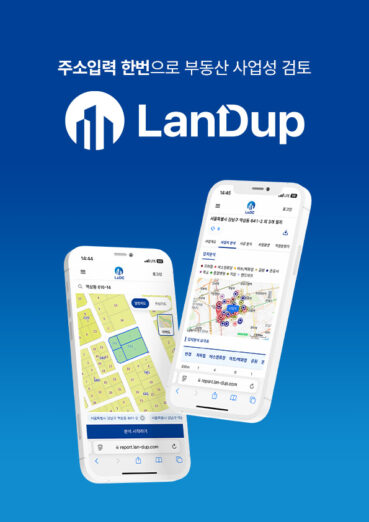
But things have changed. With the introduction of 'LandUp', which provides a 13-page professional analysis report by entering just one address, it has surpassed 15,000 cumulative usage cases in less than a year since the beta service was launched in July last year. This is about 8% of the five-year average of 200,000 building permits per year. This is evidence that professionals in the real estate and construction industries are using it as a 'means of securing competitiveness with other companies' or for 'actual work'.
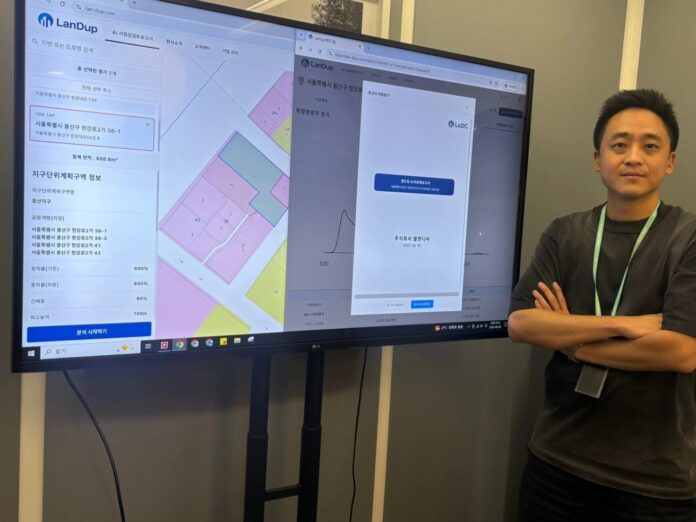
Deok-Haeng Lee (39), CEO of Landup, whom we met at Seoul Fintech Lab in Yeouido, was straightforward from the start.
“Have you ever felt tired of repetitive tasks? In the real estate development industry, such tasks are a daily occurrence.”
I have met many startup founders, but there have been few who have such a clear sense of problem regarding their domain as CEO Lee Deok-haeng. As expected from someone from Samsung C&T, I felt a conviction that came from field experience.

An industry buried in Excel and reports… ‘Is this really 2025?’
Landup was different from the ‘real estate + IT’ combination commonly seen in the proptech market. While many proptech startups focus on B2C services or rental/management solutions targeting general consumers, Landup targeted the upstream area of real estate development.
“At Samsung C&T, I experienced the entire real estate development process from bidding to order receipt, PM, completion, and permitting. But even in the 2020s, everything was still done with Excel, email, and PDF reports.”
Listening to CEO Lee Deok-haeng’s story, the reality of the industry was dire. When reviewing 20 or so business sites in the metropolitan area, it took one or two days for each business site, and it took several weeks just for the overall comparative analysis.
“There are countless instances where a small mistake can lead to the entire job being redone. Meanwhile, good investment opportunities are passed on to other companies.”
This was a clear pain point for those who have been watching the proptech industry for a long time. Especially these days, when investment decisions are more cautious due to rising interest rates, the importance of quick and accurate initial review has increased.

‘13 pages in one click’… Innovation in workflow, not technology
Landup's solution is not technically complex. It is simple. When you enter an address, a 13-15 page report is generated, consisting of five categories: ▲Business Overview ▲Business Site Analysis ▲Construction Analysis ▲Business Environment Analysis ▲Appropriate Sale Price Analysis.
“Users input dozens of fields, select the top three or four, and then use those to hold team meetings. This is for the first filtering.”
The value of LandUp was evident. It was a workflow innovation rather than a technology itself. It was a change in the work process itself, where a report that used to take an analyst several days to write could be produced in a matter of minutes.
The actual usage status also supports this. The user base has expanded from the initial target of construction and implementation companies to PF financial institutions and real estate brokerage firms.
“The brokerage industry uses it as a means of differentiation when brokering properties with development issues. They appeal by saying, ‘We have already reviewed the business feasibility.’”
This is a typical B2B SaaS success pattern: going beyond simply providing functions to enhancing the customer’s business competitiveness.
Emerging as a ‘must-have’ in the era of high interest rates… ‘A means of survival, not a choice’
The timing of the land-up was also exquisite. In a high-interest environment, risk management in the real estate development industry has become a hot topic.
“Things that were tolerated and ‘can be done roughly’ in the past are no longer acceptable. Especially for small and medium-sized companies, a single mistake in judgment can directly affect the existence of the company.”
In fact, as real estate PF defaults continued to occur after 2023, the screening standards of financial institutions have been significantly strengthened. A thorough review from the initial stage of the project has become essential.
“Large companies have their own analysis teams, but small and medium-sized companies do not. The information gap is leading to a gap in survival.”
CEO Lee Deok-haeng’s diagnosis was accurate. The logic of ‘democratization’, which is often seen in the startup ecosystem, is also at work here. Lowering the entry barrier through technology allows small and medium-sized companies to use analysis tools at the level of large companies.
“The practical reason why many customers use LandUp is that they can start a complex business review with just one ‘click on the map.’ This is a structural innovation that turns the difficult decision of implementation into a simple action, and it significantly reduces the initial burden of market research, location analysis, and profitability simulation.”
AI is an ‘extension’, not a ‘replacement’… Spreading wings with prop fintech
A clear line was drawn regarding concerns about job replacement due to the introduction of AI.
“We are not competing with appraisers or real estate consultants. We are helping them focus on higher value-added work.”
It was a mature perspective. Instead of being arrogant about replacing everything with technology, it sought to coexist with the existing ecosystem. It was a welcome approach from the perspective of someone who had seen many startups fail due to conflicts with existing industries over a long period of time.
“AI is an ‘assistant tool’ that helps experts focus on more strategic and creative planning and decision-making by automating repetitive and routine tasks. Ultimately, AI is an ‘extension’ of people, not a ‘replacement’ of them.”
Landup is also preparing for the next step. It signed an MOU with NH Nonghyup Bank and was recently selected as a resident company in Seoul Fintech Lab.
“We aim to jointly promote PF loan screening and risk management model development with financial institutions. We also want to contribute to the prevention of real estate financial accidents.”
The combination with finance is a natural progression. Finance is an inseparable element in real estate development, and from the perspective of financial institutions, it is time for more sophisticated risk assessment tools.
The roadmap is also systematic. Starting with specialized brokerage services in the second half of this year, specialized functions for each industry will be sequentially launched in the order of implementation/construction and finance.
“There are still many people who don’t know about it. Spreading brand awareness is the immediate task.”
Reusable tools are key… Where is the confidence to monetize?
Most proptech startups struggle to monetize. The technology is good, but customers often use it only once. How about Landup?
“While typical proptech solutions focus on single-case analysis, we aim to be a ‘reusable tool’. It’s only meaningful if you can compare and review dozens of cases at once.”
This is key. Many B2B solutions fail because they are designed for one-time use. LandUp was designed from the beginning with repeated use in mind.
“We are considering the entire real estate value chain from brokerage → implementation → construction → finance. It is a structure that can be expanded step by step.”
CEO Lee Deok-haeng’s strategy was solid. One service encompasses multiple industries, while adding depth with specialized functions for each industry. This is a typical growth pattern for successful B2B SaaS.
“Landup has focused on solving practical problems in the field rather than simply implementing technology from the beginning. Our goal is to continuously reflect the voices of the field and evolve into a tool that contributes to practical decision-making beyond simple automation.”
We asked Landup about the future it envisions.
“We will grow into a solution that plays a key role in the upstream stage of the real estate development market.” It was a humble yet confident answer.
The real estate development industry is mired in manual work and Excel. Landup, which solved this chronic problem, was chosen by 10,000 people in less than a year. The secret to its success is not in its flashy technology, but in accurately identifying and solving the urgent needs of field workers. Above all, its clear positioning as a “repeatedly usable tool” stood out.
You must be logged in to post a comment.