



-Easy to build with modular HR SaaS…Introducing HR SaaS at low cost
-Used by 1000 companies… 80% time saving in performance management
– Incorporates the organizational culture philosophy of organizational growth
The paradigm of performance management is changing. Moving away from the one-sided evaluation by the team leader and the annual evaluation method, multi-faceted evaluation and continuous feedback are becoming routine. As the MZ generation's 'quiet resignation' phenomenon and the demand for fair evaluation increase, companies are in need of a more sophisticated and transparent performance management system.
The reason why we cannot introduce multi-faceted evaluation and continuous evaluation even if we want to is because performance management is complicated. In the case of multi-faceted evaluation where several colleagues participate to evaluate one person, the management points increase exponentially. If such evaluation is conducted continuously, the workload of the HR team will inevitably be considerable. It is also an important task to secure the fairness of the evaluation because each evaluator applies different criteria and there is a lot of room for interpersonal relationships and personal biases to intervene.
The biggest reason why companies cannot introduce multifaceted evaluation and continuous performance management is cost. Existing performance management took more than a month, making continuous evaluation impossible, which led to a decrease in fairness. If the resources invested in performance management are reduced, and evaluations can be conducted more frequently, fairness will naturally increase.
At the center of this change is HR tech startup D.Whale. Founded in 2021, D.Whale is emerging as a new powerhouse in the HR tech market, recording over 300% growth every year through its continuous performance management solution 'CLAP'. Currently, more than 1,000 companies, including KFC Korea, SL, and Minbyungcheol Education Group, are adopting CLAP.
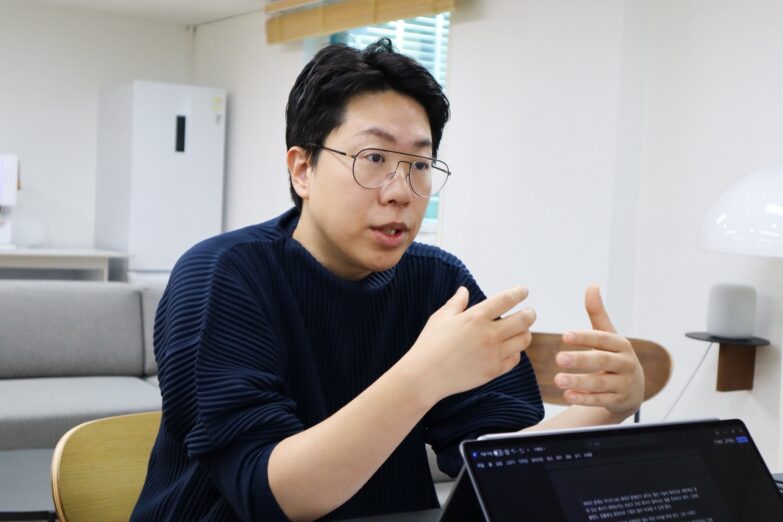
We met with CEO Koo Ja-wook at the Dewey office in Gangnam, Seoul, to talk about the performance management market environment, the reason for developing modular HR SaaS, and the advantages of modular HR SaaS.
Improving fairness through continuous feedback

“If you suddenly give a test without telling them the scope of the test, it is difficult to expect good results, and this is not fair. If you continuously conduct mock tests and provide feedback on the results, dissatisfaction will decrease and the perception of fairness will increase. A more fair evaluation system can be established through easy and frequent tests and checkups. This should be done at low cost.”
CEO Koo emphasized that the most important thing in performance management is fair evaluation, and for fair evaluation, continuous evaluation must be conducted, and for continuous evaluation to be possible, the cost must be low.
Clap can be customized at 1/5 to 1/10 the cost of SI construction. Unlike construction-type solutions that incur ongoing development costs after installation, Clap has no additional maintenance costs.
Advantages of ‘Modular SaaS’
“I realized that there was no performance management solution on the market that mid-sized companies could use. I started the business because I thought that there needed to be a solution that mid-sized companies could use without burden to manage their performance.”
Large companies spend a lot of money to build HR solutions from SAP or Oracle, but it is burdensome for mid-sized companies to use them. The reason CEO Koo started DeWail was to create an environment where mid-sized companies can use solutions without burden. CEO Koo found the answer in modular SaaS. The first advantage of modular SaaS is its price.
Businesses can select and use only the modules they need. As the business grows and needs more complex functions, they can select additional modules. It's like Lego blocks. The Lego method is structured to select only the functions they need and pay for them, so it is cheaper than existing solutions that require purchasing a package that includes unnecessary functions. Businesses can gradually expand functions according to their needs and budgets, reducing the cost burden.
The second advantage is that, unlike existing SaaS, the solution is not tailored to a set of functions by the company, but rather tailored to the company's processes. This is also possible because it is modular.
“The performance management market has long been a construction-type market. While there are correct solutions for salary and work attendance management because labor laws are set, performance management reflects everything from the company’s industry, number of employees, business model, and even the management’s will. That’s why each company has a different performance management form and process. Clap can customize each company’s unique performance management process and implement it 100%.”
Usually, before starting performance management, you receive performance management construction consulting. If a consulting company creates a system design document that is hundreds of pages long, you have to implement it, but it is difficult to implement it with existing SaaS. DeWail can actually implement the performance management content in the company's system design document by combining modules.
Clap currently has over 100 modules. It combines modules such as permission customization modules, report generation modules, ERP linkage modules, messenger linkage modules, and calibration modules like Lego blocks to provide solutions optimized for each company.
The third advantage lies in fairness. The calibration module is one of the core functions of Clap.
“People have bias. Some people give 5 points a lot, and some people give 3 points a lot. Using the calibration module, you can adjust the evaluation distribution based on the standard deviation. Fairness is secured by adjusting the scores of evaluators who gave 4 points a lot to 3 points based on the standard deviation.”
Clap is also actively utilizing AI technology. 'Clap AI' analyzes the collaboration process and generates feedback in just 10 seconds.
“AI recommends who you have collaborated with a lot recently and even provides feedback related to that person. AI analyzes the results of the multifaceted diagnosis so that management can extract meaningful insights.”

Simple and timely performance management
The effectiveness of Clap can be confirmed through actual customer cases. Airline A completely transformed the complex performance management unique to the airline industry by introducing Clap. This airline conducts a multi-faceted evaluation of cabin crew for each flight, and previously conducted it manually using Google Form or Naver Form. Not only was it difficult to evaluate all personnel equally, but mistakes frequently occurred during the manual work. DeWail linked its flight scheduling system with Clap to automatically retrieve internal data and conduct evaluations when a flight ends. As a result, the resources invested in evaluations were reduced by 90%, and employees were able to receive feedback in a timely manner.
Companies that have introduced Clap have shown excellent results in common. In particular, the reduction in performance management time is remarkable. After introducing Clap, performance management time was reduced by 80%, and the average length of employment of employees increased by more than 30%, showing a significant increase in job satisfaction compared to before.
Performance management is the core of an organizational culture of growth and development.
CEO Koo said that he wanted to change the negative perception of HR through Clap. The mission DeWhale is an abbreviation of 'Dancing Whale'. CEO Koo said, "It was named with the meaning that even whales can dance" and explained, "It's a name that came from the hope that HR would have a good image." The whale symbolizes a huge organization. It contains the message that even the largest organization can move happily.
“In Korea, I think the HR team leader is considered to be the representative person. Clap has a better image of performance management and a direction for good collaboration.”
CLAP is a service name derived from the English word meaning applause. Applause is an act of acknowledging and encouraging someone’s achievements or efforts, and it well represents the performance management philosophy pursued by DeWail.
“When you think of HR solutions, it feels like the company is supervising the employees to manage their organization members and achieve performance,” said CEO Koo, pointing out the limitations of existing HR solutions. He continued, “We named it Clap because we wanted it to be a solution that would allow the members of the organization to give and receive feedback from each other and achieve good results for their growth.”
The name Clap contains the philosophy that performance management should be a means of recognition and encouragement, not punishment or monitoring. It also reflects the will to create an organizational culture that grows together through mutual feedback and support, rather than one-sided evaluation.
Dewey's work environment is also based on this philosophy. Many of the 50 employees work remotely from all over the country, which supports an environment for optimal performance creation for each individual. The company uses its own solution, Clap, for performance management. The systematic performance management through Clap can be seen as the background to Dewey's high retention rate and excellent performance rate.
No. 1 in the domestic performance management market, evolution into people analytics
CEO Koo said his goal is to become number one in the domestic performance management market within three years.
“From the customer’s perspective, there is no longer any reason to build with SI, and no other general SaaS company has as many enterprise customers as we do. I am confident that we will become the number one in the domestic performance management market within three years.”
The area that DeWayle will focus on in the future is people analytics. It plans to focus on providing insights based on personnel data beyond simple performance management.
“What mid-sized and large companies want most is data analysis and AI. For this purpose, we are developing statistical packages and AI modules. We also plan to provide management with insights into what core leadership is and what kind of talent they should hire.”
Understanding and experience with people is required
“I think the domestic HR tech market is a big market. It’s not just the market that is visible on the surface, but there are still so many companies that want to adopt it but can’t. There are still so many companies that are managing their performance on paper.”
However, he gives some careful advice to juniors who dream of starting a HR tech business. “This market requires understanding and experience with people. I think it would be good if you have experience in management at a company. It is a market that is growing steadily, but there may be a barrier to entry due to its conservative nature.”
Since attracting investment from Naver-affiliated venture capital Spring Camp in September 2021, Dewey has successfully secured pre-A investment from 500 Global, We Ventures, Spring Camp, and Kingsley Ventures in just 10 months, and Series A investment in just a year, securing a total investment of about 8 billion won. It is also considering additional investment this year.
DeWail’s growth story goes beyond a simple corporate success story and shows the evolution of the Korean HR tech ecosystem. The ‘modular SaaS’ approach, which recognizes the uniqueness of each company and breaks away from the existing uniform solutions, is an innovation that deserves attention not only in the domestic market but also in the global market.
The future that CEO Koo Ja-wook and Dewey are drawing is clear. Performance management is becoming a core driving force that goes beyond simple evaluation and leads to the growth of members and the development of the organization. This is also why more than 1,000 companies have chosen Clap.
“There is no right answer in HR” is the core value pursued by Dewey. This is not to force a uniform management method, but to acknowledge the characteristics of each organization and individual and provide customized solutions that fit them. Dewey’s vision is to create a dynamic and enjoyable organizational culture, not a rigid and rigid organizational culture. Dewey continues to accompany each company on its journey to find its own right answer.
You must be logged in to post a comment.