



-CEO Park Jae-byeong presents a new paradigm for the senior industry through his book <Silver Wave>
“Elderly people are not welfare recipients but creators of added value”… Emphasizes innovation in the private-sector-centered care industry
-“Senior Housing is the Comprehensive Solution for Care Services”… Caredoc’s Senior Housing ‘Care Home Nursing Home’ is Expanding
-Plan to expand to 1,000 senior hubs by 2030
“The Silver Wave is an opportunity, not a crisis.”
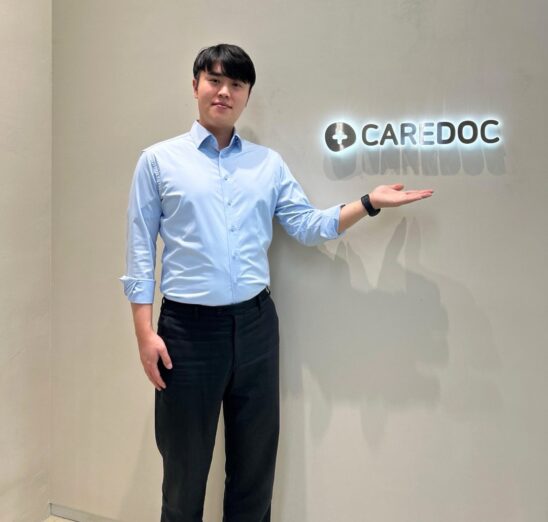
With the population over 65 years old reaching 10 million, South Korea has entered a super-aging society. In the face of this enormous change, which most call a “crisis,” Park Jae-byung, CEO of senior total care startup Caredoc, spoke firmly.
In his recently published book, <Silver Wave>, CEO Park likened the super-aging society to a wave. “The aging population is a change as big as the third wave that futurist Alvin Toffler talked about,” he said, explaining, “A consumer market created by 15 million baby boomers is suddenly created.”
We spoke with CEO Jae-Byeong Park, whom we met at the Caredoc office in Gangnam-gu, Seoul, about the direction of the silver industry emphasized in <Silver Wave>, why Caredoc focuses on senior housing, and the present and future of care services.
The limits of government welfare , when the private sector must step forward
“We need to ask the fundamental question of whether the government can care for all the elderly.”
Since founding Caredoc in 2018, CEO Park has had a vision of ‘solving care as an industry, not as welfare.’ The background to this philosophy was regret over the structural limitations of the government welfare system.
Park pointed out that the current welfare budget covers only about 1% of the very sick, and long-term care insurance covers only 9-10%. “The remaining 89% are outside government care. This gap will only grow larger over time,” Park said.
The bigger problem is the inefficiency of the government system. Park analyzed, “The government system is a fee-based system based on time, not performance,” and “since sales are fixed, they tend to save money, which ultimately lowers the quality of care.” Park argues that the private sector’s role is essential to break this vicious cycle.
“We need to view the elderly as customers who can create added value, not as welfare recipients. The role of the private sector is to create new services through technological innovations such as tech services, mobile platforms, IoT, and AI.”
New Active Seniors , New Key Players in Consumer Market
The concept that President Park particularly emphasized in <Silver Wave> is the ‘New Active Senior.’ Unlike the average life expectancy in Korea at the time of the enactment of the Social Welfare Act in 1981, which was 66-67 years old, today’s 65-year-olds are healthy.
“Active seniors are a generation in their 60s and 70s who support their parents in their 80s and 90s, but they consider their own lives as important as supporting their parents.” According to CEO Park, they do not consider themselves elderly, and in the consumer market, they still show similar patterns to the general adult market.
The necessity of this change in perspective is demonstrated by the 'Elderly Care Gap Index' announced by Caredoc in 2023. The shocking result was that the elderly population at risk of care cost and facility gaps as of 2021 was 7.25 million. Representative Park predicted that the elderly population at risk of care cost and facility gaps would reach nearly 10 million in 2025. It is expected that at least 2 million care gaps have occurred since 40,000 to 50,000 people receive new care benefits each year, but about 650,000 people are pushed out of care.
CEO Park emphasized the need for vigilance, saying, “You have to be afraid to prepare.” He also offered advice to entrepreneurs who want to challenge themselves in the senior industry.
“The superficial business of business and the hidden essence are different. On the surface, it seems like the elderly and the government are the customers, but in reality, we need to look at who is paying and what their pain is.”
“If we think about how to create added value rather than relying on the government for seniors, this is still a market with a lot of opportunity,” Park emphasized.
Senior Housing , the Core of a Comprehensive Solution
The reason Caredoc focuses on senior housing is because it can solve multiple problems at the same time. Mr. Park explained in three aspects.
First, there is the government budget issue. Nursing homes are the most burdensome facility for the government, costing 2 to 2.5 million won per month per elderly person. Second, there is the quality issue. If the government provides services for 2.5 million won, someone will inevitably be dissatisfied. Third, there is the problem of lack of personnel. If they visit each home, there is only one elderly person that a nursing caregiver can care for, and there is no management.
Senior housing is a way to solve these problems. If seniors gather in senior housing, resources can be distributed efficiently. Managers can monitor, and nursing assistants can also be retrained. From the consumer’s perspective, they can receive services at a lower cost. There are also great benefits for the seniors who move in. “People who used to watch TV alone are now socializing, and their health index improves through systematic meals, exercise, and outings. In the end, a virtuous cycle is created in which the country’s medical expenses also decrease.” This is why senior housing is called a comprehensive solution for care services.
Establishing a standardized senior housing system
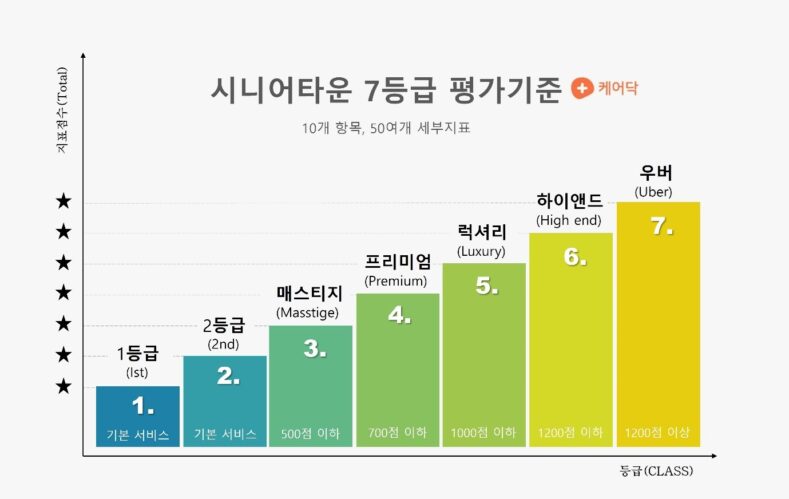
Caredoc is gaining attention for developing the industry's first 'Senior Town Standard Rating Guide'. Reflecting on-site inspections, senior interviews, and expert opinions, it created 10 items and 50 detailed indicators, including size, program, location, auxiliary facilities, health care, space design, F&B, IT solutions, convenience of living, and other evaluations.
Caredoc classifies senior towns into 7 grades based on these indicators. The grade system provides accurate information to consumers and has the effect of guiding them to choose good facilities.
High-quality residential care facility brand , care home and nursing home operation
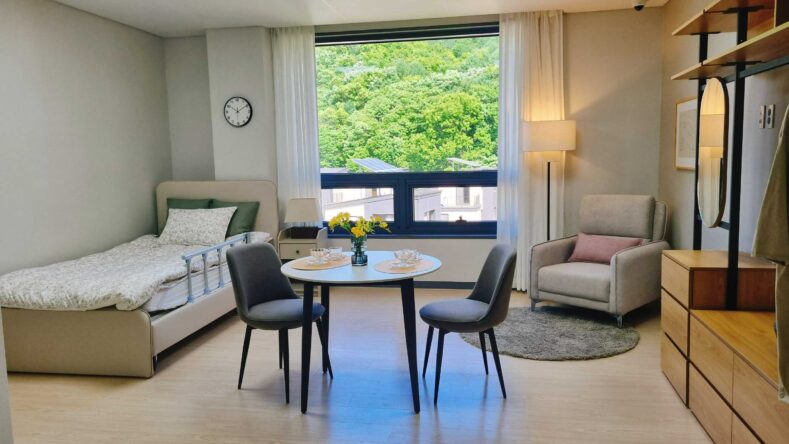
“We had to break the image of the existing nursing home. Care homes and nursing homes are large-scale co-living homes that provide ‘homes with care.’”
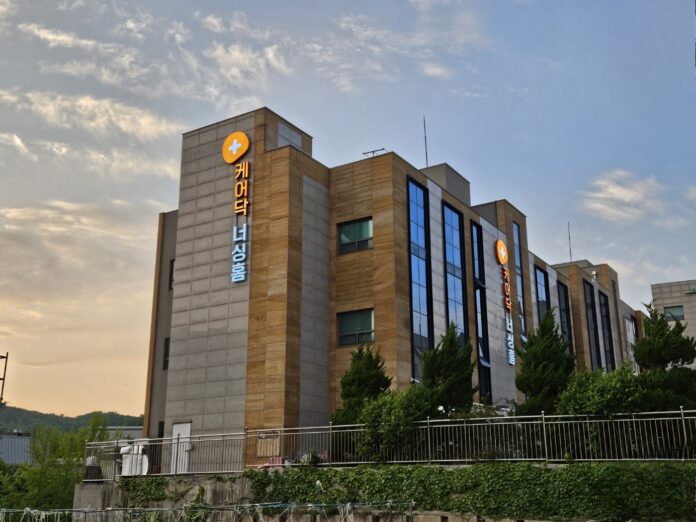
Caredoc launched 'Care Home/Nursing Home', a high-end residential nursing facility brand that provides comfortable senior care like home in 2023. Care Home and Nursing Home are distinguished by whether or not they have acquired a long-term care insurance grade. Care Home is a premium senior residential brand that allows for a private retirement life while receiving customized care even without a long-term care grade, while Nursing Home is a premium nursing home that provides nursing and rehabilitation services as a facility that requires 24-hour intensive care and is supported by long-term care benefits.
Care homes and nursing homes have gained great popularity since their launch. In particular, the Baegot New Town branch achieved a 100% occupancy rate within 6 months of launching, and other branches are also creating a sensation in the senior housing market by recording high occupancy rates of close to an average of 90%.
Starting with the first branch in Baegot New Town, the company opened four branches in three regions in just one year, including Songchu and Yongin, and plans to open three new branches this month, including Nursing Home Songchu Village Branch, Nursing Home Okjeong City Branch, and Care Home Siheung Noble Hill Branch.
All Care Home and Nursing Home branches provide professional care services for the daily lives and health of seniors, including cleaning, laundry, meal delivery, medication management, and 24-hour emergency response. They also have a solid staff of professional senior care workers, nursing assistants, nurses, physical therapists, and care coordinators. In particular, the number of nursing assistants has been increased by 1.2 to 3 times the mandatory number of personnel, and the quality of care has been improved by strengthening the deployment of care workers.
In order to increase the number of directly managed stores and actively engage in consignment operation business, Caredoc received investment from Invesco, the world's 7th largest asset management company, in September 2024 and jointly established 'Care Operation', the first senior housing specialized operation company in Korea.
Total care service covering the entire senior life cycle
In addition to its senior housing business, Caredoc also provides total care services covering the entire senior life cycle, including matching platforms, home care, hospital nursing, and home care.
1) Caredoc platform operation
'Caredoc' is a matching platform that connects seniors in need of care with customized care coordination. More than 3,000 care coordinations and 10,000 senior customers use it on average every month. It provides detailed profiles of caregivers and nursing assistants, including photos, qualifications, care history, and COVID-19 vaccination status, as well as actual user reviews, to increase reliability. In addition, it introduced a care cost quota system to improve transparency in facility and service fees where additional costs or standards are ambiguous. Caregivers can check care logs that record meal amounts, bowel movements, and care areas in real time, providing a more secure environment.
2) Operation of home care center
Caredoc operates eight direct branches and 16 partner branches nationwide as home visiting nursing care centers. It is an integrated service that covers both long-term care beneficiaries and non-benefit recipients. Four major direct branches have been recognized for their expertise by receiving an A grade in the top 20% in the 2024 regular evaluation of long-term care institutions.
The center director visits the homes to assess the needs of the recipients and their guardians and designs a customized care plan, adopting a beneficiary-centered operation method. In particular, it is contributing to eliminating blind spots in care, as any senior who needs care can use it, even if they do not have a nursing level. In fact, about 20% of non-covered users are using it.
Caredoc plans to strengthen its nationwide network by expanding its partner branches to 40 by 2025.
3) Hospital care and home care services
Caredoc also provides hospital nursing services through cooperation with medical institutions. It has signed a contract for the supply of nursing staff with 131 nursing hospitals and signed a cooperation agreement with Kangbuk Samsung Hospital and Soonchunhyang University Central Medical Center to expand nursing credit support, train professional nursing staff, provide customized care solutions for discharged patients, support patients’ recovery and return to daily life, and link nursing services.
Home care service is a residential environment management service in which a care coordinator regularly visits the home. It is in charge of life care areas centered on housework such as cleaning, laundry, meal preparation, medication management, and accompanying people out and about. Unlike general housework services, it focuses on improving the senior’s life satisfaction by reorganizing items according to the senior’s movement path and organizing laundry in convenient locations to maintain a comfortable residential environment.
4) Securing global manpower
To solve the problem of lack of care workers, Caredoc has established a global care worker recruitment system in cooperation with three Southeast Asian countries. By cooperating with 12 specialized organizations in three countries, Vietnam, Myanmar, and Indonesia, it is possible to recruit 1,000 care workers.
“There aren’t many people in Korea who want to work as caregivers. Demand keeps growing but there’s no supply, so price inflation keeps happening.” Park pointed out that because demand is high, even problematic workers who should have been eliminated are continuing to work, creating a vicious cycle.
5) Care Chat
The KakaoTalk chatbot 'CareChat', developed in collaboration with Kakao Healthcare, is a nursing reservation service. By allowing users to apply for CareDoc's hospital nursing service during the hospitalization reservation process, the inconvenience of the hospitalization process can be minimized. It is expected to greatly increase accessibility as users can be matched with CareDoc's specialized nursing service directly through KakaoTalk without installing a separate app or registering as a member.
Target of 1,000 Senior Care Hubs by 2030
“Our goal is to create 1,000 senior care centers nationwide, including senior towns, by 2030.”
CEO Park finds Caredoc’s core competitiveness in its independent revenue structure that does not rely on government subsidies. “If you rely on subsidies, your company’s performance may look good, but the deficit will also increase. We have made most of our senior care matching business units in the private sector profitable.”
We are also preparing for global expansion. “Caredoc’s goal is to complete Korea’s care model. As Korea is the first country in the world to experience aging, we want to become a global company that exports this model to the next aging countries.”
Caredoc is aiming for an IPO in 2027.
For ‘Care for the Nation’
“Just as Chairman Lee Byung-chul said, ‘Doing business well is the same as protecting the country,’ solving Korea’s biggest problem today, the aging population, is Care for the Nation.”
Caredoc's ultimate vision is 'Care Bo-guk (Care Bo-guk)'. CEO Park saw the core of the aging problem as lack of added value creation and tax burden. "If we change these two things from taxes to creating added value, we can solve the biggest problem of the Republic of Korea."
The philosophy of 'Care Boguk', which means 'protecting the country through care', shows the will to make the aging population a new growth engine rather than a national burden.
In an era where the population is 65 years or older and has reached 10 million, the 'Silver Wave' presented by Caredoc is a paradigm that goes beyond simply responding to aging and creates a new growth engine. Attention is being paid to whether it can actually become a model for solving the aging problem of Korean society and whether it can develop into a global standard. The Silver Wave has just begun. The future of Korea will change depending on how this huge wave is utilized. If Caredoc's challenge is successful, it will mean a paradigm shift for the entire society, not just the success of one company.
You must be logged in to post a comment.