



Just a few years ago, flame-retardant Styrofoam from construction sites was non-recyclable, incineration was prohibited by law, and landfills were full and had nowhere to go. This led to illegal dumping or the problem of microplastics being re-distributed into the ocean.
MCE is using mealworms to address this problem. One larva can eat its own weight in Styrofoam in a day, and after 24 hours, it spits out the black gold, humic acid, that helps the soil. MCE’s small miracle is changing the paradigm of waste disposal.
The Miracle of Life Born from a Grave of Styrofoam
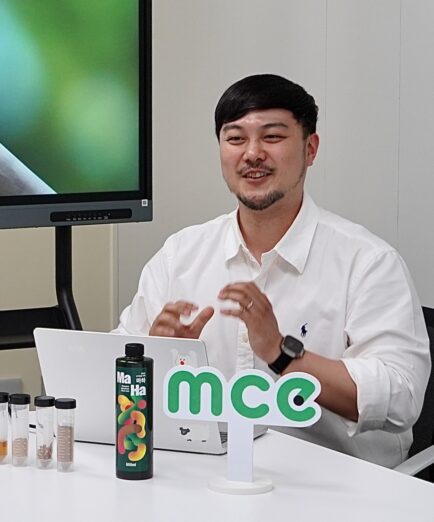
“I still vividly remember my father sighing as he looked at the piles of Styrofoam in the farmland,” said Park Jong-wook, CEO of MCE, who I met at the Daejeon office, as he began his story while placing a transparent plastic container on the table. Inside the container, small larvae were busily munching on pieces of Styrofoam.
Park Jong-wook’s father, who was a professor at Kongju National University, had a persistent concern about the problem of agricultural waste. Agricultural Styrofoam boxes were left all over the farmland, polluting the soil and being blown away by the wind into rivers and the sea. This was a common reality for farms across the country. Park Jong-wook, who worked at a patent law firm from 2016 to 2020, helped his father with patent work related to insects, and discovered an overseas paper that stated that mealworms decompose plastic.
“It’s something that has been proven at Stanford and elsewhere since 2015, but we’ve gone one step further. We’ve developed a technology that creates new value rather than simply disassembling it.”
Although he did not win the African Startup Idea Contest in 2020, which he participated in at the suggestion of a friend, he started full-scale commercialization after winning the Minister of Agriculture, Food and Rural Affairs Award at the FAO Korea Branch Contest in December of the same year. Five years later, MCE has grown into a bio company that has attracted global attention, winning the Innovation Award in the Food & AgTech category at CES 2025 in January of this year.
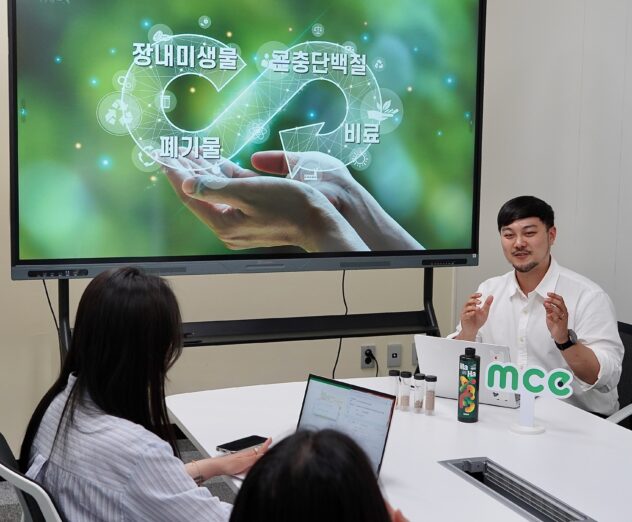
MCE (Mealworm Clean Earth), which produces high-quality humic acid fertilizer by decomposing waste Styrofoam with mealworms, is taking a leap forward as a global bio company after winning the CES 2025 Innovation Award. CEO Park Jong-wook emphasized, “Through collaboration with small organisms, we have realized a technology that completely transforms waste into a useful resource that revives the vitality of the soil.” MCE, which is receiving love calls from durian farmers in Southeast Asia, is accelerating its overseas expansion and is expanding its business into carbon emission rights and biomaterials with the goal of an IPO in 2028.
The Carbon Neutral Dream Created by Mealworm Gut Microbes
MCE’s core technology lies in the biochemical changes caused by the gut microbes of mealworms. He took out a small vial and showed it to me. “The FT-IR analysis results showed that the mealworms that ate Styrofoam had humic structures, not microplastics, in their feces. They had changed into completely different substances.”
Humic acid is an expensive soil conditioner called black gold in the agricultural industry. It was extracted by chemically treating existing brown coal, but MCE implemented it biologically. It created a substance that has the same effect from waste without secondary environmental pollution caused by coal mining.
“Our flagship product, MaHa, promotes root and leaf growth by more than 15% and increases flowering by 40%. Best of all, it is the most affordable of the existing humic acid products.”
The Korea Institute of Science and Technology Information market survey continued with an explanation that the company's competitiveness was recognized as high compared to the oligopolistic companies in the U.S. fertilizer market.
What is even more surprising is the carbon reduction effect. Each bottle of fertilizer reduces CO2 by 12.8kg. “When evaluating the entire process from waste disposal to insect breeding, we secured a carbon emission reduction of more than 99% compared to the existing one.” This is data that received domestic certification through the 2022 Environmental Industry & Technology Institute Eco Startup Support Project.
CES Innovation Awards Prove the Potential of Korean Bio
“I couldn’t believe that I was named one of only 12 companies that received awards in the Food & AgTech category this year,” said CEO Jongwook Park in his acceptance speech for the CES 2025 Innovation Award. The analysis is that the company received high marks for utilizing waste resources as food for mealworms while simultaneously bioconverting them into useful substances.
The change after the award was dramatic. Love calls poured in from North America, Peru, Chile, South America, and Southeast Asia. In particular, Southeast Asian plantation farmers who export durian to China are showing keen interest. “Our product is the perfect solution for farmers who want to grow durian, a kind of luxury good, organically.”
We have started exporting to Malaysia and Vietnam, and are discussing establishing a joint venture in the long term. In Africa, we are receiving interest at the government level. “We were contacted first by government agencies such as the Ministry of Agriculture, Food and Rural Affairs, rather than the private sector. It is difficult to give specific details because it is based on policy funds, but we will have good news soon.”
He does not see MCE as a typical fertilizer company. “Our essence is material processing technology using enzymes or microorganisms. We have the original technology covering the entire green bio area.”
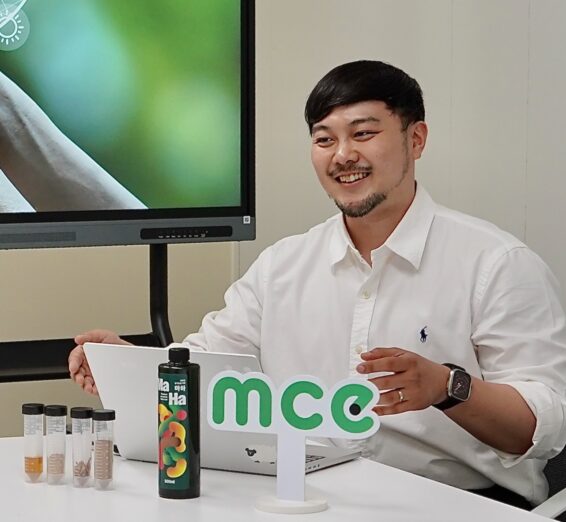
In fact, we have also secured the technology to make insect protein into a high value-added product. If we sell it as existing feed, we have to compete with soybean meal that costs 800 won per kg or fish meal that costs 2,000 won. However, MCE produces biological products such as amino acids that can become key materials for biotechnology and the future food industry.
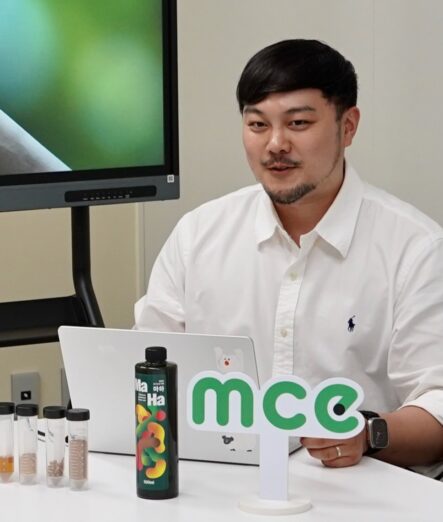
The carbon emissions business is also in full swing. Through a demonstration project being conducted in Vietnam, we will promote registration of the UN FCCC-based methodology from the second half of this year.
“Our approach can have a big impact on carbon reduction. We are considering suggesting which areas to add to further reduce carbon, and then building and delivering the equipment once the agreement is complete.”
In the investment market, it has now completed the pre-A stage, but it is aiming for an IPO in 2028. “We are focusing on the advancement of natural mimicry biological solutions that are the core of the final vision of building a closed circulatory system in the synthetic bio area, which is a national strategic technology.”
CEO Park Jong-wook also cautiously shared his outlook on the climate crisis.
“Honestly, I’m not that optimistic about the future. In the future, people may have to change their entire lifestyle.”
In the future, climate change may lead to the worst possible situation where we can only live in extreme environments, such as Siberia or Antarctica. That is why it is necessary to proactively build a survivable environment.
“In this environment, our solution can help reduce the climate crisis in the short term, and in the long term, it can help ensure stable resource management in a closed circulatory system. We use insects and microorganisms to transform food waste and plastic into useful substances with minimal carbon, and we build a circulatory system that uses this to grow plants and produce oxygen.”
CEO Park Jong-wook emphasized, “The company’s vision of a virtuous cycle for humanity is not a simple belief, but a technological outcome and a solution that the global market demands.”
You must be logged in to post a comment.