



The headquarters of Contactus, located in Samseong-dong, Gangnam-gu, Seoul. In the office, the development team is discussing new features of the 'Nest' platform, and field managers are checking the status of building management and talking to clients.
In the past, owners of small and medium-sized buildings had to entrust facilities, rentals, and asset management to different companies. When the air conditioner broke down, they contacted the facility company, when the tenant changed, they contacted a brokerage, and when a tax issue arose, they contacted another specialized company. Contactus presented a business model that integrated these scattered services into one. We looked into the current status of Contactus, which has grown more than threefold every year since 2021 and recorded sales of approximately KRW 4.8 billion last year, through co-founder and COO Shin Dong-hoon.
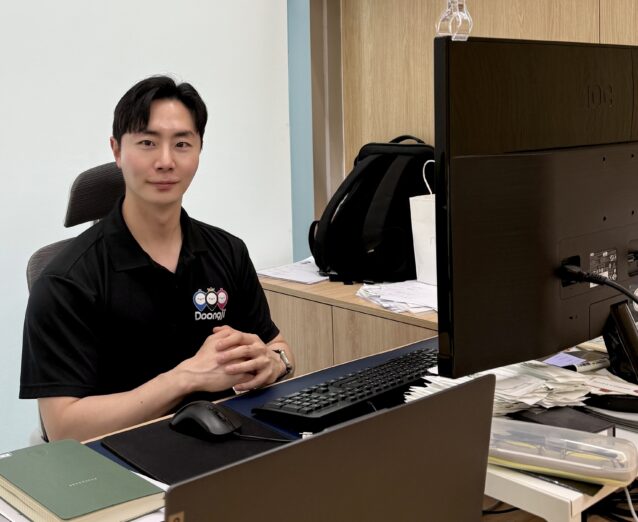
First feature: Platform-based data integration management
“If you look at our staff composition, most of them are in their 20s and 30s,” said COO Shin Dong-hoon. “Because they are a young generation that is not familiar with the analog practices of the existing building management industry, they naturally accept digital platforms and data-based approaches. This is our core competitiveness.”
The core of Contactus is its self-developed 'Nest' platform. The demonstration screen showed several buildings in Seoul on a map, and the management status of each building was updated in real time. When you click on a specific building, information such as rental status, repair history, and tenant satisfaction are displayed at a glance.
“All data generated in the building is collected in real time, and everything from facility inspections to lease contracts and profit analysis can be checked on a single screen,” explains COO Shin Dong-hoon. This is a completely different approach from existing companies that manage manually or with Excel. The recently implemented ‘automatic monthly report generation’ function is a representative example of utilizing the collected data. These data will also be utilized in future AI development.
Second feature: A centralized circulation management system
There was a period of trial and error before the current business model was established. After a year and a half since the establishment of the corporation, the 'base-based cyclical building management' model was completed in September 2022.
“In the beginning, we focused only on optimizing the circulation route, but we ran into problems with on-site response speed and quality control.” Shin Dong-hoon, COO, introduced the structure by pointing to the organizational chart. “Each branch has a team of 10 people, including the branch manager, facility, administration, and brokerage staff, and we manage more than 50 buildings from one base.”
The company operates bases in major regions such as Gangnam and Gangbuk in Seoul, and Bundang and Ilsan in Gyeonggi Province. Each base manager regularly visits the building in charge and handles facility inspections, rental management, and administrative work. The headquarters is divided into facility support, management support, asset management, and development teams to support each branch. If a specialized issue that is difficult to resolve occurs on site, the relevant team will step in to provide support. 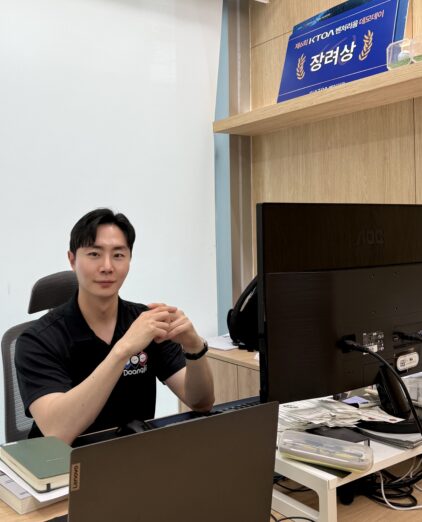
Third feature: Integrated FM·LM·PM service
COO Shin Dong-hoon explained the differentiating factor of Contactus as follows: “The key is to provide integrated FM (facilities management), LM (lease management), and PM (asset management) services.”
COO Shin Dong-hoon explained, “When a tenant contract expires, the LM team decides whether to renew the contract, and when the contract ends, the FM team is in charge of restoration and interior design. When the building is sold or a large-scale remodel is needed, the PM team writes a sales proposal and conducts a bidder search.”
This is an application of the comprehensive management service that large companies have provided only to prime offices to the small and medium-sized building market.
During the interview, an employee reported an emergency. There was a water leak in the building under management. COO Shin Dong-hoon connected the call with the branch manager, checked the contact information of the partner company through the nest platform, and gave instructions for response. The entire process took less than 5 minutes.
“Existing companies take 1-2 days to confirm the person in charge, find out about the company, and receive a quote. We can process it immediately through our platform and response process.”
Challenges of the Growth Process: Organizational Management and System Establishment
Rapid growth came with side effects. COO Shin Dong-hoon revealed the difficulties at the time. “Compared to external growth, internal capacity enhancement did not keep up. I expected that the organization would naturally stabilize as sales increased, but there were more difficulties than expected in organizational management and system establishment.”
To address this, we recently implemented a reorganization. We separated the organization into a service-focused organization and an operation-focused organization, and established a brokerage corporation and a construction subsidiary to strengthen our expertise.
Expanding human resources was also an important task. “In order to secure key talent, we moved the office to the vicinity of Teheran-ro in Gangnam and hired mainly experienced people such as development team leaders and facility support team leaders.” Most of the team leader-level employees have more than 7 years of experience in their respective fields.
At the entrance to the office, there is a signboard that says, “1,000+ Super Gap Startups.” Various certificates, such as venture business certification, corporate research institute, and technology innovation small and medium-sized enterprise certification (Innobiz), are also displayed.

“Technology certification and R&D are the core axes of our business strategy. After being selected as one of the ‘1,000+ Super Gap Startups,’ our technological reliability was secured, making it easier to sign B2B contracts with public institutions and large asset management companies.”
In 2024, it signed management contracts with domestic major corporations and about 60 affiliates nationwide, and is currently participating in bids for various large corporation franchise management projects. COO Shin Dong-hoon emphasized, “Platform possession and emergency response processes are key differentiating factors from existing first-generation building management companies.”
COO Shin Dong-hoon mentioned the changing market situation. “The startup investment market is currently being reorganized around companies that are actually making profits.”
The strategy has also changed since attracting Series A investment. “If we focused on external expansion in 2024, this year we are working on cost efficiency to achieve BEP.”
The management principle was clear: “We focus on two things: ‘Are we making profits right now?’ and ‘Is that profit sustainable?’”
Market Expansion Strategy: From B2C to B2B
COO Shin Dong-hoon emphasized, “The two axes of business operation are sales growth and technology development,” and explained, “Sales growth is divided into the existing small and medium-sized building B2C market and the large building management B2B market.”
Acquiring customers in the early stages was not easy. “We attracted customers by checking the building owner’s registration copy and visiting them in person.” Currently, inbound inquiries are increasing through branding and marketing, and in the B2B market, we are pursuing differentiation based on platforms and expertise.
There are still challenges to be solved. The main tasks are maintaining service quality during rapid expansion, recruiting and training personnel, and securing profitability. In addition, competition with existing large companies is expected when entering the B2B market.
The case of Contactus is a good example of the digital transformation of traditional industries and customer-centered service innovation. However, for sustained growth, stabilizing the organization, securing profitability, and responding to competition in the process of market expansion remain key tasks.
You must be logged in to post a comment.