



-Madeleine Memory, Presenting a New Standard for Second-hand Transactions with the ‘RaaS’ Model
-Providing ESG and profitability to brands, reliability and convenience to consumers
– 40,000 units purchased and 30,000 units sold over 3 years… due to efficient purchasing and quality control
-“The goal is to create a second-hand ecosystem in the clothing industry.”
“As brands began to participate directly in the second-hand market, official resale platforms that utilize the brand’s own product information emerged. These platforms provide a completely new experience for both brands and consumers, different from the existing second-hand transaction.”
Madeleine Memory is a startup that develops and operates Korea's first brand resale solution, 'RaaS (Resale as a Service).' RaaS is a business model that provides all solutions, including technology, logistics, and operations, in the form of a service so that brands can build and operate their own resale businesses.
The biggest difference between existing C2C second-hand transactions and RaaS lies in the operating entity. While C2C is a transaction between individuals, RaaS is a platform directly operated by a brand, and transactions take place between the brand and individuals. There is also a difference in terms of product information management. In existing second-hand transactions, individual sellers directly enter product information, but RaaS provides accurate product information using the brand’s official data. The quality inspection method is also different. In C2C, individual sellers judge quality, while RaaS conducts professional inspections that meet brand standards. There is also a difference in payment methods. While C2C is mainly a cash transaction between individuals, RaaS provides brand points. There is also a difference in terms of customer experience. In C2C, personal negotiation is an important factor, but RaaS provides the same purchasing experience as a general online shopping mall.
The most important result of these differences is reliability. The used car market has become advanced thanks to the official certification system of the brand. Likewise, the used clothing market has become advanced thanks to the direct certification of the brand.
Although the RaaS model is unfamiliar in Korea, many startups in North America and Europe, including Trove, Archive, Recurate, Treet, Reflaunt, and Faume, are already operating their businesses with the RaaS model. Among them, Trove, a representative company, was founded in 2012 and has been operating the Patagonia-only resale market 'Patagonia Worn Wear' since 2016. Trove signed partnerships with 12 fashion brands in 2023 and is currently expanding its resale partners to 25 brands by 2025.
Madeleine Memory was the first to introduce the RaaS model in Korea. Madeleine Memory is currently growing by forming partnerships with major brands such as Kolon FnC and Hyundai Department Store. We met CEO Jae-won Yoo at his office in Gangnam, Seoul, and heard about Madeleine Memory.
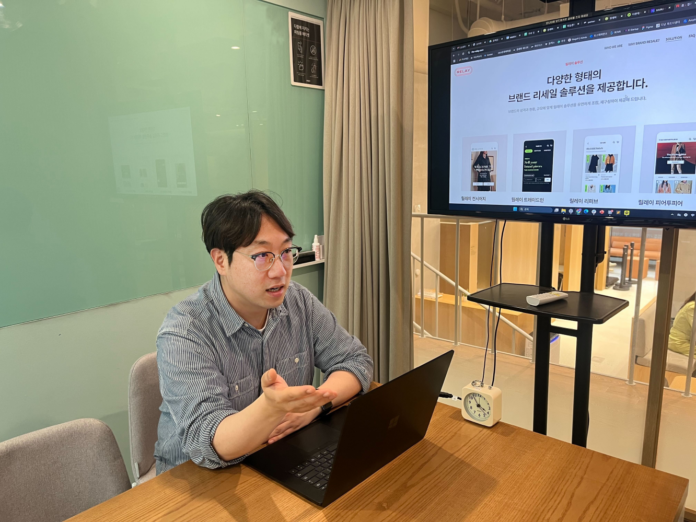
The answer found after 7 years of trial and error
Madeleine Memory launched various services combining IT and fashion in November 2018 when it was first established. However, they all ended in failure.
“For the first three years, I did a different business than I do now. I tried both SaaS and B2C distribution platforms, but neither of them worked well. I stopped the service in mid-2021 and started a new business from scratch.”
CEO Yoo worked for five years at a fashion startup and social enterprise before starting his own business. With his experience at a social enterprise, CEO Yoo was thinking about sustainability and resource circulation, and he paid attention to the B2B partnership model of the overseas second-hand market. At that time, second-hand transactions in Korea were only conducted in the form of C2C and B2C.
“At that time, B2B partnership-type second-hand trading businesses in collaboration with brands were slowly emerging overseas. I decided that it would be worth a try if we optimized this to fit the domestic environment.”
To trade used goods, sellers take pictures of used goods and post descriptions online. Buyers find the products they need online, pay for them, and then meet in person to receive the goods. The biggest problem with these existing C2C used goods transactions is the lack of product information. In particular, in the case of clothing, there are so many types of products that it is difficult for buyers to obtain accurate information. CEO Yoo thought about what was needed to improve the used goods transaction experience and thought that this problem would be solved if the first manufacturer participated. He judged that the market would be revolutionized if product information was received from manufacturers and distributors, and began developing 'Relay'.
Solving the “lack of product information” problem through brand collaboration
Madeleine Memory’s difference lies in its ability to secure product information in advance through collaboration with brands and to conduct quality inspections based on this information. Unlike general second-hand stores that check the condition of products after purchase, Madeleine Memory conducts inspections by comparing the product information with the information at the time of release.
Thanks to this prior information acquisition, the accuracy of inspection is high. For example, if a product had a specific decoration at the time of release, products without that decoration are not purchased. Also, if any part is found to be different from the original specifications, it can be immediately identified. As a result, this systematic inspection process has enabled us to guarantee the quality of the product.
'Relay', a customized solution for each affiliate
Depending on the nature of the affiliate, 'Relay' provides different solutions to manufacturers and distributors: 'Relay Concierge' and 'Relay Trade-in'.
Relay Concierge is a comprehensive model that allows you to buy and sell used clothing. Since the manufacturer plans and releases the product directly, they have all the product information and can efficiently carry out the entire process from purchase to sale. Kolon FnC's Relay Concierge, 'OLO Relay Market', trades used products from 22 Kolon FnC brands.
RelayTradeIn is a sales-only model, designed to fit the characteristics of distributors. Distributors handle products from multiple brands. However, they do not have all the information on the products they sell. Hyundai Department Store is purchasing used products from 130 brands through RelayTradeIn to fit these characteristics. MadeleineMomary launched RelayTradeIn last month.
Relay Tradein does not purchase or sell used clothing, but plans to sell and distribute it in the future through pop-up stores in department stores, Madeleine Memory's own mall, C2C platforms, and collaborations with distributors.
Providing ESG and customer lock-in for brands, and a reliable second-hand transaction experience for consumers
“It’s a program that kills two birds with one stone for brands.”
There are two main things that brands gain by participating in the resale business. Resale creates environmental effects through resource circulation. It is an important tool for realizing ESG. However, existing ESG projects have not secured sustainability. This is because they are not synchronized with the company's core business activities.
“Previously, brands did not receive any benefits when second-hand goods were distributed on C2C platforms. However, through our system, the demand from second-hand goods distribution can be used to strengthen the original business. The second-hand business can create business benefits while also having environmental effects.”
In Relay, when customers sell their used items, they receive points that can be used to buy new products from that brand instead of cash, which naturally locks in customers.
“We provide consumers with a safe and easy used goods trading experience.”
The biggest problem when purchasing used goods from the consumer's perspective is reliability. However, since Relay has directly certified used goods by the brand, consumers can have the same experience as purchasing new goods on e-commerce. The sales process is also simple. If you enter the serial number on the care label into the platform, you can immediately check the expected compensation amount for the clothing. After checking the compensation amount, you can apply for the sale. If the sale is approved, brand points are awarded, and these points can be used to purchase new products from the brand.
In Relay, the condition of the used clothing requested by the used goods seller is checked, and the compensation amount is determined after checking whether the product is sellable. The price is calculated by comprehensively considering the brand's discount policy, existing used market price, time elapsed since release, and product category.
Achieved sales of 3 billion by purchasing 40,000 sets and selling 30,000 sets
In the three years since the launch of Relay, Madeleine Memory has purchased about 40,000 used items and sold 30,000 of them. 75% of the clothing was resold. This is a very high figure in the used clothing business. Usually, it is difficult to sell 100% of used items due to conditions or demand, but 75% shows efficient purchasing and quality control.
The cumulative sales amount to 3 billion won. The average selling price per unit is around 100,000 won. It is forming a higher price range than the general used clothing market. Relay has filled the gap between the low-priced used goods and the luxury used goods of the existing C2C platform and established a premium positioning through brand certification and quality assurance.
“The market we are targeting is between the luxury goods and low-margin mass market. We mainly deal with used goods from brands distributed in department stores. Previously, this market was only distributed in C2C, but we are pioneering this market as a B2C business.”
Leading the market with sales target of 170 billion by 2028
“The fashion industry is conservative. I expect that there will come a point when the entire industry will take second-hand business for granted.”
Madeleine Memory aims to achieve annual sales of 170 billion won by 2028. The strategy for achieving this is clear.
Due to the nature of the second-hand business, it is more difficult to purchase than to sell. Therefore, purchasing good products is the key. Madeleine Memory efficiently purchases good quality products through partnerships with manufacturers and distributors, so there is a high possibility of expansion in the future.
Currently, we are planning to secure two additional large fashion manufacturers, including LF, in the second half of the year, and are also discussing cooperation with two small and medium-sized brands. We are also planning to start an offline used goods collection service in July.
Madeleine Memory is preparing to expand overseas while securing an exclusive position in the domestic market. First, it aims to support the domestic second-hand business of global fashion brands such as Patagonia.
“We are also considering entering the Japanese market. Japan has a large fashion industry and rich cultural assets, so I think this business model will work well. However, rather than entering independently, we plan to cooperate with appropriate partners.”
“The goal is to mature the used goods ecosystem”
The ultimate goal that CEO Yoo dreams of is the maturity of the used goods ecosystem.
“There are good outlets on the outskirts of Gyeonggi-do. It’s a great environment for shopping for leftover items neatly organized by brand. We are also aiming for the second-hand business to reach that level of maturity.”
CEO Yoo said, “Just like when you buy a smartphone, you put a screen protector on it and put a bumper on it to use it while thinking about selling it later, I hope that the same thing happens with clothes,” and added, “If people start to think that it’s normal to buy clothes at a department store, wear them well, give them back next year, and earn points to buy more clothes, then that will be meaningful.”
Attention is being paid to the results of Madeleine Memory's challenge to catch three birds with one stone: ESG management, customer lock-in, and creating a sustainable consumption culture.
You must be logged in to post a comment.