



Water is an essential element of life. However, rusty pipes in old buildings have destroyed trust in clean tap water.
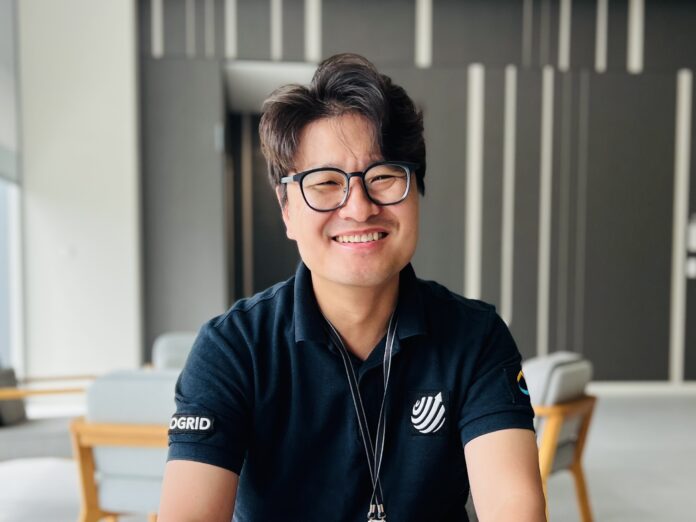
The water environment in Korea, where shower filter purchases are taken for granted and bottled water consumption is increasing. There is a company that has taken on this reality. Geogrid CEO Kim Ki-hyun, who moved into Samsung Electronics Seoul R&D Campus in Seocho-gu, developed the 'BLOS (Building Oasis)' solution that provides drinkable water from the faucet without replacing the building's pipes.
The walls of the Geogrid office are filled with monitors that update various water quality data in real time. On the table are pipe sections and water samples. Geogrid CEO Kim Ki-hyun holds up two iron pipe samples. One is covered in red rust, and the other has a black coating.
“This is before and after BLOS technology was applied,” says CEO Kim Ki-hyun, placing the two samples side by side.
“Water is the basic necessities of life, but there is still a shortage of ‘drinkable water’ around us. What’s even more ironic is that water purified by waterworks becomes contaminated as it passes through old pipes.”
Innovation in aging pipes, water quality improvement technology without pipe replacement
The map that CEO Kim Ki-hyun shows on his tablet shows the current status of aging pipes in Korea. Pipes that are over 20 years old are about 95,000 km long. That's the equivalent of two and a half times around the Earth. Replacing these aging pipes would cost a tremendous amount of money and time. BLOS suggests a way to solve this realistic difficulty.
CEO Kim Ki-hyun continues his explanation in front of a mock-up of the BLOS system installed on one side of the office. “BLOS improves water quality physically and electrically without chemicals. In particular, it reduces the oxygen concentration in water through the magnetite system and changes red rust into a protective film.”
His fingers point to various parts of the device, explaining how it works. The technology removes rust from buildings and creates a protective layer in two weeks to two months without having to tear out pipes.

Water seen as data, technology leading to trust
“The biggest challenge we had to solve was how to make people believe in the invisible changes.” CEO Kim Ki-hyun leads us into a small conference room and takes out his smartphone. A real-time water quality monitoring dashboard is displayed on the screen. Various water quality indicators such as pH, ORP, and TDS are updated in real time. The graph shows the water quality status changing over time.
“This is real-time data from an apartment currently in operation.” As CEO Kim Ki-hyun flips through the screens, monitoring screens for several buildings appear one after another. BLOS goes beyond simple water purification functions and acts as a ‘water infrastructure’ that monitors water quality, water usage, and pipe conditions all at once. In particular, the ‘Water-BEMS’ developed by Geogrid manages and optimizes the water environment of the entire building in real time.
He points to the monitor screen and smiles. “Real-time data goes beyond simply providing information and builds trust. Users only change their behavior when they can see it with their own eyes.”

Water technology extends beyond the environment to social value
On the office wall are photos of various installation cases. It shows that the scope of application of BLOS is expanding to apartments, schools, hospitals, hotels, and resorts. Next to one photo is a summary of water quality improvement data from a high school cafeteria in Gyeonggi Province. This is the result of general bacteria, which had reached 120 CFU/mL, improving to meet drinking water standards in just two months after BLOS was installed.
“It’s not the individual numbers that are important,” he says, looking at the photographs. “It’s the change that the technology creates that is important, not the technology itself.”
CEO Kim Ki-hyun’s expression becomes quite serious. He is particularly interested in applying BLOS to public facilities such as old schools and welfare facilities. “Creating an environment where children can drink water with confidence is the ‘water welfare’ we dream of.”
Inquiries are increasing from apartment complexes and schools that have already begun to seriously consider the 'water' that children use to wash and drink.
CEO Kim Ki-hyun also predicted that hotels and resorts will soon highlight 'good water' as their most fundamental differentiating point. He said that premium accommodation facilities are becoming increasingly interested in the 'water' consumed within their buildings.

On the office table are spread out maps and contracts from Indonesia and Japan. Geogrid is also accelerating its entry into the global market with the support of overseas investment companies such as 500 Global. Beyond simply exporting domestic technology, it is preparing a localization strategy that takes into account the water quality environment and cultural characteristics of each country.
As he leaves the office, he leaves with his final words: “Water is not simply a resource that flows, but a mirror that diagnoses the condition of buildings and cities.” These words contain the vision of the future that Geogrid envisions. Starting with water quality improvement, the journey toward the intelligence and sustainability of urban infrastructure continues.

You must be logged in to post a comment.