



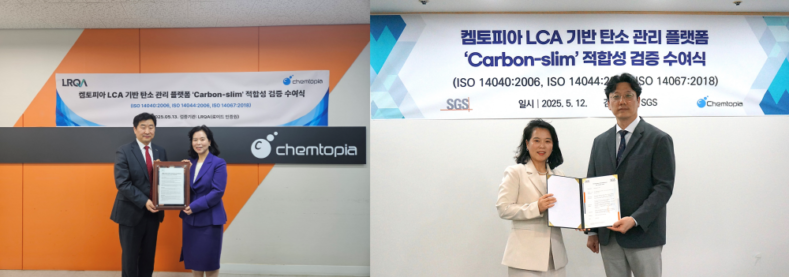
Chemtopia Co., Ltd. (CEO Park Sang-hee), a chemical substance and environment, safety, and health (EHS) specialist, announced that its supply chain carbon management platform 'Carbon-Slim' has received official verification from global certification agencies LRQA (Lloyd's Register Quality Assurance) and SGS for international LCA standards such as ISO 14040:2006, ISO 14044:2006, and ISO 14067:2018. Carbon Slim is the first carbon platform in Korea to receive certification from two major international certification agencies simultaneously.
LRQA (LRQA) conducted a precise and in-depth verification of the standard consistency of the 'Carbon-Slim' platform based on its accumulated greenhouse gas and supply chain verification experience in various industrial fields. LRQA is currently leading third-party verification for greenhouse gas emission verification and supply chain transparency in over 150 countries around the world, and in particular, it has a customized evaluation system for strengthening corporate ESG response capabilities and verification know-how based on international standards.
“In the global market, transparency and reliability of carbon information are becoming key elements of corporate competitiveness,” said Lee Il-hyung, CEO of Lloyd’s Register (LRQA). “Chemtopia has not only implemented a sophisticated carbon emissions calculation system throughout the entire product life cycle, but has also met all requirements, from systematizing measurement-based data to verifying international standards, and is evaluated as a company with practical carbon management capabilities.”
He added, “Even from the perspective of a verification agency, Kemtopia’s solution has shown a very high level of completeness in terms of ▲ clarity of calculation logic ▲ data consistency ▲ reporting automation, and will serve as a model case for the industry in responding to ESG in the global supply chain in the future.”
In addition, this SGS verification is the first case in Korea to apply a high-level evaluation system comprised solely of a panel of expert examiners from China, the global manufacturing center. The SGS evaluation team applied strict international standards to various items, including ▲carbon emission calculation method by product life cycle ▲verifiability based on actual measurement data ▲level of standardization within the system, and ▲supply chain linkage scalability.
Kemtopia’s Carbon-Slim not only met all requirements to a high level, but also exceeded the standards in some items, proving the technical perfection and global reliability of the solution. Through this, ‘Carbon-Slim’ has once again proven that it is a reliable carbon management platform that can be practically applied even in a global supply chain environment including complex manufacturing processes.
Recently, as the EU's product environmental regulations and global corporations' ESG requirements for their supply chains have been rapidly strengthened, it has become essential, rather than optional, for domestic and foreign manufacturing companies to secure the ability to provide quantitative carbon information based on LCA beyond simple carbon emission calculations.
Accordingly, companies must simultaneously satisfy complex requirements such as ▲quantitativeness and reliability of LCA-based calculations ▲data traceability at each stage of the supply chain ▲international standard certification by an authorized verification agency, and in particular, verification costs, time required, and manpower burden are rapidly increasing for companies that produce multiple items or have many global customers.
In this environment, digital LCA platforms based on international standards are rapidly increasing in demand, and are gaining attention as a key strategic tool for reducing costs and securing supply chain competitiveness beyond simple regulatory response.
Chemtopia's 'Carbon-Slim' is an integrated carbon management platform with various functions such as ▲Specialized calculation function for carbon-intensive industries such as steel, aluminum, cement, electrical/electronic, and display ▲Supply chain LCA linkage ▲Automatic calculation based on actual manufacturing process measurement ▲Protection of sensitive information within the supply chain ▲Automation of monitoring and reporting. In particular, it provides practical effects such as ▲Reduction of third-party verification period ▲Reduction of verification cost ▲Simplification of reporting work through the built-in structure based on ISO 14067.
“With global environmental regulations accelerating, establishing a carbon management system based on LCA has now become a survival strategy for companies,” said Park Sang-hee, CEO of Chemtopia. “Now that Chemtopia has obtained verification from two global verification agencies, we have acquired the only solution capacity in Korea that can satisfy both the accuracy and transparency of carbon information required in the global market.”
In addition, in this verification, ▲the ISO 14040:2006, ISO 14044:2006, ISO 14067:2018 verification award ceremony was held by SGS, and ▲the same verification was officially awarded consecutively by Lloyd's Register (LRQA), etc. “Carbon-Slim is a next-generation platform equipped with industry-specific functions, AI-based customer-tailored reports, and supply chain security functions, and will actively support domestic manufacturing companies in securing sustainable management and export competitiveness in global markets including Europe,” they said.
In particular, Chemtopia's Carbon Slim was selected for the 2025 Smart Green Industrial Complex Promotion Project and will be applied to the demonstration project for energy and greenhouse gas measurement of the Smart Energy Platform (TOC+) for the expansion of digital infrastructure in industrial complexes and the creation of eco-friendly carbon reduction industrial complexes. It is expected to be expanded to major industrial complexes in the country starting this year, and in the future, we plan to proactively respond to global environmental regulations, such as AI-based LCA advancement and Digital Battery Passport response functions, and continue to expand collaboration with various industries.
- See more related articles
You must be logged in to post a comment.