



– Precise validation of EGFR inhibitor responsiveness biomarkers using organoid models
– The two companies expect to overcome the limitations of existing treatments through technological convergence to realize precision medicine.
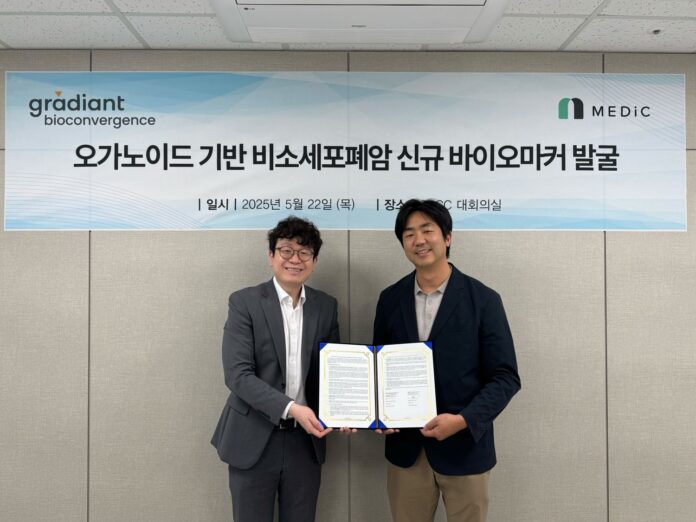
Gradient Bioconvergence (CEO Jin-Geun Lee) and MEDiC Life Sciences (CEO Kyu-Ho Han), a bio company in Silicon Valley, USA, are conducting joint biomarker validation and research to explore the therapeutic applicability of EGFR inhibitors for patients with EGFR gene-negative (wild-type) non-small cell lung cancer (NSCLC). On the 23rd, it was announced that a business agreement had been signed.
This agreement formalizes the collaboration plan discussed by both companies at the American Association for Cancer Research (AACR 2025) Annual Meeting, and the two companies plan to closely cooperate on biomarker validation and data comparison using each company's platform.
First, the two companies will embark on a joint project to verify whether the biomarker candidates discovered by Medic Life Science can consistently reproduce the responses shown in existing 3D cell culture models in Gradient Bioconvergence’s patient-derived organoid (PDO) model. Afterwards, they plan to verify the validity of the biomarkers by clustering patient groups based on specific biomarkers using genomic and transcriptomic data of non-small cell lung cancer PDO and comparing and analyzing the sensitivity to various EGFR inhibitors.
Gradient Bioconvergence is developing a platform for discovering new drug targets and evaluating drug responses using AI technology based on organoids and genome analysis data. Recently, it completed organoid drug evaluations for major anticancer target treatments, including 1st to 3rd generation EGFR inhibitors. Medic Life Science is discovering anticancer biomarkers and new drug targets, including EGFR inhibitors, through the MCAT™ platform utilizing CRISPR-based genome screening and 3D tumor models.
“Through collaboration between our two companies, we aim to combine the strengths of each company’s platforms and gain insight into the new applicability of EGFR inhibitors,” said Jin-Geun Lee, CEO of Gradient Bioconvergence. “We will strive to present an innovative treatment strategy that overcomes the limitations of existing treatments.”
“EGFR treatments are currently only recommended for patients with EGFR mutations, but there have been reports of responses in some patients without mutations,” said Han Kyu-ho, CEO of Medic Life Science. “Through this joint research, we will discover new biomarkers that can screen for this patient population and expand the scope of application of EGFR inhibitors.”
You must be logged in to post a comment.