


On May 20 (local time), domestic startup company Dot was invited as an official presenter to Microsoft's annual developer conference '@Build 2025' held at the Seattle Convention Center in the United States, and unveiled 'Dot Vista', an inclusive AI solution utilizing the company's artificial intelligence (AI)-based Braille display technology.
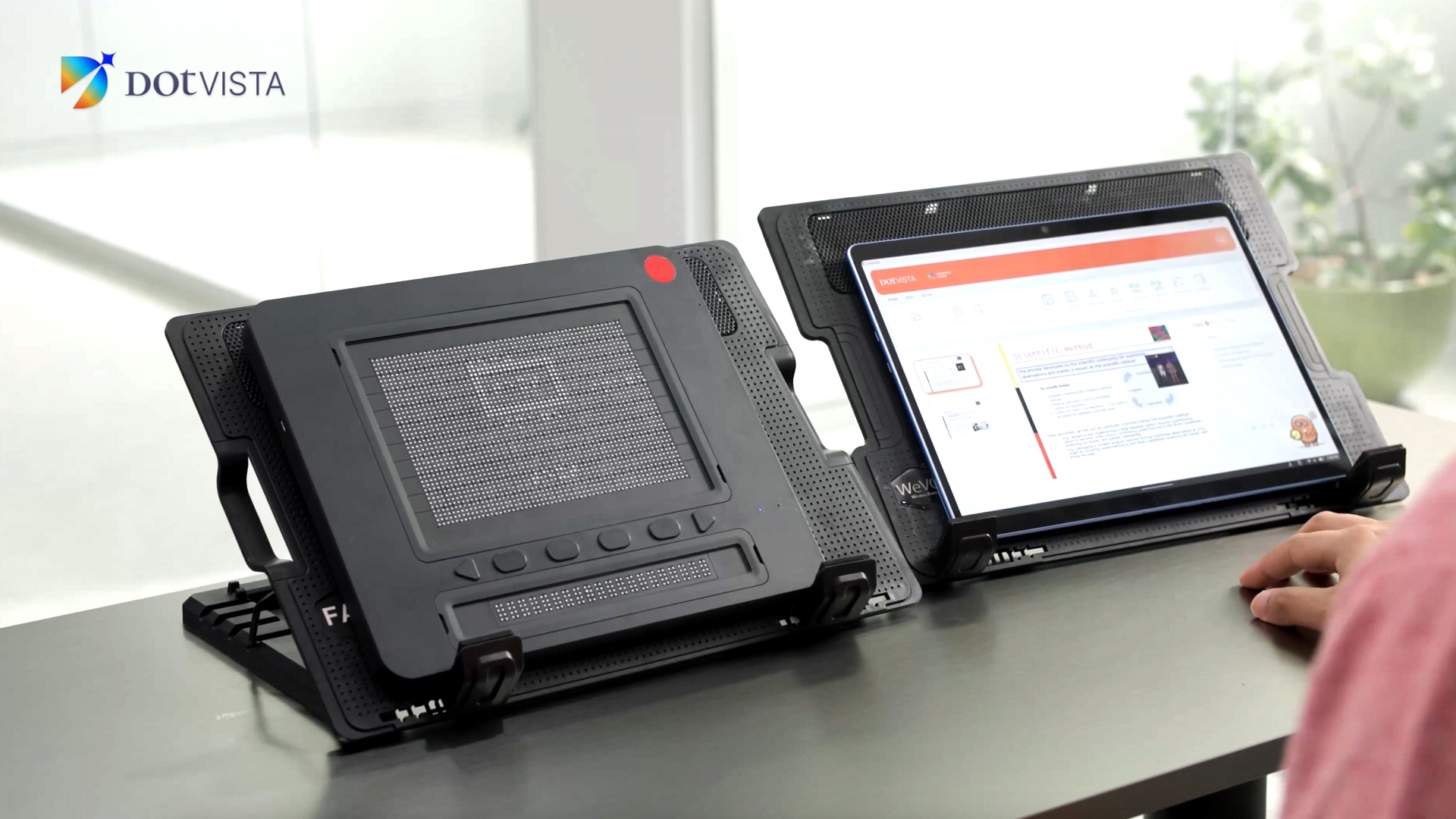
Dot Vista was developed through industry-academia collaboration between Dot's AI team and the research team of Professor Yongjae Yoo of the Department of Artificial Intelligence at Hanyang University ERICA. It is a Windows application that uses the Windows AI API and the DotPad tactile display to help visually impaired users understand visual content such as graphs and charts in Microsoft PowerPoint files in voice and Braille.
This presentation was part of a session led by the Microsoft Windows AI API team, and Dot presented a live demo on a Windows Copilot+ PC that integrates three core Windows AI APIs. The demo utilized Dot Pad to output text and visual information from a PowerPoint presentation to speech and Braille, helping visually impaired users better understand the presentation.
“Windows AI API enabled a lightweight design that can quickly summarize and extract key information without relying on complex large language model servers,” said Kim Joo-yoon and Sung Ki-kwang, co-founders of Dot Inc. “Thanks to the built-in NPU, it can now be run stably locally on Copilot+ PCs such as Microsoft Surface devices without an internet connection.”
DotPad, the flagship product of Dot Inc., is a digital tactile device that can read up to seven lines at a time in Braille and tactile graphics, going beyond the limitations of conventional single-line Braille displays. It easily expresses complex structures such as mathematical formulas, programming codes, and tables, thereby increasing learning efficiency and work productivity.
“DotPad presents a variety of images in a tactile way, and has enabled blind and sighted people to collaborate,” said Dave Williams, a blind accessibility expert at the Braillists Foundation in the UK. “As a parent of a blind child, this is the first time I’ve experienced my son’s drawings with a tactile sense. As AI advances, Dot Vista will continue to evolve, and this is just the beginning.”
Beyond K-12 education, Dot Inc. is currently developing a 'tactile curriculum' for various major subjects with Oxford University, Boston College and University, University of Massachusetts, and Tufts University.
Maziar Zarrehparvar, Leading Researcher in Haptic Learning and Director of the Global University Initiative at the University of Oxford, said: “As the person responsible for developing educational content for blind and visually impaired students at Oxford, I am impressed by how the Dot team is using AI to make their content more interactive and immersive. I feel that Dot’s advanced AI models are rapidly enabling the future of personalized learning for blind and visually impaired people, and Oxford is a strong supporter of Dot’s AI-based approach to personalized education.”
You must be logged in to post a comment.